

Introduction
You walk into the interview room. You greet the panel and sit down. The interviewer looks at your file, smiles and says, “So, tell me about yourself.”
This is often the very first question in a job interview, a campus placement or an admission interview. It sounds easy. After all, who knows you better than you? But many students freeze. Some repeat their whole resume. Some talk about their family and hobbies. Some finish in ten seconds with “That’s all, sir.”
The first answer sets the mood for the whole interview. A clear and confident answer makes a good first impression. It also guides the interviewer towards the strengths you want to talk about.
The good news is that this answer can be planned and practised. In these notes you will learn the meaning of the question, standard definitions of an interview, a simple three-part structure, eight important tips, common mistakes, sample answers, exam tips and important questions.
Meaning of “Tell Me About Yourself”
“Tell me about yourself” is the introductory question of most interviews: an open question asked right at the start. The interviewer is not asking for your life story. They want a short, professional introduction: who you are, what you have done, and why you are suitable for this job or course.
In simple words, it is a self-introduction in an interview. It is your chance to present yourself in one to two minutes, in your own words, before the detailed questions begin.
Interviewers may ask it in different ways: “Introduce yourself”, “Walk me through your background”, or “Describe yourself briefly.” The answer is the same in every case.
Definitions
Self-introduction is a part of the interview, so first let us understand what an interview is.
- Bingham and Moore: An interview is “a conversation with a purpose.”
- Stewart and Cash: “Interviewing is an interactional communication process between two parties, at least one of whom has a predetermined and serious purpose, that involves the asking and answering of questions.”
- Scott and others: “Interview is the purposeful exchange of ideas, the answering of questions and communication between two or more persons.”
All three definitions agree that an interview is a two-way conversation with a clear purpose. So your self-introduction must also have a purpose: to show that you are the right person.
Simple definition: A self-introduction in an interview is a short, planned answer in which a candidate presents their present position, relevant past experience and future goals, to show why they are suitable for the job or course.
Why Do Interviewers Ask This Question?
- To break the ice and help you settle down.
- To hear how well you speak and organise your ideas.
- To check your confidence and body language.
- To find out what you think is important about yourself.
- To pick points for the next questions. Whatever you mention, they may ask about.
You can read more about the purpose of interviews in our notes on Introduction of Interview.
Structure of a Good Answer: Present – Past – Future
Many university career centres suggest a simple three-part structure for this answer: Present, Past and Future (see Figure 1).
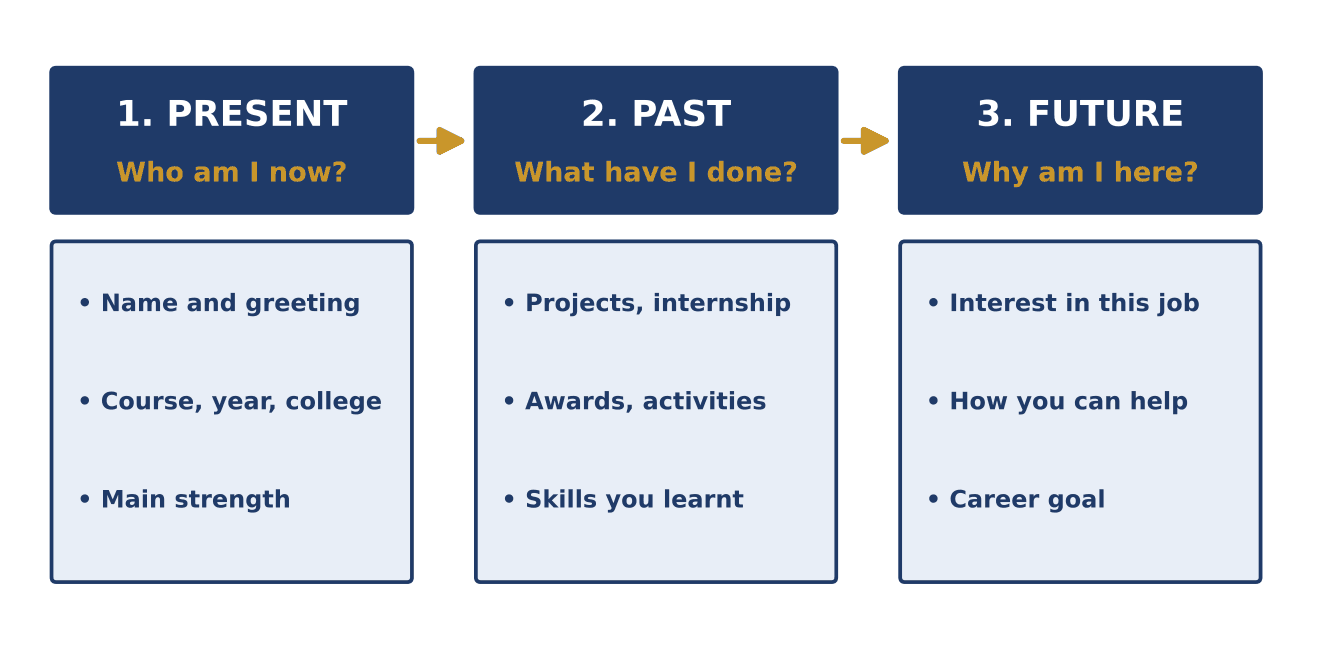
- Present (Who am I now?): Your name, your course and year, and your main strength.
- Past (What have I done?): Two or three relevant points: projects, internships, awards, college activities, and the skills you learnt.
- Future (Why am I here?): Why you want this job or course, and how you can help the organisation.
Memory tip: Remember “Now – Then – Next.” Now is who you are, Then is what you have done, and Next is where you want to go.
Eight Tips for Introducing Yourself in an Interview
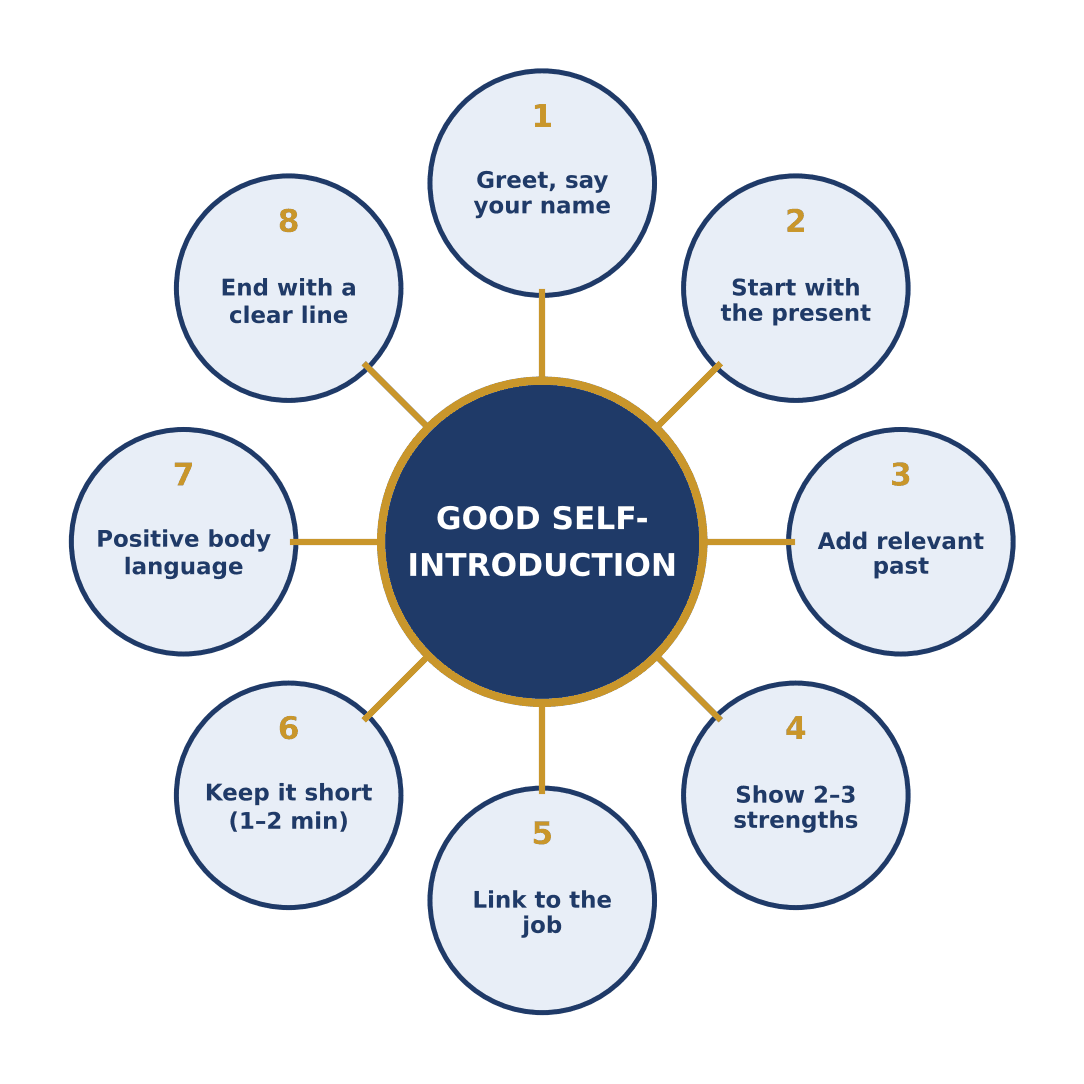
Figure 2 shows all eight tips at a glance. Each one is explained below.
1. Greet Politely and Say Your Name
Begin with a polite greeting suited to the time of day. Then say your full name clearly. A calm start helps you relax and creates a good first impression.
Example: “Good morning, sir. My name is Sana Shaikh.”
Remember: The first ten seconds create the first impression.
2. Start with the Present
Tell the interviewer what you are doing now: your course, year and college, or your current job. Add one line about your main area of interest.
Example: “I am a final-year BMS student specialising in Marketing.”
Remember: Begin with where you stand today.
3. Add the Relevant Past
Mention only those past experiences that are connected to the job: internships, projects, part-time work, college fests, NSS, sports or awards. Do not list every class from school onwards.
Example: “During my internship at a digital marketing agency, I handled social media posts for three small businesses.”
Remember: Relevant past, not your whole past.
4. Show Two or Three Strengths with Proof
Do not just say “I am hard-working and honest.” Every candidate says that. Choose two or three strengths that suit the job, and give a small proof for each.
Example: “I am good at teamwork. As the head of our college fest’s sponsorship team, I worked with eight volunteers and we raised our target amount.”
Remember: A strength without proof is just a claim.
5. Link Your Answer to the Job
End the main part by connecting yourself to this job or course. This shows that you have read about the organisation and thought about your career.
Example: “I have read that your bank is opening many new branches in Maharashtra. I would like to begin my career in customer service with you.”
Remember: Tell them why you fit this job, not just any job.
6. Keep It Short
A good self-introduction is short. About one to two minutes is a good target. If the interviewer wants more details, they will ask.
Example: Instead of narrating your full internship, say the one result you are proud of, and stop.
Remember: Short and strong beats long and boring.
7. Use Positive Body Language
Your body speaks before your words do. Sit straight, keep gentle eye contact with the panel, smile naturally and keep your hands still. Speak at a steady pace. To learn more, read our notes on non-verbal communication and body language.
Example: A candidate who looks at the floor and speaks fast seems nervous, even if the words are good.
Remember: Confident body, confident answer.
8. End with a Clear Closing Line
Do not end with “That’s all” or “That’s it.” Finish with a clear, positive line that shows interest.
Example: “That is a little about me. I am excited about this opportunity and would be happy to tell you more.”
Remember: A good ending invites the next question.
Poor Answer vs Good Answer
Look at Figure 3. Both students are introducing themselves for an accounts job. Notice the difference.
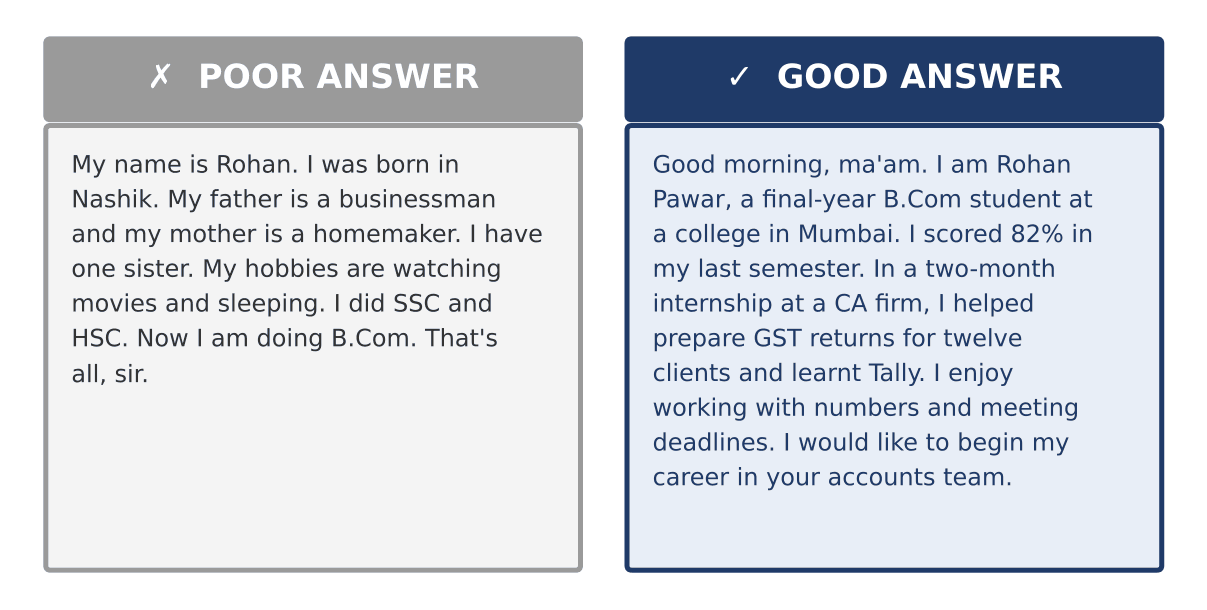
The poor answer talks about birthplace, family and hobbies, and gives no reason to hire the student. The good answer follows Present–Past–Future, gives proof (82%, internship, twelve clients, Tally) and ends by linking to the job.
Table 1: Self-Introduction vs Resume
| Point | Self-introduction | Resume |
|---|---|---|
| Form | Spoken (oral) | Written document |
| Length | One to two minutes | Usually one to two pages |
| Content | Only the most relevant points | Complete record of education, skills and experience |
| Order | Present – Past – Future | Usually latest education and experience first |
| Purpose | To make a good first impression and guide the talk | To get you called for the interview |
| Extra | Shows voice, confidence and body language | Shows details, dates and facts |
Table 2: Poor Lines vs Good Lines
| Poor line | Good line | Why it is better |
|---|---|---|
| “My father is a businessman and my mother is a homemaker.” | “I am a final-year B.Com student at a college in Mumbai.” | Professional, not personal |
| “I am hard-working and honest.” | “I completed all my internship tasks before the deadline.” | Gives proof |
| “My hobbies are watching movies and sleeping.” | “I enjoy reading business news, which helps me follow the market.” | Hobby linked to the job |
| “I don’t have any experience.” | “I have not worked full-time yet, but I did a two-month internship and led our college fest team.” | Positive and honest |
| “That’s all, sir.” | “I would be happy to tell you more about my internship.” | Clear, confident ending |
Sample Answers
Sample 1: B.Com fresher for an accounts job
“Good morning, ma’am. I am Rohan Pawar, a final-year B.Com student at a college in Mumbai. I scored 82% in my last semester. Last summer I did a two-month internship at a CA firm, where I helped prepare GST returns for twelve clients and learnt Tally. I enjoy working with numbers, and I am careful about deadlines. I would like to begin my career in your accounts team, and I am keen to learn more about how a large company manages its accounts. Thank you.”
Sample 2: BMS student for a marketing role
“Good afternoon, sir. My name is Sana Shaikh. I am in the final year of BMS, specialising in Marketing. During my internship at a digital marketing agency, I handled social media posts for three small businesses, and one page grew its followers steadily in two months. In college, I led the sponsorship team for our annual fest. These experiences taught me to understand customers and work in a team. I am interested in your company because of its work with young consumers, and I would like to start my career in your marketing team.”
Note: Both samples are examples. Students should write their own answer using their own true details. Never copy a sample word for word.
Table 3: Which Points to Stress in Different Situations
| Situation | What to stress | Reason |
|---|---|---|
| Campus placement (accounts or finance) | Marks, internship, Tally or Excel skills | Shows job-ready skills |
| Bank or customer-service job | Communication, patience, any work with people | The job needs dealing with customers daily |
| Marketing or sales job | Fest, events, social media work, confidence | Shows you can persuade and connect |
| MBA or higher-studies admission | Academic interest, projects, career goal | The panel wants to know why you chose the course |
| Internship interview | Willingness to learn, college activities | They expect less experience, more attitude |
| Online (video) interview | Same structure; look at the camera, clear audio | The screen makes eye contact and voice more important |
For more on the kinds of interviews you may face, see Types of Interview.
Extra Point for Good Marks: Common Mistakes to Avoid
In a long answer, add a short paragraph on mistakes. Students often (1) repeat the resume word for word, (2) share personal or family details, (3) speak too long or too briefly, (4) memorise a speech and sound like a machine, (5) speak negatively about a previous college or employer, and (6) give false information. Interviewers often check what you say. Honesty and preparation are more important than fancy words. Our notes on handling psychology during an interview can help you manage nervousness.
Table 4: Quick Revision Table
| No. | Point | Key idea in one line |
|---|---|---|
| 1 | Meaning | A short, professional self-introduction at the start of an interview |
| 2 | Bingham and Moore | An interview is “a conversation with a purpose” |
| 3 | Structure | Present – Past – Future (Now – Then – Next) |
| 4 | Greet and name | Polite greeting and clear full name |
| 5 | Present | Course, year, college or current job |
| 6 | Relevant past | Only experiences linked to the job |
| 7 | Strengths | Two or three strengths, each with proof |
| 8 | Link to job | Why you fit this job and organisation |
| 9 | Length | About one to two minutes |
| 10 | Body language | Straight posture, eye contact, natural smile |
| 11 | Closing | A clear, positive last line, not “That’s all” |
| 12 | Avoid | Family details, resume reading, false claims, negative talk |
How to Write This Answer in the Exam
For a 10/15-mark answer (e.g. “How should a candidate introduce himself or herself in an interview? Explain with examples”):
- Write the meaning of self-introduction in two or three lines.
- Give one or two definitions of an interview (Bingham and Moore; Stewart and Cash).
- Explain the Present–Past–Future structure. Draw Figure 1 as a simple diagram.
- Write 6–8 tips as sub-headings, each with two lines and a short example.
- Add a table (poor vs good lines) or a short sample answer.
- End with a conclusion.
For a 5-mark short note (e.g. “Self-introduction in an interview”): write the meaning in two lines, the three-part structure, three or four tips and a one-line conclusion.
Model conclusion:
The self-introduction is the first and most important answer in an interview. A good answer is short, honest and well organised. It moves from the present to the relevant past and then to the future, and it links the candidate’s strengths to the job. With preparation and practice, every student can turn “Tell me about yourself” into a strong first impression.
Important Exam Questions
(Model questions for practice.)
Long-answer questions
- What is meant by self-introduction in an interview? Explain the steps to introduce yourself effectively.
- “The first answer in an interview creates the first impression.” Discuss with reference to the question “Tell me about yourself.”
- Explain the tips a candidate should follow while preparing for and facing an interview.
- Draft a self-introduction for a campus interview for the post of Accounts Assistant.
Short notes
- Present–Past–Future structure
- Self-introduction vs resume
- Body language in an interview
- Mistakes to avoid in a self-introduction
Fill in the blanks / one-line answers
- Bingham and Moore define an interview as “a conversation with a ________.” (purpose)
- The three parts of a good self-introduction are present, past and ________. (future)
- A self-introduction should usually last about ________ minutes. (one to two)
- A strength should always be supported with ________. (proof or an example)
- The written document that lists your education and experience is called a ________. (resume)
- Instead of “That’s all”, end with a ________ closing line. (clear, positive)
Conclusion
“Tell me about yourself” is not a trick question. It is an open door. The interviewer is giving you a chance to show who you are, what you have done and why you are right for the job. If you plan your answer with the Present–Past–Future structure, choose two or three strengths with proof, and link them to the job, you will begin your interview on a strong note.
Prepare your answer in writing, practise it aloud a few times, and then speak naturally. Keep it short, honest and positive. For more help, read our notes on Types of Interview and Introduction of Interview.
Frequently Asked Questions
1. How long should my answer to “Tell me about yourself” be? About one to two minutes is a good target. Keep it short and let the interviewer ask for more.
2. Should I talk about my family in a self-introduction? Usually no. The interviewer wants to know about your education, skills and goals, not your personal life.
3. What if I have no work experience? Talk about internships, projects, college activities, NSS, sports or fests. Show what you learnt from them.
4. Can I memorise my answer? Prepare the points and practise, but do not learn it like a poem. It should sound natural, not rehearsed.
5. Should my answer be the same for every interview?
The structure can stay the same, but change the strengths and the last part to suit each job and organisation.
6. How do I end my self-introduction? End with a clear, positive line, such as “I am excited about this opportunity and would be happy to tell you more.”
Dr. Amar Sontakke has taught English and Communication Skills since 2011. He is an Associate Professor of English at NSS College of Commerce and Economics, Mumbai.