
Imagine you ordered a new mixer grinder online. You waited a whole week for it. The box finally arrives, you open it with excitement… and the big jar is cracked.
What will you do? You could call customer care and wait on hold for twenty minutes. Or you could send a short, clear and polite letter that explains what went wrong, when you bought the product and what you want the company to do.
Now think about a second situation. Mr. Patil runs a small stationery shop in Thane. The new school term starts soon, and he needs 500 notebooks, 200 packs of pens and 100 geometry boxes from his supplier. If he sends a confusing message, he may get the wrong items, the wrong quantity, or nothing at all.
In both cases, one skill solves the problem: writing a good business letter.
Business letters are not only for big companies and managers in suits. Students, shopkeepers, customers, job seekers, college committees and small business owners use them all the time. They are one of the most practical parts of business communication. Once you learn the format and a few simple rules, you can write almost any business letter with confidence — in your examination and in real life.
Let us begin with the basics of business letters.
In This Guide
- What Is a Business Letter?
- Why Are Business Letters Important?
- Main Features of a Business Letter
- Format of a Business Letter: Parts Explained Step by Step
- Complete Business Letter Format (Model to Copy)
- Types of Business Letters
- Business Letter Examples (5 Complete Sample Letters)
- Business Letter vs Personal Letter
- Business Letter vs Business Email
- Dos and Don’ts of Business Letter Writing
- Common Mistakes to Avoid While Writing a Business Letter
- How to Write a Business Letter in an Examination
- Business Letter: Quick Revision
- Frequently Asked Questions (FAQs) on Business Letters
- A Final Word from Your Teacher
What Is a Business Letter?
A business letter is a formal letter written for business or professional purposes. People and organizations use it to ask for information, place orders, make complaints, reply to customers and share important decisions.
Let us break this definition into small parts:
- Formal means serious and polite. You do not write it the way you chat with a friend.
- Business or professional purpose means the letter is about work, goods, services, money, jobs or official matters.
- It is usually sent from one person or organization to another person or organization.
- It is a form of written communication, so every word stays on record.
Think of it this way. Business letters and personal letters are very different. A letter to your cousin about your summer holiday is a personal letter. A letter to a bookshop asking the price of 50 dictionaries is a business letter.
A simple real-life example: Sneha is a B.Com student. Her college wants to take students on a visit to a dairy plant. Her teacher writes to the plant manager asking for permission. The letter has a subject line, polite language and a proper format. That is a business letter.
Remember: Business letter = formal language + clear purpose + correct format.
Why Are Business Letters Important?
Business letters are important because they give clear, formal and written communication that can be kept as a record. They help people and organizations make requests, place orders, solve problems and build trust.
Here is why business letters still matter:
- Formal communication: Some matters are too serious for a casual chat. A letter shows that you respect the reader and the matter.
- Record of communication: A letter stays on paper or in a file. If there is confusion later, anyone can check what was written and on which date. Words spoken on a phone call are easily forgotten.
- Professional image: A neat, well-written letter makes the sender look responsible and trustworthy. A careless letter does the opposite.
- Making requests: You can politely ask for permission, a price list, a sponsorship, a meeting or a service.
- Placing orders: A written order clearly lists the items, quantity, price and delivery date. This reduces mistakes.
- Making complaints: A calm, written complaint with facts (bill number, date, problem) is taken more seriously than an angry phone call.
- Making enquiries: Before buying a product or joining a course, you can ask for details in writing.
- Building business relationships: Letters of thanks, polite replies and apologies help a business keep its customers and suppliers happy for years.
- Sharing important information: Companies inform people about new prices, a change of address, new office timings or holidays.
- Official or legal record: In some situations — agreements, appointment orders, notices or payment reminders — a signed letter can act as proof. That is why organizations keep copies of important letters.
Teacher’s Tip: Confused about whether a matter needs a business letter? Ask yourself one question: “Will I need written proof of this later?” If the answer is yes, write a letter or a formal email.
Main Features of a Business Letter
A good business letter is formal, clear, polite, brief, accurate and correctly formatted.
Let us look at each feature one by one. You will notice that many of them come from the 7 Cs of communication — clear, concise, correct and courteous writing.
1. Formal Language
Use standard, respectful English. Avoid slang (very informal words) such as “hey”, “gonna” or “thanks a ton”. Never use emojis.
Write: “I would like to know the fees for this course.” Not: “Just tell me the fees.”
2. Clear Purpose
The reader should understand why you are writing within the first two lines. Do not hide your main point at the end.
3. Correct Format
Every part of a business letter has a fixed place. A correct format makes the letter look professional and easy to read.
4. Polite Tone
Tone means the feeling behind your words. Stay polite even when you are complaining.
Write: “I was disappointed to find that the product was damaged.” Not: “Your company cheated me.”
5. Concise Writing
Concise means short but complete. Say everything that is needed, but nothing extra. Your reader is busy.
6. Accurate Information
Names, dates, bill numbers, quantities and prices must be correct. One wrong number in an order letter can bring the wrong goods to your shop.
7. Proper Salutation
The salutation is the greeting, such as “Dear Sir/Madam” or “Dear Mr. Kulkarni”.
8. Proper Closing
The letter must end with a suitable closing, such as “Yours faithfully” or “Yours sincerely”. The closing should match the salutation. (You will learn how below.)
9. Correct Grammar and Spelling
Small mistakes can make the reader doubt the writer. Always read your letter once more before sending it.
Remember: The best business letter is the one the reader understands in a single reading.
These features are closely linked to the general characteristics of communication that every student of commerce studies.
Format of a Business Letter: Parts Explained Step by Step
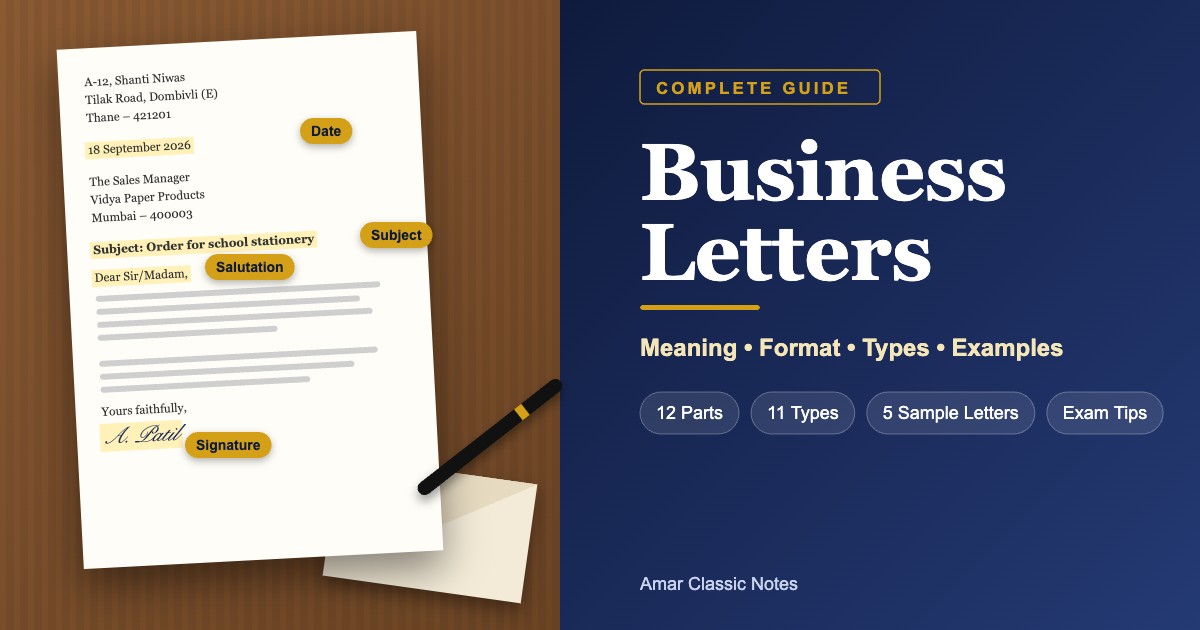
The business letter format has these parts: sender’s address, date, receiver’s address, subject, salutation, body (opening, main and closing paragraphs), complimentary close, signature, name and designation, and enclosures if any.

Before we study each part, here is one important point.
There is more than one accepted layout for a formal business letter:
- Full block format: Every line starts from the left margin. There is no indentation (no space at the start of a paragraph). This is the most common layout today.
- Modified block format: The sender’s address, date, closing and signature are placed on the right side. The rest starts from the left.
Both layouts are correct. (The Purdue Online Writing Lab also explains these layouts in detail.) Many schools, colleges and university examinations in India prefer the full block format because it is neat and simple. Always follow the layout your teacher or syllabus recommends. In this article, we use the full block format.
Now, look at each part of the business letter format carefully.
1. Sender’s Address
- Meaning: The address of the person or organization writing the letter.
- Where: At the top left of the page.
- What to write: House or office number, building, street, area, city and PIN code. An individual usually writes only the address here; the name comes at the end, below the signature. A company uses its printed letterhead (paper with the company’s name, logo and address already printed), so it does not write the address again.
- Example:
A-12, Shanti Niwas
Tilak Road, Dombivli (East)
Thane – 421201
2. Date
- Meaning: The date on which the letter is written.
- Where: Below the sender’s address, after one blank line.
- What to write: Write the date in full, with the month in words.
- Example: 18 September 2026 or September 18, 2026
Avoid writing 04/05/2026. In India, this means 4 May. In the USA, it means April 5. Writing the month in words removes the confusion.
3. Receiver’s Address (Inside Address)
- Meaning: The name or designation (post) and address of the person or organization receiving the letter. It is also called the inside address.
- Where: Below the date, after one blank line.
- What to write: The receiver’s name (if known), designation, company name and full address.
- Example:
The Customer Care Manager
BrightHome Appliances Pvt. Ltd.
Plot No. 14, MIDC Industrial Area
Andheri (East), Mumbai – 400093
4. Subject
- Meaning: A short line that tells the main purpose of the letter.
- Where: Below the receiver’s address and above the salutation. (Some formats place it after the salutation. Follow your syllabus.)
- What to write: Begin with “Subject:” and write the purpose in a few words — usually fewer than ten.
- Example: Subject: Complaint regarding damaged mixer grinder (Order No. BH-45872)
Some letters also have a reference line just above the subject, for example: Ref.: Your letter No. SA/112 dated 10 September 2026. It helps the reader find the earlier letter quickly.
5. Salutation
- Meaning: The greeting at the start of the letter.
- Where: Below the subject, after one blank line.
- What to write: “Dear Sir/Madam,” when you do not know the receiver’s name. “Dear Mr. Joshi,” or “Dear Ms. Fernandes,” when you know it.
- Example: Dear Sir/Madam,
6. Opening Paragraph
- Meaning: The first paragraph of the letter.
- Where: Just below the salutation.
- What to write: Who you are (if needed) and why you are writing. One to three sentences are enough.
- Example: “I am writing to inform you that the mixer grinder I ordered from your website on 10 September 2026 has reached me in a damaged condition.”
7. Main Body
- Meaning: The heart of the letter, where you give all the details.
- Where: After the opening paragraph.
- What to write: Facts, dates, numbers, the problem or requirement, and any explanation needed. Use one paragraph for one idea. For orders, a numbered list or table works well.
- Example: “I placed the order on 10 September 2026 and paid ₹3,499 online. When I opened the box, I found a deep crack in the large jar.”
8. Closing Paragraph
- Meaning: The last paragraph of the letter.
- Where: After the main body.
- What to write: What action you expect from the reader, and a polite ending line.
- Example: “I request you to replace the product at the earliest. I look forward to your prompt reply.”
9. Complimentary Close
- Meaning: A polite way of saying goodbye in a formal letter.
- Where: Below the closing paragraph, on the left side (in full block format).
- What to write: “Yours faithfully,” or “Yours sincerely,” — only the first word begins with a capital letter, and a comma follows.
- Example: Yours faithfully,
The salutation and the complimentary close must match:
| If the salutation is… | Use this complimentary close |
|---|---|
| Dear Sir / Dear Madam / Dear Sir/Madam | Yours faithfully, |
| Dear Mr. Joshi / Dear Ms. Fernandes | Yours sincerely, |
This is the British and Indian practice. In American English, “Sincerely,” or “Yours truly,” is common in most business letters.
10. Signature
- Meaning: The writer’s handwritten signature.
- Where: Just below the complimentary close.
- What to write: Sign by hand on a real letter. In an examination, follow the instructions — if the question gives a name, use that name.
11. Name and Designation
- Meaning: The writer’s full name and job title.
- Where: Below the signature.
- What to write: Full name; then designation and organization, if writing for a company.
- Example:
Anil Patil
Proprietor
Shree Ganesh General Stores
12. Enclosures (Where Applicable)
- Meaning: Documents sent along with the letter, such as a bill copy, photograph or certificate.
- Where: At the bottom left, after the name and designation.
- What to write: “Encl.:” followed by a numbered list of documents.
- Example:
Encl.: 1. Copy of the invoice
       2. Photographs of the damaged product
Remember: Write “Encl.” only if you are really sending documents with the letter. If nothing is attached, leave it out.
Complete Business Letter Format (Model to Copy)
Here is the business letter format in full block layout, with every part in its place. Copy this into your notebook.
[Sender's Address]
[Street / Area]
[City – PIN Code]

[Date]

[Receiver's Designation / Name]
[Organization Name]
[Street / Area]
[City – PIN Code]

Subject: [Purpose of the letter in a few words]

[Salutation],

[Opening paragraph: why you are writing]

[Main body: all details, facts, numbers]

[Closing paragraph: action expected + polite ending]

[Complimentary close],

[Signature]
[Name]
[Designation]

Encl.: [List of documents, if any]
Now let us see the same format filled in with a real situation. A college wants new furniture for its library, so the office writes to a supplier asking for a quotation (a written statement of prices).
Sunrise College of Commerce
Dr. Ambedkar Road, Parel
Mumbai – 400012

8 September 2026

The Sales Manager
Modern Office Furniture Co.
27, Station Road, Kurla (West)
Mumbai – 400070

Subject: Request for quotation for library furniture

Dear Sir/Madam,

Our college is setting up a new reading room in the library. We would like to receive your quotation for the furniture listed below.

1. Reading tables (6 feet x 3 feet, wooden) – 10 pieces
2. Chairs with back support – 60 pieces
3. Steel bookshelves (7 feet, 5 shelves) – 8 pieces

Kindly mention the price of each item, GST, delivery charges, delivery time and warranty. Please also let us know if you offer any discount for educational institutions.

We would be grateful to receive your quotation by 20 September 2026.

Yours faithfully,

(Signature)
Suresh Iyer
Office Superintendent
Sunrise College of Commerce
Teacher’s Tip: Leave one blank line between every part of the letter. This small habit makes your letter look neat and helps the examiner find each part quickly.
Types of Business Letters
The main types of business letters are enquiry letters, replies to enquiries, order letters, complaint letters, adjustment letters, sales letters, application letters, circular letters, request letters, appointment letters and collection letters.
Each type of business letter has its own purpose. Let us understand when and why each one is used.
1. Enquiry Letter
- Meaning: A letter that asks for information.
- When and why: Before buying a product, joining a course or hiring a service, you need details such as price, quality, timings or terms. An enquiry letter asks for these details clearly.
- Example line: “Kindly send us your latest price list for school uniforms, along with your terms of delivery.”
2. Reply to Enquiry (Quotation Letter)
- Meaning: A letter that answers an enquiry.
- When and why: When a company receives an enquiry, it replies with the information asked for. A good reply is prompt, complete and friendly, because the enquirer may become a customer.
- Example line: “Thank you for your enquiry dated 5 September 2026. Please find our latest price list enclosed.”
3. Order Letter
- Meaning: A letter that places an order for goods or services.
- When and why: When you have decided to buy, you write an order letter. It must mention the exact items, quantity, price, delivery date, delivery place and payment method, so that nothing goes wrong.
- Example line: “Please supply the following items by 5 October 2026 as per your quotation dated 15 September 2026.”
4. Complaint Letter
- Meaning: A letter that reports a problem with a product or service.
- When and why: When goods arrive damaged, late or wrong, or a service is poor, the customer writes a complaint letter. It gives facts calmly and asks for a solution.
- Example line: “I regret to inform you that 20 of the 100 chairs delivered to us yesterday are broken.”
5. Adjustment Letter
- Meaning: A reply to a complaint that tells the customer how the problem will be solved.
- When and why: A company writes it after checking a complaint. If the complaint is right, the company apologizes and offers a replacement, repair or refund. If not, it politely explains why.
- Example line: “We are sorry for the trouble caused. A replacement will reach you within three working days.”
6. Sales Letter
- Meaning: A letter written to sell a product or service.
- When and why: Businesses use sales letters to introduce a new product, announce an offer or attract new customers. A good sales letter catches attention, shows the benefits and asks the reader to act.
- Example line: “Now get fresh farm vegetables delivered to your door every morning — 10% off on your first month.”
7. Application Letter
- Meaning: A formal letter applying for a job, internship or position.
- When and why: Job seekers send it with their resume. It explains the post applied for, the candidate’s qualifications and why they are suitable.
- Example line: “I wish to apply for the post of Accounts Assistant advertised in The Times of India on 2 September 2026.”
8. Circular Letter
- Meaning: A letter with the same message sent to many people at the same time.
- When and why: Used to share common information — a new branch, a change of address, new office timings, a price change or a holiday. The same letter goes to all customers, members or employees.
- Example line: “We are happy to inform all our customers that our new branch will open in Borivali on 1 November 2026.”
9. Request Letter
- Meaning: A letter that politely asks for a favour, permission or help.
- When and why: Used to ask for permission for an industrial visit, sponsorship for a college event, extra time for payment, a meeting, or any special help.
- Example line: “We request you to kindly permit our students to visit your factory on 15 October 2026.”
10. Appointment Letter
- Meaning: A letter from an employer offering a job to a selected candidate.
- When and why: After selection, the company sends an appointment letter. It mentions the post, salary, joining date, place of work and main terms. It is an important official record for both sides.
- Example line: “We are pleased to appoint you as Sales Executive at our Pune branch with effect from 1 October 2026.”
11. Collection Letter (Payment Reminder)
- Meaning: A letter that reminds a customer to pay money that is due.
- When and why: When a customer has not paid a bill on time, the seller sends a polite reminder. If payment is still not made, later letters become firmer, but they should always remain respectful.
- Example line: “This is a gentle reminder that our Invoice No. 2215 for ₹18,600 was due on 31 August 2026.”
Types of Business Letters at a Glance
| Type | Usually written by | Main purpose |
|---|---|---|
| Enquiry letter | Buyer / customer | To ask for information |
| Reply to enquiry | Seller / organization | To give the information asked for |
| Order letter | Buyer | To buy goods or services |
| Complaint letter | Customer | To report a problem |
| Adjustment letter | Seller / company | To solve a complaint |
| Sales letter | Seller | To sell a product or service |
| Application letter | Job seeker | To apply for a job |
| Circular letter | Organization | To inform many people at once |
| Request letter | Anyone | To ask for permission or help |
| Appointment letter | Employer | To offer a job |
| Collection letter | Seller | To ask for pending payment |
Teacher’s Tip: Many types of business letters come in pairs. Enquiry → Reply. Complaint → Adjustment. Order → Acknowledgement. When you learn one, learn its partner too. Examiners often ask for the reply.
Business Letter Examples (5 Complete Sample Letters)
This is the most useful part of the article. These business letters are based on everyday situations. Read each letter slowly and notice where every part is placed.
Example 1: Complaint Letter About a Damaged Product
Situation: Rohan Deshmukh ordered a mixer grinder online. It arrived with a cracked jar.
A-12, Shanti Niwas
Tilak Road, Dombivli (East)
Thane – 421201

18 September 2026

The Customer Care Manager
BrightHome Appliances Pvt. Ltd.
Plot No. 14, MIDC Industrial Area
Andheri (East), Mumbai – 400093

Subject: Complaint regarding damaged mixer grinder (Order No. BH-45872)

Dear Sir/Madam,

I am writing to report that the mixer grinder I ordered from your official website has reached me in a damaged condition.

I placed the order (Order No. BH-45872) on 10 September 2026 for a BrightHome Turbo 750-watt mixer grinder and paid ₹3,499 online. The parcel was delivered on 16 September 2026. When I opened the box, I found a deep crack near the base of the large jar, and the lid of the small jar was missing. The outer box was also torn on one side. I have kept the product and the packing material exactly as I received them.

I request you to replace the damaged mixer grinder with a new one at the earliest. If a replacement is not possible, kindly refund the full amount. I would also be grateful if you could arrange for the damaged product to be collected from my address.

I look forward to your prompt action.

Yours faithfully,

(Signature)
Rohan Deshmukh

Encl.: 1. Copy of the invoice
       2. Photographs of the damaged product
Why this letter works: It gives the order number, date and amount. It describes the damage exactly. It asks for a clear solution. And it stays polite throughout.
Example 2: Enquiry Letter About a Course
Situation: Priya Nair wants to join a Tally course on weekends and needs details.
7, Sai Krupa Society
Ram Maruti Road, Thane (West)
Thane – 400602

12 September 2026

The Director
Excel Computer Academy
Ranade Road, Dadar (West)
Mumbai – 400028

Subject: Enquiry about the Tally Prime with GST course

Dear Sir/Madam,

I saw your advertisement for the Tally Prime with GST course in a local newspaper. I am a second-year B.Com student and would like to join the course. I shall be grateful if you could send me the following details:

1. Duration of the course
2. Timings of weekend batches
3. Total fees, and whether fees can be paid in instalments
4. Whether a certificate is given at the end of the course
5. Whether practical sessions or placement help are included

I would also like to know the starting date of the next batch.

Thank you for your time. I look forward to your reply.

Yours faithfully,

(Signature)
Priya Nair
Why this letter works: The questions are numbered, so the reader can answer each one easily and nothing is missed.
Example 3: Order Letter from a Shopkeeper to a Supplier
Situation: Anil Patil orders school stationery for his shop before the new term.
Shree Ganesh General Stores
Shop No. 5, Gokhale Road
Naupada, Thane (West) – 400602

20 September 2026

The Sales Manager
Vidya Paper Products
21, Abdul Rehman Street
Mumbai – 400003

Ref.: Your price list dated 1 September 2026

Subject: Order for school stationery

Dear Sir/Madam,

With reference to your price list dated 1 September 2026, we are pleased to place the following order:

Sr.  Item                              Quantity    Rate (₹)   Amount (₹)
1.   Long notebooks (172 pages)        500         40         20,000
2.   Blue ball pens (pack of 10)       200 packs   50         10,000
3.   Geometry boxes                    100         85          8,500
                                                   Total      38,500

Kindly deliver the goods to our shop by 5 October 2026, as the demand will rise when the new term begins. Please pack the notebooks carefully to avoid damage from moisture.

As per our usual terms, payment will be made by cheque within 30 days of delivery.

Kindly confirm the order and the expected date of dispatch.

Yours faithfully,
For Shree Ganesh General Stores

(Signature)
Anil Patil
Proprietor
Why this letter works: The table shows every item, quantity and price. The delivery date, packing instruction and payment terms are clear.
Example 4: Reply to a Customer Complaint (Adjustment Letter)
Situation: BrightHome Appliances replies to Rohan Deshmukh’s complaint from Example 1.
BrightHome Appliances Pvt. Ltd.
Plot No. 14, MIDC Industrial Area
Andheri (East), Mumbai – 400093

Ref.: CC/2026/1187

21 September 2026

Mr. Rohan Deshmukh
A-12, Shanti Niwas
Tilak Road, Dombivli (East)
Thane – 421201

Subject: Replacement of damaged mixer grinder (Order No. BH-45872)

Dear Mr. Deshmukh,

Thank you for your letter dated 18 September 2026. We are sorry to learn that the mixer grinder you ordered reached you in a damaged condition.

We have checked the matter with our delivery partner and found that the parcel was damaged during transport. Our delivery team will visit your address on 24 September 2026 between 10 a.m. and 1 p.m. They will collect the damaged product and hand over a new mixer grinder at the same time. You will not have to pay any extra charges.

As a small apology for the trouble, we have extended the warranty on your new product by one year. Please quote the reference number given above if you need to contact us.

We value your trust in BrightHome and hope to serve you better in the future.

Yours sincerely,

(Signature)
Rakesh Menon
Customer Care Manager
Why this letter works: It says sorry, explains what happened, gives a clear solution with a date and time, and ends on a positive note. Notice that the salutation uses the customer’s name, so the close is “Yours sincerely”.
Example 5: Request Letter for an Industrial Visit
Situation: A college teacher asks a dairy company for permission to bring students on a visit.
Commerce Association
Sunrise College of Commerce
Dr. Ambedkar Road, Parel
Mumbai – 400012

25 September 2026

The Plant Manager
Green Valley Dairy Products Ltd.
Survey No. 48, Village Road
Vasai (East), Palghar – 401208

Subject: Request for permission for an industrial visit

Dear Sir/Madam,

I am writing on behalf of the Commerce Association of Sunrise College of Commerce, Mumbai. We request your kind permission for our students to visit your dairy plant.

The visit will help our second-year B.Com students understand how milk is collected, processed, packed and distributed. The group will include 40 students and 2 teachers. We would prefer to visit on 15 or 16 October 2026, between 10 a.m. and 1 p.m. We will arrange our own transport, and our students will follow all the safety and hygiene rules of your plant.

We would be grateful if you could confirm a suitable date by 5 October 2026. Please let us know if you need any documents from the college.

Thank you for considering our request.

Yours faithfully,

(Signature)
Meera Kulkarni
Coordinator, Commerce Association
Why this letter works: It explains the purpose, gives exact numbers and dates, assures the company about safety, and asks for a reply by a fixed date.
Remember: A good letter answers five questions for the reader: Who is writing? Why? What exactly is needed? By when? What happens next?
Business Letter vs Personal Letter
A business letter is formal and written for work or official matters. A personal letter is informal and written to family or friends.
| Point | Business Letter | Personal Letter |
|---|---|---|
| Purpose | Work, trade, service or official matters | Sharing news, feelings and personal matters |
| Language | Formal, standard English | Simple, friendly, informal |
| Tone | Polite and professional | Warm and personal |
| Format | Fixed format with subject line | Flexible format, no subject line |
| Relationship | Often between strangers or organizations | Between family, friends or relatives |
| Subject matter | Orders, complaints, enquiries, jobs | Holidays, family events, feelings |
| Salutation and close | Dear Sir/Madam … Yours faithfully | Dear Riya … With love / Your loving friend |
| Examples | Complaint letter, order letter, application | Letter to a friend, letter to parents |
Business Letter vs Business Email
Today, much business communication happens through email and other methods of communication. So are traditional business letters still needed? Yes. Both are useful. The right choice depends on the situation.
| Point | Business Letter | Business Email |
|---|---|---|
| Format | Full format with addresses, date, subject, salutation, body, close and signature | Subject line, salutation, body, close and signature block; addresses are not written at the top |
| Speed | Takes days to reach by post or courier | Reaches in seconds |
| Cost | Paper, printing and postage | Almost free |
| Formality | Very formal; a signed letter carries extra weight | Formal or semi-formal, depending on the situation |
| Record keeping | Physical copy kept in files | Saved in the inbox; easy to search |
| Attachments | Physical documents sent as enclosures | Files attached digitally |
| Common uses | Appointment letters, legal notices, agreements, official government communication, formal complaints | Everyday enquiries, quick replies, order confirmations, meeting requests |
Which one should you use? Use email for quick, everyday business communication. Use a printed, signed letter when the matter is official, legal or very important, or when the receiver asks for a signed copy. Many organizations also send a scanned letter as an email attachment — which gives you both speed and formality.
Teacher’s Tip: A formal email follows the same rules as a business letter: a clear subject, a polite greeting, short paragraphs and a proper closing. If you can write a good business letter, you can write a good business email.
Dos and Don’ts of Business Letter Writing
| Do ✔ | Don’t ✘ |
|---|---|
| Be polite, even in a complaint | Use rude, angry or blaming language |
| Be clear and simple | Write unnecessary stories or details |
| State the purpose in the first paragraph | Use slang, short forms like “pls” or emojis |
| Check grammar before sending | Leave grammar mistakes uncorrected |
| Check spelling, names and numbers | Misspell the receiver’s name or company |
| Use the correct format | Forget the subject line |
| Include all necessary details (dates, bill numbers, quantities) | Write unclear sentences that confuse the reader |
| Keep a professional tone throughout | Give incomplete information or end with an unsuitable closing like “Bye” or “Take care” |
Common Mistakes to Avoid While Writing a Business Letter
These mistakes in business letters cost students marks every year. Read them carefully before your examination.
- A missing or vague subject. “Subject: Letter” tells the reader nothing. Write the real purpose, such as “Subject: Order for 50 office chairs”.
- A salutation and close that do not match. “Dear Sir/Madam” goes with “Yours faithfully”. “Dear Mr. Shah” goes with “Yours sincerely”. Mixing them is a common error.
- Wrong spelling or capitals in the close. “Your’s faithfully” (with an apostrophe) and “Yours Faithfully” (with a capital F) are both wrong. The correct form is “Yours faithfully,”.
- Starting with a long story. The reader should not have to read three paragraphs to find out why you wrote. Put the purpose first. Unclear writing is one of the common barriers to communication.
- Using informal words. “Hi”, “pls”, “thx”, “ASAP”, “OK” and emojis do not belong in a business letter.
- Missing important details. A complaint without a bill number, or an order without quantities, cannot be acted upon.
- An angry or rude tone. You can be firm without being rude. Firm and polite letters get better results.
- Short, confusing dates. Write “5 October 2026”, not “5/10/26”.
- Mixing layouts. Some lines on the left, some indented, some on the right — this looks messy. Choose one layout (full block is easiest) and follow it everywhere.
- Writing “Encl.” without any enclosure. Mention enclosures only if you are really sending them.
- Ignoring the word limit or the question. If the question asks you to write as “Rahul, the manager of XYZ Ltd.”, use exactly that name and designation. Also, do not reveal your own identity if the question paper says so.
Remember: Examiners give marks for format, content and expression. A correct format alone can earn you a good share of the marks.
How to Write a Business Letter in an Examination
Follow these eight simple steps whenever business letters come in your question paper.
- Understand the question. Read it twice. Underline the key details — names, dates, items, the problem.
- Identify the sender and the receiver. Who is writing? To whom? This decides the addresses, the salutation and the close.
- Decide the purpose. Is it an enquiry, an order, a complaint, a reply or a request? The type decides the content.
- Follow the correct format. Use the full block format unless your syllabus says otherwise. Leave one blank line between parts.
- Write a suitable subject. Short, clear and specific.
- Keep the language polite. Simple sentences. No slang. No anger.
- Check grammar and spelling. Especially names, numbers and dates.
- End properly. A closing paragraph, the correct complimentary close, then signature, name and designation.
Smart time plan: Spend about 2 minutes planning (jot down the points), most of your time writing, and the last 2 minutes checking.
A Memory Trick for the Format
Remember this funny sentence:
“Sita’s Dog Runs Straight Since Breakfast, Chasing Seven Eggs.”
| Word | Letter | Part of the Business Letter |
|---|---|---|
| Sita’s | S | Sender’s address |
| Dog | D | Date |
| Runs | R | Receiver’s address |
| Straight | S | Subject |
| Since | S | Salutation |
| Breakfast | B | Body (opening, main, closing paragraphs) |
| Chasing | C | Complimentary close |
| Seven | S | Signature (with name and designation) |
| Eggs | E | Enclosures |
Picture a little dog running after eggs in the morning, and you will never forget the order.
Teacher’s Tip: For the closing, remember this line: “Don’t know the name? Be faithful. Know the name? Be sincere.” Dear Sir/Madam → Yours faithfully. Dear Mr. Rao → Yours sincerely.
Business Letter: Quick Revision
- Business letters are formal letters written for business or professional purposes.
- It must have formal language, a clear purpose and the correct format.
- It gives a written record, so it is useful as proof later.
- The main parts are: sender’s address, date, receiver’s address, subject, salutation, body, complimentary close, signature, name and designation, and enclosures.
- Full block format: every line starts from the left margin. It is the most common layout.
- Write the date with the month in words: 18 September 2026.
- The subject line tells the purpose in a few words.
- “Dear Sir/Madam” → “Yours faithfully”. “Dear Mr. Joshi” → “Yours sincerely”.
- The opening paragraph says why you are writing; the body gives details; the closing paragraph says what action you expect.
- Main types of business letters: enquiry, reply to enquiry, order, complaint, adjustment, sales, application, circular, request, appointment and collection letters.
- Complaint letters should be firm but polite, with facts like bill number and date.
- Order letters must list items, quantity, price, delivery date and payment terms.
- Emails are faster; signed letters are better for official and legal matters.
- Avoid slang, anger, spelling mistakes and missing details.
- Memory trick: “Sita’s Dog Runs Straight Since Breakfast, Chasing Seven Eggs.”
Frequently Asked Questions (FAQs) on Business Letters
1. What is a business letter?
A business letter is a formal letter written for business or professional purposes, such as asking for information, placing an order, making a complaint or sharing an official decision.
2. What is the format of a business letter?
A business letter follows this order: sender’s address, date, receiver’s address, subject, salutation, body (opening, main and closing paragraphs), complimentary close, signature, name and designation, and enclosures (if any). In the full block format, all lines start from the left margin.
3. What are the main types of business letters?
The main types are enquiry letters, replies to enquiries, order letters, complaint letters, adjustment letters, sales letters, application letters, circular letters, request letters, appointment letters and collection letters.
4. What are the 7 parts of a business letter?
Different textbooks count the parts differently. A common list of seven is: (1) heading — sender’s address and date, (2) receiver’s (inside) address, (3) subject, (4) salutation, (5) body, (6) complimentary close, and (7) signature with name and designation. Enclosures are added when documents are attached.
5. What is the purpose of a business letter?
Its purpose is to communicate formally and clearly about business matters — to inform, request, order, complain, reply or confirm — while keeping a written record.
6. How do you start a business letter?
After the addresses, date and subject, begin with a salutation such as “Dear Sir/Madam,” or “Dear Ms. Pillai,”. In the first paragraph, state the purpose directly, for example: “I am writing to enquire about…”
7. How do you end a business letter?
End with a short closing paragraph that says what action you expect, followed by a complimentary close (“Yours faithfully,” or “Yours sincerely,”), your signature, your name and, if needed, your designation.
8. What is the difference between a business letter and a personal letter?
A business letter is formal, follows a fixed format with a subject line and deals with work or official matters. A personal letter is informal, has a flexible format and is written to family or friends.
9. What is an enquiry letter?
An enquiry letter asks for information about a product, service, course or price before making a decision. It should list the questions clearly, preferably in numbered points.
10. What is a complaint letter?
A complaint letter reports a problem with goods or services — such as damage, delay or poor quality — and politely asks for a solution like a replacement, repair or refund.
11. What is an order letter?
An order letter is written to buy goods or services. It mentions the items, quantity, price, delivery date, delivery address and payment terms.
12. When should I use “Yours faithfully” and “Yours sincerely”?
In British and Indian practice, use “Yours faithfully” when the salutation is “Dear Sir/Madam” (name unknown). Use “Yours sincerely” when you address the receiver by name, such as “Dear Mr. Joshi”.
13. Is a business letter still useful today?
Yes. Emails are used for quick everyday communication, but signed business letters are still used for appointment letters, agreements, legal notices, official complaints and government communication. Learning letter writing also makes your emails more professional.
A Final Word from Your Teacher
Writing business letters is not about using big words. It is about being clear, polite and complete. Read the five sample letters again, notice where each part sits, and then try writing one on your own — a complaint about a late parcel, or an enquiry about a coaching class. After two or three letters, the format will feel natural.
Keep this guide to business letters handy for your revision. And the next time something goes wrong with a product or you need to place an order, you will know exactly how to write about it.
Want to strengthen your written and spoken communication further? Read our simple guides on the 7 Cs of Communication, Presentation Skills and Public Speaking Skills.