Imagine you walk into a room. You haven’t said a single word yet. But somehow, people already have an opinion about you.
How?
Your face, your walk, your posture, and even the way you hold your bag have already “spoken” for you. Strange, right? You stayed silent, yet you still sent a message.
That silent message is called non-verbal communication.
Think about this for a second. When your friend says “I’m fine” with a flat face and tired eyes, do you believe the words or the face? Almost always, we trust the face. This is the quiet power of body language, and once you understand it, you start reading people like an open book.
In this complete beginner’s guide, I’ll explain non-verbal communication (also called kinesics or body language) in the simplest way possible — as if we’re sitting together and I’m your teacher. We’ll cover the meaning, types, real-life examples, interview tips, psychology facts, myths, FAQs, and much more. By the end, you’ll notice things about people that most others completely miss.
Let’s begin. 😊
What Is Non-Verbal Communication?
Let’s understand this in the easiest way.
Non-verbal communication means sending or receiving messages without using words.
That’s it. No fancy definition needed. When you communicate using your face, hands, eyes, body, voice tone, or even silence — that is non-verbal communication.
Definition (simple)
Non-verbal communication is the process of sharing thoughts, feelings, and information without spoken or written words, using body movements, expressions, gestures, tone, space, and appearance.
Meaning
Every time you nod your head, roll your eyes, cross your arms, or smile at someone, you are “talking” — just without your mouth. Your body is doing the speaking.
Super-simple explanation
Picture a baby who cannot talk yet. How does the baby tell you it is happy, hungry, or upset? Through crying, smiling, kicking, and reaching out. That baby is a master of non-verbal communication — long before learning a single word.
We all started that way. And we never really stopped.
Did you know? Researchers estimate that a very large share of the emotional meaning in a face-to-face conversation is carried by tone and body language rather than the actual words. The exact percentage is debated, but nearly every expert agrees on one thing: how you say something often matters as much as what you say.
Meaning of Kinesics
Here comes a slightly heavy word — kinesics. Don’t worry, I’ll make it easy.
Kinesics simply means communicating through body movements.
The word comes from “kinesis,” which means movement. So kinesics is the study of how we send messages using our body — our face, hands, eyes, head, and posture.
An American researcher named Ray Birdwhistell made this word popular in the 1950s. He believed that our body movements are like a silent language with their own “grammar.”
So whenever someone says kinesics, just replace it in your head with “body language.” Same thing, simpler word.
Quick example: A teacher raising one eyebrow at a noisy student says “Be quiet” without speaking. That single eyebrow is kinesics in action.
Why Non-Verbal Communication Matters
You might be thinking, “Okay, but is it really that important?”
Let me show you with real life.
Imagine this situation. You go to a shop. The shopkeeper is talking on the phone, doesn’t look at you, and points lazily at a shelf. Even if he says “Welcome, sir,” you don’t feel welcome at all. His body said the opposite of his words.
Now imagine another shop where the owner smiles, makes eye contact, and turns fully toward you. You instantly feel comfortable — maybe you even buy more.
Same words. Totally different feeling. That difference is non-verbal communication.
Here’s why it matters so much:
- It builds first impressions. People judge you within seconds, mostly from how you look and carry yourself.
- It shows true feelings. Words can lie easily; faces and body movements usually leak the truth.
- It creates trust. A warm handshake and steady eye contact make people believe you.
- It supports your words. Good body language makes your message stronger and clearer.
- It works everywhere. A smile is understood in every country, even without a common language.
Think about this: In interviews, sales, teaching, love, and leadership — the people who “win” are often not the ones with the best words. They’re the ones with the best body language.
Characteristics of Non-Verbal Communication
Non-verbal communication has some special features. Let’s understand each one with an example.
1. It is always happening (continuous). Even when you stay silent, your body keeps sending signals. Sitting quietly with slumped shoulders still says “I’m tired.”
2. It is often unconscious. You don’t plan most of it. You frown when confused without deciding to. Your body reacts on its own.
3. It is culture-based. A thumbs-up is positive in many countries but rude in a few. The same gesture can mean different things in different places.
4. It is fast and instant. A single look can express anger faster than a full sentence. Your face reacts in a split second.
5. It supports or contradicts words. Saying “I’m so happy” while crying sends a confusing, mixed message. Body and words don’t always match.
6. It is powerful and believable. When words and body clash, people trust the body more. A fake smile rarely fools anyone for long.
7. It cannot be fully hidden. You can control words, but tiny expressions still slip out. These quick flashes are called micro-expressions — very short facial reactions we can’t fully stop.
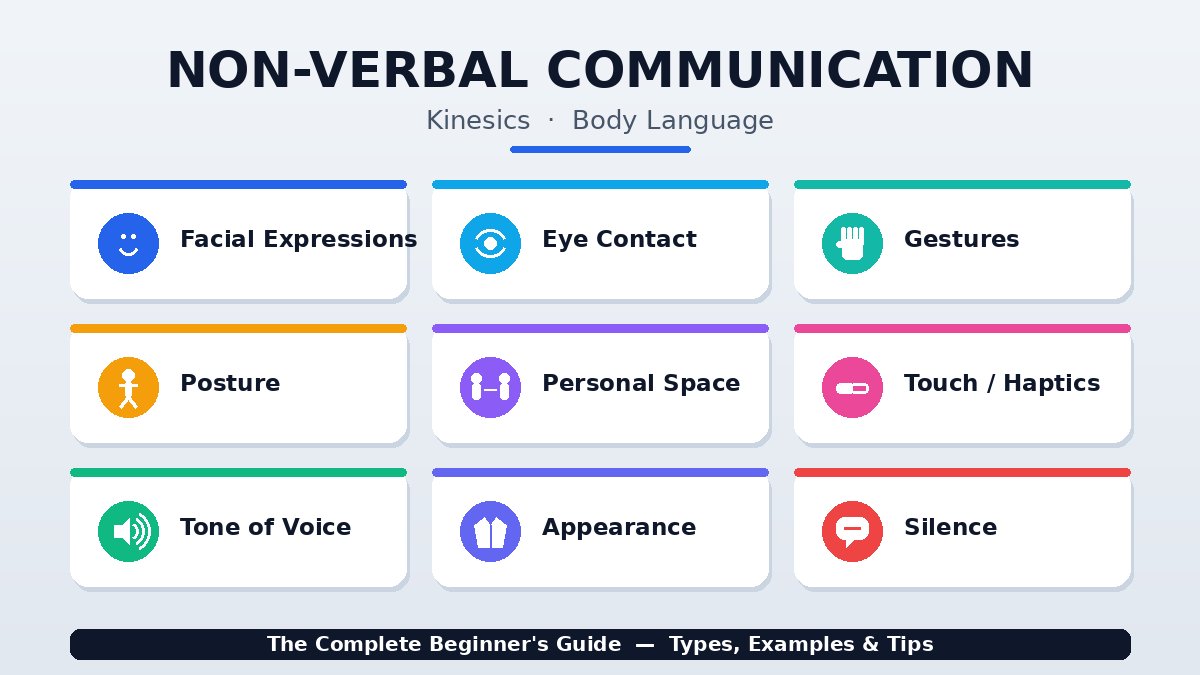
Types of Non-Verbal Communication
This is the heart of the topic. There are many types, and I’ll explain each one simply, with examples you can picture right away.
1. Facial Expressions
Your face is the biggest signboard you own. Happiness, sadness, anger, surprise, fear, and disgust show up on the face almost the same way around the world. Example: A student’s face lights up the moment they finally understand a hard sum.
2. Eye Contact (Oculesics)
The way we use our eyes speaks volumes. Good eye contact shows confidence and honesty. Too little looks nervous; too much can feel like staring. Example: A confident speaker gently looks around the room, making each listener feel included.
3. Gestures
These are movements of the hands, arms, and head. Waving, pointing, a thumbs-up, or a “come here” motion are all gestures. Example: A cricket umpire raising a finger tells the whole stadium “Out!” without a word.
4. Posture
This is how you hold your body — sitting or standing. An upright posture shows confidence; a slouched one shows low energy. Example: A soldier standing tall instantly looks alert and disciplined.
5. Body Movement
The way you walk and move sends signals. A quick, light walk suggests energy; a slow, heavy walk suggests tiredness or sadness. Example: You can often tell a person’s mood just from the way they enter a room.
6. Personal Space (Proxemics)
Proxemics simply means the study of physical distance between people. We keep close friends near and strangers at a distance. Standing too close can feel uncomfortable. Example: In a lift, strangers naturally stand apart and avoid touching.
7. Touch (Haptics)
Haptics simply means communication through touch. A handshake, a pat on the back, or a hug all send messages. Example: A coach patting a player’s shoulder says “Well done, keep going.”
8. Voice Tone (Paralanguage)
Paralanguage simply means the “how” of your voice — tone, pitch, speed, and pauses — not the actual words. The same sentence can sound kind or rude depending on tone. Example: “Really?” can show excitement or sarcasm, all based on tone.
9. Appearance
How neat and clean you look affects how people see you. A tidy appearance often earns quick respect. Example: A well-groomed candidate walks into an interview already looking prepared.
10. Clothing (Attire)
Clothes send strong signals about your role and mood. Example: A doctor’s white coat instantly signals trust and authority.
11. Signs
Signs are direct signals that stand for something. Example: A red traffic light silently orders everyone to stop.
12. Symbols
Symbols carry deeper meaning agreed upon by society. Example: A heart symbol means love; a national flag means pride and identity.
13. Charts
Charts turn information into pictures so we understand faster. Example: A bar chart shows sales growth in one quick glance.
14. Pictures
A single image can express what many words cannot. Example: A photo of a flooded street tells the story of a disaster instantly.
15. Colour Communication
Colours carry feelings and messages. Example: Red often means danger or love; green often means “go” or nature.
16. Silence
Yes — even silence speaks. Example: An awkward silence after a joke tells you clearly that no one found it funny.
17. Time Communication (Chronemics)
Chronemics simply means how we use time to send messages. Example: Arriving early for an interview says “I’m serious and respectful,” while arriving late says the opposite.
18. Artifacts
Artifacts are personal objects that say something about us. Example: A watch, ring, or badge can signal status, taste, or profession.
19. Environment
The space around you — its cleanliness, lighting, and setup — sends a message too. Example: A neat, well-lit office feels professional and welcoming before anyone speaks.
Non-Verbal Communication in Daily Life (50+ Examples)
Let’s see body language in action across places you visit every day. Here are more than 50 quick real-life examples.
🏠 At Home 1. Mom’s one look that means “Stop it right now.” 2. A child hugging a parent after a bad day. 3. Slamming a door to show anger. 4. A thumbs-up to say “Well done.” 5. Rolling eyes at a boring lecture from an elder.
🏫 At School 6. A teacher’s silence to quiet a noisy class. 7. Raising a hand to answer. 8. A student looking down to avoid a question. 9. Clapping to praise a classmate. 10. A finger on the lips meaning “Be quiet.”
🎓 At College 11. Sitting in the front row to show interest. 12. Yawning during a dull lecture. 13. Nodding to show you agree with a friend. 14. Checking a phone under the desk (says “I’m bored”). 15. A confident walk onto the stage during a fest.
🏢 At the Office 16. A firm handshake before a meeting. 17. Crossed arms showing disagreement. 18. Leaning forward to show interest in an idea. 19. A boss’s nod of approval. 20. Tapping a pen while feeling impatient.
🏥 At the Hospital 21. A nurse’s calm smile to relax a patient. 22. A doctor’s gentle hand on a worried patient’s shoulder. 23. A “shhh” gesture to keep the ward quiet. 24. Anxious pacing in the waiting area. 25. A relieved smile after good test results.
👮 With the Police 26. A raised palm meaning “Stop.” 27. A whistle and hand signal directing traffic. 28. A stern, straight posture showing authority. 29. A salute showing respect. 30. Handcuffs signalling arrest without words.
⚖️ In Court 31. Everyone standing when the judge enters (respect). 32. The judge’s serious face setting the tone. 33. A witness fidgeting nervously. 34. A confident, calm lawyer walking to the stand. 35. Silence when the verdict is read.
🏦 At the Bank 36. A polite smile from the teller. 37. A “please wait” hand gesture. 38. Standing behind the yellow line for privacy. 39. A manager’s welcoming handshake. 40. A frustrated customer checking the clock repeatedly.
🛒 In the Market 41. A shopkeeper waving you in warmly. 42. A vendor’s hand signals over a noisy crowd. 43. A bargaining shake of the head meaning “No, too high.” 44. A satisfied nod to close a deal. 45. Pointing at the item you want.
🚉 At the Railway Station / ✈️ Airport 46. A guard’s green flag telling the train to move. 47. Signboards and symbols guiding passengers. 48. A hurried run showing someone is late. 49. Ground staff using hand signals to guide a plane. 50. A warm hug at the arrival gate.
🎤 Interviews, Meetings & Public Speaking 51. A confident smile and steady eye contact in an interview. 52. A speaker using open hand gestures to hold attention. 53. Everyone leaning in during an exciting business pitch.
🗳️ Politics, 📱 Social Media, 💍 Marriage & 🏆 Sports 54. A politician waving to a cheering crowd. 55. Emojis and reactions replacing words online. 56. A garland exchange marking a wedding bond. 57. Players hugging after scoring a goal.
See? Body language is truly everywhere. Once you start noticing it, you can’t switch it off.
Importance in Job Interviews
This section is gold for students and job seekers. Imagine this situation: two candidates give almost the same answers. One gets selected, the other doesn’t. Why? Very often, the difference is body language.
✅ Body language that impresses interviewers
- Walk in with an upright, confident posture.
- Offer a firm (not crushing) handshake.
- Maintain warm, steady eye contact.
- Smile naturally when greeting.
- Sit straight and lean slightly forward when listening.
- Keep your hands calm and use gentle gestures.
- Nod to show you’re paying attention.
❌ Things you should NEVER do
- Don’t slouch or sit like you’re at home.
- Don’t avoid eye contact or stare at the floor.
- Don’t fidget, tap your feet, or play with a pen.
- Don’t cross your arms — it looks defensive.
- Don’t check your phone or the clock.
- Don’t give a weak, cold, or sweaty handshake.
- Don’t fake a smile; interviewers can tell.
Pro tip: Before an interview, sit or stand tall and breathe slowly for two minutes. Confident posture actually helps you feel more confident, not just look it.
Importance in Business, Leadership & Teaching
💼 In Business Communication
In business, trust closes deals. A confident posture, calm tone, and open gestures make clients feel safe. A salesperson who mirrors a customer’s friendly energy often builds an instant connection. Poor body language, on the other hand, can lose a deal even when the offer is great.
👑 In Leadership
Great leaders “speak” powerfully without words. They stand tall, stay calm under pressure, and use warm eye contact to make people feel valued. When a leader stays composed during a crisis, the whole team relaxes. Body language is a big part of what we call “presence.”
👩🏫 In Teaching
A teacher’s body language can make or break a class. Moving around the room, using expressive gestures, smiling, and making eye contact keep students awake and engaged. A teacher who reads confused faces and slows down instantly is using non-verbal listening — a superpower in the classroom.
Non-Verbal Communication in Online Meetings
On Zoom, Google Meet, and Microsoft Teams, and in virtual interviews, body language still matters — sometimes even more, because the camera zooms right into your face.
Here’s how to shine online:
- Look at the camera, not the screen, to create “eye contact.”
- Sit up straight with good lighting on your face.
- Smile and nod so people know you’re engaged.
- Keep the background neat — your environment speaks too.
- Avoid looking away often; it seems like you’re distracted.
- Mind your tone, since the camera can flatten your energy — add a little extra warmth.
Did you know? On video calls, a plain, tidy background and a well-lit face can make you look more prepared and trustworthy — before you say a single word.
Advantages of Non-Verbal Communication
Let’s look at the benefits one by one.
- It’s fast. A single gesture works quicker than a full sentence.
- It crosses language barriers. A smile needs no translation.
- It expresses true emotions. Feelings show clearly on the face.
- It supports words. Gestures make your message stronger.
- It helps when speaking is impossible. Useful in noisy or silent places.
- It builds relationships. Warm body language creates trust and closeness.
- It helps people with hearing or speech challenges. Sign language is powerful non-verbal communication.
- It saves time. A nod can replace a long “yes.”
Limitations of Non-Verbal Communication
Let’s be honest — it’s not perfect.
- It can be misunderstood. A gesture may mean different things in different cultures.
- It isn’t precise. You can’t explain a complex idea with body language alone.
- It’s hard to prove. Words can be recorded; a “look” cannot easily be shown as evidence.
- It can be faked. A polite smile may hide real feelings.
- It depends on visibility. In the dark or on a phone call, most of it is lost.
- It varies by person. Not everyone shows emotions the same way.
- No permanent record. Once the moment passes, it’s gone.
Common Mistakes People Make
- Avoiding eye contact and looking nervous.
- Crossing arms and looking closed-off.
- Fake smiling, which feels dishonest.
- Standing too close and invading personal space.
- A weak or overly aggressive handshake.
- Fidgeting, tapping, or restless movement.
- Slouching, which signals low confidence.
- Checking the phone while someone is talking.
- Ignoring the other person’s body language.
- Letting words and body language contradict each other.
30 Practical Tips to Improve Your Body Language
- Stand and sit up straight.
- Keep your shoulders relaxed, not stiff.
- Make warm, steady eye contact.
- Smile genuinely when greeting people.
- Give a firm, friendly handshake.
- Keep your arms open, not crossed.
- Lean slightly forward while listening.
- Nod to show you’re paying attention.
- Use natural hand gestures while talking.
- Slow down your movements to look calm.
- Match your facial expression to your words.
- Respect people’s personal space.
- Walk with a confident, steady pace.
- Keep your hands out of your pockets.
- Avoid fidgeting with objects.
- Mirror the other person’s friendly energy.
- Take a deep breath before speaking.
- Face people fully when talking to them.
- Keep your chin level, not down.
- Use pauses instead of “um” and “uh.”
- Vary your voice tone to stay interesting.
- Dress neatly for the occasion.
- Keep your phone away during conversations.
- Watch your facial expression when listening.
- Practice in front of a mirror.
- Record yourself and review your gestures.
- Observe confident speakers and learn from them.
- Stay relaxed — tension shows on your body.
- Adjust your body language to the culture.
- Above all, be genuine — real beats rehearsed.
20 Interesting Psychological Facts
- Our brain judges faces in a fraction of a second.
- Genuine smiles reach the eyes; fake ones don’t.
- Micro-expressions can leak real feelings in less than a second.
- People often “mirror” the posture of those they like.
- Crossed arms can reduce how much information we take in.
- Confident posture can slightly change how we feel inside.
- We usually trust body language over words when they clash.
- Feet often point toward where a person wants to go.
- Dilated pupils can signal interest or excitement.
- Nodding while listening encourages the speaker to continue.
- A warm handshake can create an instant sense of trust.
- Standing tall can make you appear more competent.
- People blink faster when stressed or lying.
- Open palms signal honesty and openness.
- We tend to like people who subtly copy our gestures.
- Eye contact activates social bonding in the brain.
- Tone of voice can change a sentence’s meaning completely.
- Colours can influence mood and even appetite.
- Personal space needs differ from culture to culture.
- Babies read facial expressions before they learn words.
(These reflect widely reported findings in psychology; exact effects can vary by person and situation.)
Myths vs Facts
| ❌ Myth | ✅ Fact |
|---|---|
| Crossed arms always mean anger. | Sometimes people are just cold or comfortable. |
| One gesture reveals everything. | You must read clusters of signals together. |
| Body language means the same worldwide. | Many gestures change meaning by culture. |
| Good speakers don’t need body language. | The best speakers use it constantly. |
| More eye contact is always better. | Too much can feel like staring. |
| You can fully fake confident body language. | Micro-expressions often reveal the truth. |
| Only the face matters. | Posture, hands, tone, and space matter too. |
| Body language is a modern idea. | Humans have used it since before language existed. |
Helpful Comparison Tables
Verbal vs Non-Verbal Communication
| Point | Verbal Communication | Non-Verbal Communication |
|---|---|---|
| Uses | Words (spoken/written) | Body, face, tone, space |
| Speed | Slower | Instant |
| Control | Easy to control | Often unconscious |
| Clarity | Very precise | Can be vague |
| Record | Easy to store | Hard to store |
| Emotion | Limited | Very strong |
| Language barrier | Big problem | Often understood anyway |
Good Body Language vs Poor Body Language
| Good Body Language | Poor Body Language |
|---|---|
| Upright posture | Slouching |
| Steady eye contact | Looking away |
| Genuine smile | Blank or fake face |
| Open arms | Crossed arms |
| Calm, still hands | Constant fidgeting |
| Firm handshake | Weak or sweaty handshake |
Positive Gestures vs Negative Gestures
| Positive Gestures | Negative Gestures |
|---|---|
| Nodding while listening | Rolling eyes |
| Thumbs-up | Pointing aggressively |
| Open palms | Clenched fists |
| Leaning in | Turning away |
| Relaxed smile | Frowning or smirking |
5 Real-World Case Studies
Case 1 — The Silent Interview Winner. Two candidates, similar answers. One sat up, smiled, and made eye contact. The other slouched and looked at the floor. The confident one got the job. The words were equal; the body language wasn’t.
Case 2 — The Doctor’s Calm Hand. A frightened patient relaxed the moment a doctor sat down at eye level, spoke slowly, and gently placed a hand on their arm. Nothing about the diagnosis changed — but the fear did.
Case 3 — The Teacher Who Moved. A teacher who walked around the class, used big gestures, and read confused faces kept students far more engaged than a teacher who stood still and stared at the board.
Case 4 — The Lost Deal. A talented salesperson kept checking his phone and avoiding eye contact during a pitch. The client felt ignored and walked away — even though the offer was excellent.
Case 5 — The Leader in a Crisis. During bad news, a manager stayed calm, stood steady, and kept a warm tone. The team stayed calm too. Her body language became the whole room’s anchor.
Fun Facts & Did You Know?
15 Fun Facts
- A smile is the most universal human expression.
- We can make thousands of different facial expressions.
- Sign languages are full, rich languages of their own.
- Peacocks, dogs, and bees all use body language too.
- Handshakes may have started as a way to show “no weapon.”
- Nodding for “yes” is common, but not universal.
- Some cultures point with their lips, not fingers.
- Poker players train hard to hide their “tells.”
- Emojis are a modern digital body language.
- Actors study micro-expressions to look believable.
- A silent pause can make a speech more powerful.
- Uniforms are non-verbal messages of role and authority.
- Colours in ads are chosen to trigger feelings.
- Great comedians use timing and body more than jokes.
- Even your walking style can hint at your mood.
20 “Did You Know?” Facts
- Did you know your feet often reveal your true interest?
- Did you know fake smiles skip the muscles around the eyes?
- Did you know we mirror people we like without knowing?
- Did you know standing tall can boost your confidence?
- Did you know pupils widen when we’re interested?
- Did you know silence is a form of communication?
- Did you know tone can flip a sentence’s meaning?
- Did you know arriving on time sends a respect message?
- Did you know colours can affect appetite and mood?
- Did you know a firm handshake builds quick trust?
- Did you know babies read faces before words?
- Did you know eye contact strengthens social bonds?
- Did you know crossed arms can lower your focus?
- Did you know a tidy space feels more professional?
- Did you know open palms signal honesty?
- Did you know clothing changes how people treat you?
- Did you know micro-expressions last under a second?
- Did you know personal space rules differ by culture?
- Did you know nodding encourages people to keep talking?
- Did you know body language existed before spoken language?
Inspiring Quotes on Communication
“The most important thing in communication is hearing what isn’t said.” — Peter Drucker
“What you do speaks so loudly that I cannot hear what you say.” — Ralph Waldo Emerson
“We are all wonderful, beautiful wrecks. That’s what connects us.” — a reminder that being real beats being perfect.
Let these sink in. Communication is far bigger than words.
Quick Revision (One-Minute Recap)
- Non-verbal communication = sharing messages without words.
- Kinesics = body language (communication through movement).
- Main types: facial expressions, eye contact, gestures, posture, proxemics (space), haptics (touch), paralanguage (tone), appearance, silence, chronemics (time), and more.
- It’s fast, emotional, powerful, and often unconscious.
- When words and body clash, people trust the body.
- In interviews: sit tall, smile, make eye contact, don’t fidget.
- Improve it with practice, awareness, and honesty.
- Limitation: it can be misunderstood across cultures.
Frequently Asked Questions (FAQs)
1. What is non-verbal communication in simple words? It’s sharing messages without words — using your face, body, gestures, tone, and space.
2. What is kinesics? Kinesics simply means communicating through body movements, also called body language.
3. What are the main types of non-verbal communication? Facial expressions, eye contact, gestures, posture, body movement, personal space, touch, voice tone, appearance, silence, and time.
4. Why is non-verbal communication important? It builds first impressions, shows true feelings, creates trust, and supports your words.
5. Is non-verbal communication more powerful than words? Often yes for emotions. When words and body clash, people usually believe the body.
6. What is proxemics? Proxemics is the study of the physical distance we keep between people.
7. What is haptics? Haptics is communication through touch, like a handshake or a pat on the back.
8. What is paralanguage? Paralanguage is how you say something — your tone, pitch, speed, and pauses.
9. What is chronemics? Chronemics is how we use time to send messages, like being early or late.
10. Can silence be communication? Yes. An awkward pause or a calm silence can say a lot.
11. How can I improve my body language for interviews? Sit up straight, smile, make eye contact, give a firm handshake, and don’t fidget.
12. What body language should I avoid? Crossed arms, slouching, avoiding eye contact, fidgeting, and checking your phone.
13. Is body language the same in every country? No. Many gestures mean different things in different cultures.
14. What are micro-expressions? Very quick facial expressions that reveal true feelings in less than a second.
15. Does eye contact really matter? Yes — it shows confidence and honesty, but too much can feel like staring.
16. How does non-verbal communication help leaders? It gives them presence — calm posture and warm eye contact build trust and respect.
17. Does body language matter on video calls? Very much. Look at the camera, sit straight, smile, and keep a neat background.
18. What is the difference between verbal and non-verbal communication? Verbal uses words; non-verbal uses body, face, tone, and space.
19. Can non-verbal communication be faked? Partly, but micro-expressions often reveal the real emotion.
20. Which type of communication do we use more? We use non-verbal signals almost constantly, even while speaking.
21. How do colours communicate? Colours carry feelings — red for danger or love, green for go or nature.
22. What is oculesics? Oculesics is the study of how we communicate through our eyes.
23. Is a smile universal? A genuine smile is understood positively almost everywhere.
24. How do I stop looking nervous? Breathe slowly, stand tall, keep steady eye contact, and slow your movements.
25. Can I learn good body language? Absolutely. With awareness and practice, anyone can improve it.
26. Why do interviewers care about body language? It shows confidence, honesty, and attitude — things words alone can’t prove.
27. What is the role of appearance in non-verbal communication? A neat appearance earns quick respect and builds a strong first impression.
Conclusion: Your Body Is Always Talking
Let’s return to where we started. You walk into a room, and before you say anything, people already “hear” you. Now you know why. Your face, posture, eyes, tone, and even your silence are speaking all the time.
Here’s the beautiful part: you can learn this language. You don’t need to be born confident. Sit a little taller. Smile a little warmer. Look people in the eye. Slow down. Little by little, your body starts telling a stronger, kinder, more confident story — and the world responds to it.
So the next time you meet someone, remember: your words matter, but your body is the one people truly believe. Make it say something wonderful.
You’ve got this. 💪
📣 Loved this guide? Do these three things:
- 💬 Comment below with one body-language tip you’ll try today.
- 🔁 Share this with a friend preparing for an interview.
- 🔖 Bookmark it so you can revise before your next big moment.
- 🔔 Subscribe for more simple, practical communication guides.