

Introduction
You can see personal barriers to communication in almost every office. A junior clerk has a good idea to save paper, but she does not tell her manager. She feels he will not listen, and she will get nothing for it anyway.
The office has phones, email and clear rules. Still, the idea never reached the manager. The problem was not the machine. The problem was the people.
Such problems are called personal barriers. In these notes you will learn the meaning, two definitions, nine personal barriers with examples, ways to overcome them and a ready exam answer. For all types of barriers in one place, read our Barriers to Communication notes. You can also read our Organisational Barriers to Communication notes.
Meaning of Personal Barriers to Communication
A barrier is anything that stops or spoils a message. Personal barriers come from the people who send and receive the message. Their attitude and behaviour block the free flow of communication.
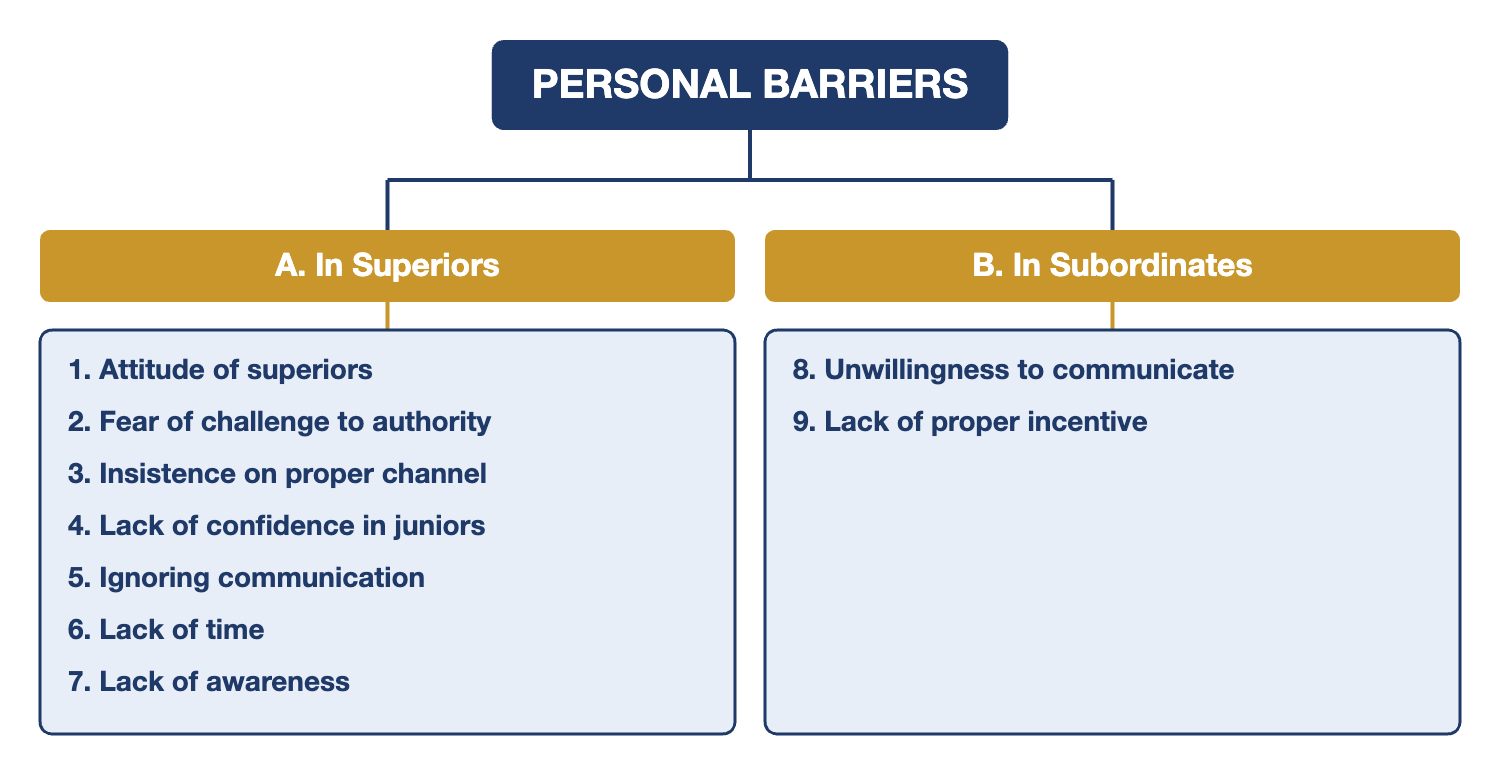
In an office, these barriers are studied in two groups. Some come from superiors (bosses, seniors). Some come from
subordinates (juniors, workers). So textbooks divide them into A. Barriers in Superiors and B. Barriers in Subordinates.
In one line
Personal barriers are the blocks in communication that come from the attitude and behaviour of the sender or the receiver.
Definitions of Personal Barriers
1. “These barriers are related to the personal factors of both sender and receiver.” – Oswal Publishers, Business Studies Notes, chapter “Directing”
2. “The flow of Communication has various internal factors to the two parties – Sender and Receiver – which may act as barriers to effective communication.” – Dr. Shazia Rahman, e-content, Patna Women’s College
Simple definition: Personal barriers are problems inside the sender or receiver that stop a message from moving freely.
Types of Personal Barriers to Communication
Personal barriers are divided into two groups. Learn them under these two heads.
A. Barriers in Superiors
The role of superiors is very important. These seven barriers come from the side of the boss.
1. Attitude of Superiors
- The attitude of the boss decides how messages move in the office.
- If he is rude or proud, juniors stop talking to him.
- A bad attitude can also block messages going down to the staff.
Example: A branch manager in Pune shouts at every question. Soon his staff stop asking, even when they are not sure.
Remember: A closed mind makes a closed office.
2. Fear of Challenge to Authority
- Authority means the power to give orders.
- Some bosses fear that a message may show their weakness.
- So they hide or hold back such information.
Example: A sales head hides a customer complaint about his own mistake. The director comes to know only after the customer leaves.
Remember: Fear of losing power hides the truth.
3. Insistence on Proper Channel
- Some bosses want every message to pass through the fixed chain of command.
- They do not like anyone going around them, even when it is urgent.
- This makes messages slow and stops new ideas.
Example: A clerk in an Andheri office cannot meet the senior manager directly. Her idea passes through two officers and reaches him after a month.
Remember: Too much “proper channel” makes messages late.
4. Lack of Confidence in Subordinates
- Some bosses feel that juniors are not capable.
- So they do not ask for their advice or share plans with them.
- Juniors feel left out and stop giving ideas.
Example: A college principal plans the annual day without asking any teacher. Many useful ideas never come up.
Remember: No trust, no talk.
5. Ignoring Communication
- Some bosses ignore messages from juniors on purpose.
- They do not reply to emails, notes or requests.
- Juniors feel their words have no value.
Example: Ravi sends three emails about a broken machine. The manager does not reply. Ravi stops reporting problems.
Remember: An ignored message is a lost message.
6. Lack of Time
- Busy bosses have very little time to talk with juniors.
- Short, hurried talks leave out important details.
- Juniors may feel the boss is not interested.
Example: A bank manager gives instructions while walking to a meeting. The cashier understands only half of them.
Remember: A busy boss must still make time to listen.
7. Lack of Awareness
- Some bosses do not know how important communication is.
- They do not see how it helps to get work done.
- So they do not plan or share messages properly.
Example: A shop owner tells the new prices only to the counter staff. The delivery boys keep telling customers the old prices.
Remember: Know the value of a message before you send it.
B. Barriers in Subordinates
Upward communication works only when juniors speak up. These two barriers come from the side of the juniors.
8. Unwillingness to Communicate
- Juniors may not want to share problems or bad news with the boss.
- They fear it may harm their image or their job.
- So upward communication (from juniors to seniors) becomes weak.
Example: A trainee breaks the office printer but tells no one. The manager finds out on the day of an urgent print job.
Remember: Fear makes juniors silent.
9. Lack of Proper Incentive
- Incentive means a reward, such as praise, a prize or extra pay.
- If good ideas get no reward, juniors stop giving them.
- Sometimes the boss even takes the credit for the idea.
Example: Priya suggests a way to cut paper use. Her manager presents it as his own idea. Priya never gives a suggestion again.
Remember: No reward, no suggestion.
Memory tip
Superiors (7): “A
Fat Parrot Can’t
Ignore Tasty
Apples”
Attitude – Fear of authority – Proper channel – Confidence (lack of) – Ignoring – Time – Awareness
Subordinates (2): “Upset
Interns” = Unwillingness – Incentive (lack of)
How to Overcome Personal Barriers
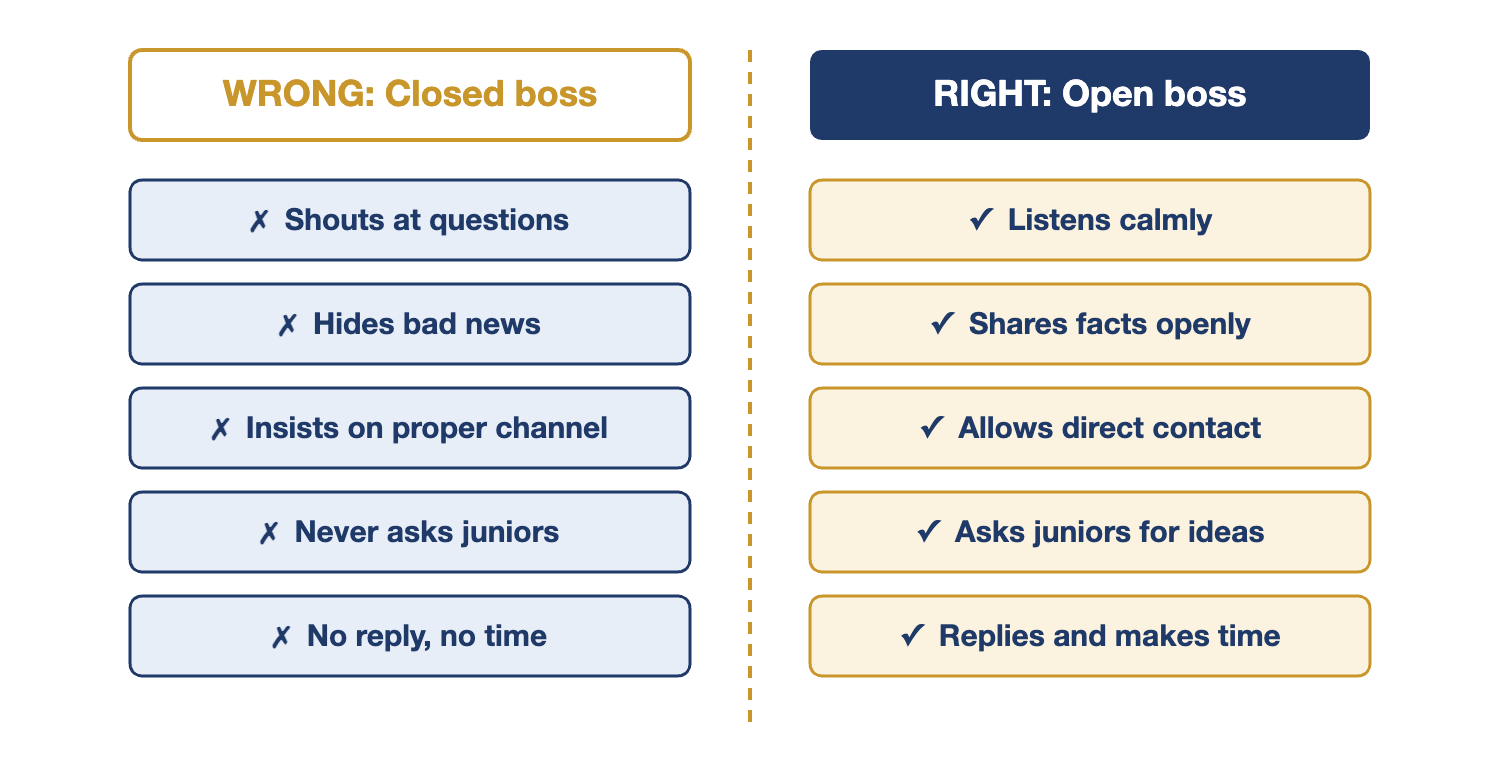
- Open-door policy: Juniors can meet the boss freely, without fear.
- Trust juniors: Ask for their ideas and share plans with them.
- Give rewards: Praise or reward every useful suggestion, and give credit to the right person.
- Make time: Fix a short time every week only to listen to the staff.
- Reply to every message: Even a one-line reply shows respect. Read more on feedback in communication.
- Allow direct contact: In urgent cases, juniors may skip the chain of command.
- No punishment for honest news: A junior who reports a mistake should not be punished for telling the truth.
- Training: Teach both seniors and juniors good communication habits.

Quick Revision Table
| No. | Point | Meaning in one line | Remedy |
|---|---|---|---|
| 1 | Attitude of superiors | Rude or proud boss blocks talk | Be polite and open |
| 2 | Fear of challenge to authority | Boss hides news that shows his weakness | Share facts honestly |
| 3 | Insistence on proper channel | Every message must go step by step | Allow direct contact when urgent |
| 4 | Lack of confidence in subordinates | Boss does not trust juniors | Ask juniors for ideas |
| 5 | Ignoring communication | Boss does not reply to juniors | Reply to every message |
| 6 | Lack of time | Boss is too busy to listen | Fix time to listen |
| 7 | Lack of awareness | Boss does not know the value of communication | Training for managers |
| 8 | Unwillingness to communicate | Junior fears speaking up | No punishment for honest news |
| 9 | Lack of proper incentive | No reward for good ideas | Praise and reward suggestions |
How to Write This Answer in the Exam
1. Begin with a two-line introduction: communication must flow freely, and barriers stop it.
2. Give the meaning of personal barriers and one definition.
3. Write the two heads clearly: A. Barriers in Superiors and B. Barriers in Subordinates.
4. Write each point as an underlined sub-heading, with two lines and one example.
5. Draw Figure 1 (the two-branch diagram). It takes one minute and looks neat.
6. End with three or four remedies and a short conclusion.
Model Answer (8–10 Marks)
Q. What are personal barriers to communication? Explain them with examples.
Introduction: Communication is the exchange of ideas between two or more persons. It is successful only when the message moves freely. Anything that stops it is a barrier.
Meaning: Personal barriers are the barriers that come from the attitude and behaviour of the sender or the receiver. According to Oswal Publishers’ Business Studies notes, “These barriers are related to the personal factors of both sender and receiver.” They are of two types.
A. Barriers in Superiors
1. Attitude of superiors: A rude or proud boss makes juniors stop talking. E.g. staff stop asking doubts when the manager shouts.
2. Fear of challenge to authority: The boss hides news that may show his weakness. E.g. a sales head hides a complaint about his own mistake.
3. Insistence on proper channel: Every message must go through the chain of command, so it gets late. E.g. a clerk’s idea reaches the senior manager after a month.
4. Lack of confidence in subordinates: The boss does not trust juniors, so he does not ask for their views. E.g. the principal plans an event without asking teachers.
5. Ignoring communication: The boss does not reply to juniors. E.g. a worker stops reporting faults after his emails get no reply.
6. Lack of time: A busy boss gives hurried instructions. E.g. a cashier understands only half the orders.
7. Lack of awareness: The boss does not know the value of communication. E.g. new prices are told only to some staff.
B. Barriers in Subordinates
8. Unwillingness to communicate: Juniors fear that bad news may harm them, so they keep quiet. E.g. a trainee hides a broken printer.
9. Lack of proper incentive: Juniors get no reward for ideas, so they stop giving them. E.g. an employee stops suggesting after the boss takes the credit.
Conclusion: Personal barriers can be removed by an open-door policy, trust, rewards and time to listen. When both seniors and juniors are open, communication in the office becomes smooth.
Short Note (4–5 Marks)
Personal Barriers to Communication: Personal barriers come from the attitude and behaviour of the sender or receiver. They are of two types. Barriers in superiors are: attitude of superiors, fear of challenge to authority, insistence on proper channel, lack of confidence in subordinates, ignoring communication, lack of time and lack of awareness. Barriers in subordinates are: unwillingness to communicate and lack of proper incentive. For example, a junior may not share a good idea because he gets no reward for it. These barriers can be removed by an open-door policy, trust in juniors, rewards for suggestions and regular time to listen.
Important Exam Questions
These are model questions for practice.
Long Answer Questions
1. What are personal barriers to communication? Explain them with examples.
2. Explain the barriers in superiors and barriers in subordinates.
3. Explain any five personal barriers. How can they be overcome?
Short Notes
1. Fear of challenge to authority
2. Insistence on proper channel
3. Lack of proper incentive
4. Unwillingness to communicate
Fill in the Blanks
1. Personal barriers come from the ______ and the receiver. (sender)
2. A boss who hides news because he fears losing power shows fear of challenge to ______. (authority)
3. When juniors get no reward for ideas, it is called lack of proper ______. (incentive)
4. Unwillingness to communicate mainly blocks ______ communication. (upward)
5. Personal barriers are divided into barriers in superiors and barriers in ______. (subordinates)
Conclusion
Personal barriers come from people, not from machines. A boss who listens and a junior who speaks up can remove most of them. Learn the two heads and nine points with one example each, and this answer becomes easy. Also revise semantic barriers and physical barriers for the full chapter.
FAQs on Personal Barriers to Communication
Q. What are personal barriers to communication?
A. They are blocks in communication that come from the attitude and behaviour of the sender or receiver.
Q. What are the two types of personal barriers?
A. Barriers in superiors and barriers in subordinates.
Q. Are personal barriers and psychological barriers the same?
A. They are close, and some books study them together. Psychological barriers are about the state of mind, like anger or poor attention. Personal barriers are about the behaviour of seniors and juniors at work.
Q. Which personal barriers block upward communication?
A. Unwillingness to communicate and lack of proper incentive. Both stop juniors from speaking to seniors.
Q. How can a manager remove personal barriers?
A. By keeping an open door, trusting juniors, rewarding ideas and making time to listen.