

Introduction
In an office, messages move all the time. The manager gives orders. Staff send reports. Notices go to everyone.
Sometimes a message gets late, gets changed or does not reach at all. Many times the mistake is not of the sender or the receiver. The mistake is in the office system itself: its rules, its levels and its facilities.
Such problems are called organisational barriers to communication. This is an important topic for B.Com and BMS exams. In these notes, you will learn the meaning, definitions, six barriers with examples, remedies and a ready exam answer.
Meaning of Organisational Barriers to Communication
A barrier means a block or an obstacle (read our full notes on barriers to communication). It stops a message, delays it or changes its meaning.
Organisational barriers are the barriers that come from the organisation itself. They come from its policies, rules, levels of authority, facilities and channels.
In one line
When the system of an office blocks, delays or changes a message, it is called an organisational barrier.
Definitions
1. e-PG Pathshala (UGC): “Communication barriers are the obstacles and problems involved in effective exchange of ideas or thoughts.”
2. DSPMU Ranchi (e-content): “The factors internal to the organization which adversely affect the flow of communication are called barriers.”
Simple definition: Organisational barriers are problems in an organisation’s rules, policies, structure, status system, facilities and channels that block or delay the flow of messages.
Six Main Organisational Barriers to Communication
Figure 1 shows all six barriers at a glance.

1. Organisational Policy
- Every organisation has a policy about how messages should flow.
- Some policies say every message must be in writing, or must go through the proper channel.
- Because of this, even a small or urgent message takes a long time.
Example: An office policy says every request must go in writing through the section head. An urgent request for a printer cartridge takes four days to reach the store.
Remember: A strict policy can slow down the message.
2. Rules and Regulations
- Rules decide what to say, to whom, and in which form.
- Too many rules mean the message waits for signatures, stamps and approvals.
- People follow the procedure and forget the purpose of the message.
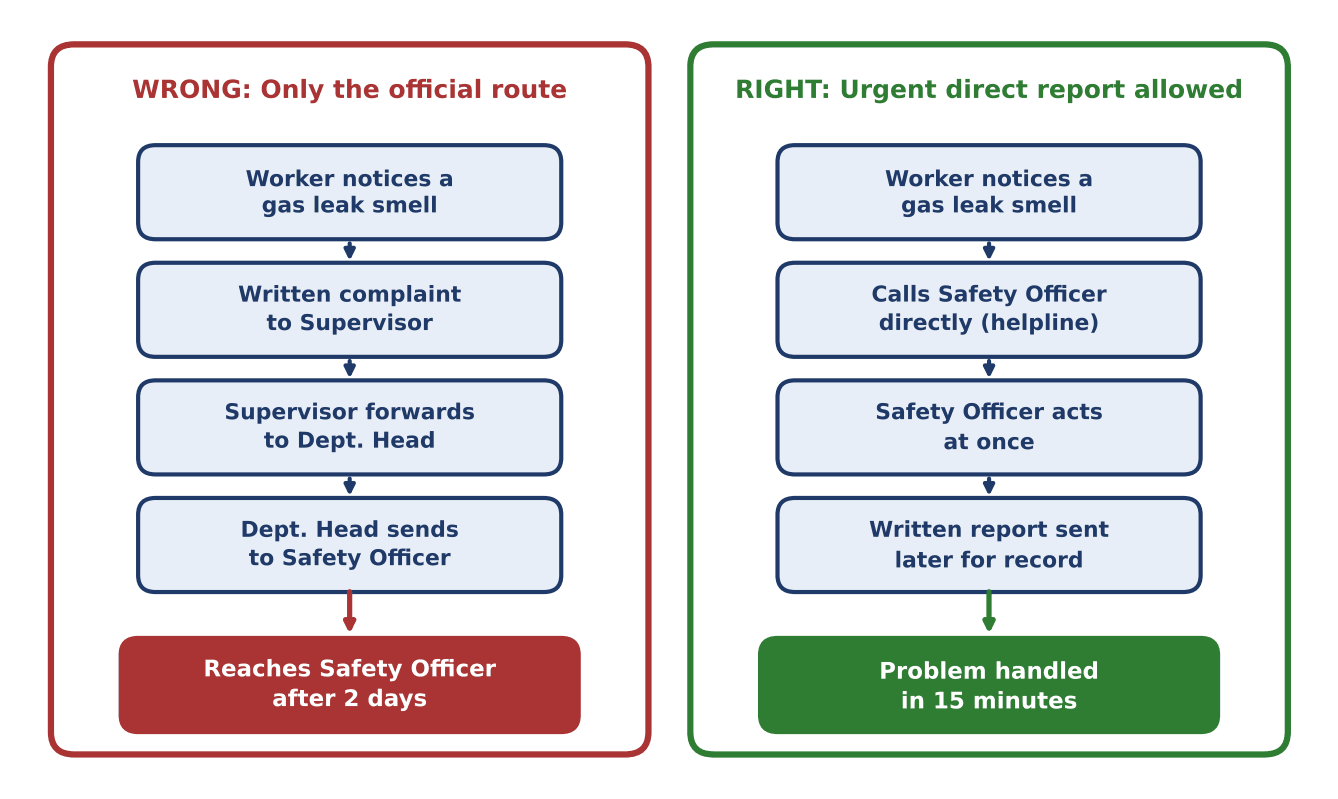
Example: In a factory, a worker notices a gas leak. As per the rule, he writes a complaint to his supervisor. It reaches the Safety Officer after two days (see Figure 3).
Remember: Rigid rules cause delay.
3. Status Differences
- In every organisation there are seniors and juniors.
- Juniors are often afraid to speak openly to seniors. They hide bad news.
- Seniors sometimes do not listen to juniors or do not trust their information.
Example: A bank clerk notices a mistake in the manager’s report but keeps quiet out of fear.
Remember: Fear and ego block upward communication.
4. Complex Organisational Structure (Too Many Levels)
- In a big organisation, a message passes through many levels of management.
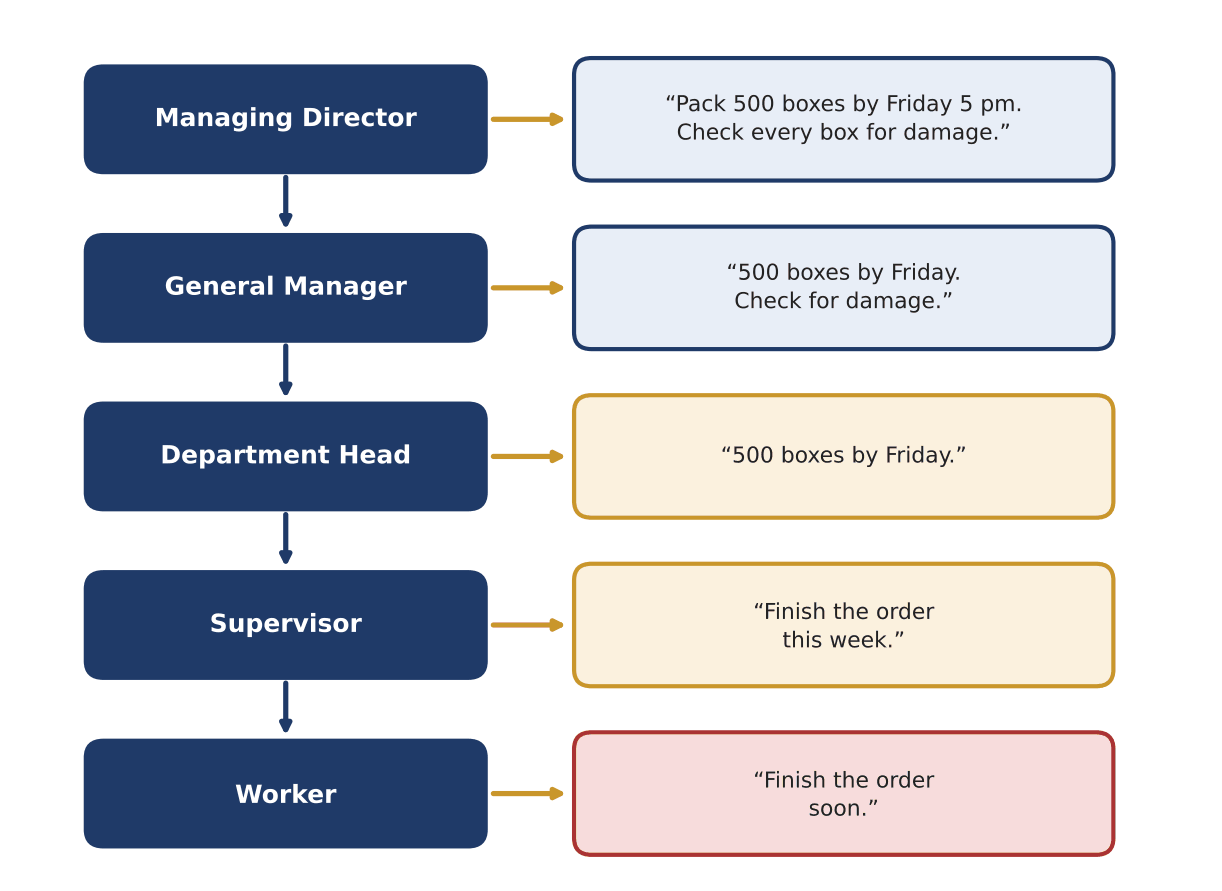
- At every level, some part of the message is dropped or changed. This is called filtering or distortion.
- More levels also mean more delay. (See also: channels of communication.)
Example: The Managing Director says, “Pack 500 boxes by Friday 5 pm and check every box for damage.” By the time it reaches the worker, it becomes “Finish the order soon” (see Figure 2).
Remember: More levels = more delay and more distortion.
5. Lack of Organisational Facilities
- Good communication needs facilities like telephone, internet, email, notice boards, meeting rooms and suggestion boxes.
- If these are missing or not working, messages are delayed or lost.
- Lack of regular meetings is also a barrier.
Example: A branch has poor internet, so the head office circular reaches the staff two days late.
Remember: No proper facilities, no smooth communication.
6. Wrong Choice of Channel
- Every message needs the right medium: oral, written, email, meeting, notice, etc.
- A long instruction given orally may be forgotten. An urgent warning sent by post may come too late.
- A sensitive message on a notice board may hurt people.
Example: A company announces staff transfers only in a WhatsApp group. Employees feel hurt because no one explained the reasons in person.
Remember: Right message + wrong channel = failed communication.
Memory tip
Remember the six barriers as P R S C F C:
Policy – Rules – Status – Complex structure – Facilities – Channel
Sentence: “Please Respect Senior Colleagues For Clarity.”
How to Overcome Organisational Barriers to Communication
- Flexible policy: Allow urgent messages to go directly to the right person.
- Fewer rules: Remove unnecessary approvals and signatures.
- Open-door policy: Seniors should listen to juniors and welcome feedback.
- Fewer levels: Keep the structure simple and flat where possible.
- Good facilities: Provide phone, internet, email, notice boards and suggestion boxes.
- Right channel: Choose the medium as per the message – urgent, detailed or sensitive.
Quick Revision Table: Organisational Barriers to Communication
| No. | Barrier | Meaning in one line | Remedy |
|---|---|---|---|
| 1 | Organisational policy | Strict policy forces a long route | Flexible policy |
| 2 | Rules and regulations | Too many approvals cause delay | Remove extra rules |
| 3 | Status differences | Juniors fear, seniors don’t listen | Open-door policy |
| 4 | Complex structure | Many levels change the message | Fewer levels |
| 5 | Lack of facilities | No phone, net, meetings | Provide facilities |
| 6 | Wrong channel | Wrong medium for the message | Choose right medium |
How to Write This Answer in the Exam
1. Start with 2–3 lines of introduction.
2. Write the meaning and one definition.
3. Write the six barriers as headings. Underline each heading.
4. Under each heading, write 3–4 lines and one short example.
5. Draw Figure 1 (a simple circle chart) if time allows.
6. End with 2–3 lines of conclusion and remedies.
Model Answer (8–10 Marks)
Q. What are organisational barriers to communication? Explain with examples.
Introduction: Communication is the lifeblood of an organisation. But sometimes the organisation itself creates problems in the flow of messages. These are called organisational barriers.
Meaning: Organisational barriers are obstacles that arise from the policies, rules, structure, status system, facilities and channels of an organisation. They block, delay or distort messages.
The main organisational barriers are:
1. Organisational policy: A policy that all messages must be in writing or through proper channel causes delay. E.g. an urgent request takes four days.
2. Rules and regulations: Too many rules and approvals slow down messages. E.g. a safety complaint reaches the officer after two days.
3. Status differences: Juniors hesitate to speak to seniors; seniors ignore juniors. E.g. a clerk hides a mistake in the report.
4. Complex structure: Many levels cause delay and distortion of the message. E.g. a clear order becomes “finish soon” at the bottom.
5. Lack of facilities: Absence of phone, internet, meetings or suggestion boxes delays messages.
6. Wrong choice of channel: Using the wrong medium spoils the message. E.g. transfers announced only on WhatsApp.
Conclusion: Organisational barriers can be reduced by a flexible policy, fewer rules, an open-door policy, fewer levels, good facilities and the right choice of channel. Then messages reach on time and work is done smoothly.
Short Note (4–5 Marks)
Organisational barriers are obstacles in communication that arise from the organisation itself. Strict policies and too many rules delay messages. Status differences make juniors afraid to speak and seniors unwilling to listen. A complex structure with many levels causes delay and distortion. Lack of facilities like phone, internet and meetings, and the wrong choice of channel also spoil communication. These barriers can be removed through flexible rules, open communication, fewer levels and proper facilities.
Important Exam Questions
Long answer (8–10 marks)
1. Explain organisational barriers to communication with examples.
2. What are barriers to communication? Discuss organisational barriers in detail.
3. How can organisational barriers to communication be overcome?
Short notes (4–5 marks)
- Organisational barriers
- Status as a barrier to communication
- Complex structure and distortion of messages
Fill in the blanks
- When a message changes as it passes through many levels, it is called ________. (distortion / filtering)
- Fear of seniors is an example of ________ barrier. (status)
- Too many approvals and signatures are a barrier of ________. (rules and regulations)
Conclusion
Organisational barriers come from the office system, not from people. Strict policies, too many rules, status gaps, many levels, poor facilities and wrong channels all block the flow of messages. If an organisation keeps its system simple and open, communication becomes fast and clear.
Frequently Asked Questions
1. What are organisational barriers in simple words?
They are problems in the office system, like strict rules, many levels and poor facilities, that block or delay messages.
2. How many organisational barriers are there?
Six main ones: policy, rules, status, complex structure, lack of facilities and wrong channel.
3. What is distortion of a message?
When a message changes as it passes from one level to another, it is called distortion.
4. How are organisational barriers different from physical barriers?
Organisational barriers come from the system (rules, levels). Physical barriers come from surroundings (noise, distance, faulty equipment). Feelings and attitudes cause psychological barriers.
5. How can organisational barriers be removed?
By a flexible policy, fewer rules, an open-door policy, fewer levels, good facilities and the right channel.