
Introduction
You already know the barriers that spoil a message. Noise, hard words, fear and anger are some of them. Now the main exam question is:
how to overcome barriers to communication?
Think of a college office. The clerk calls out a notice in a noisy corridor. Half the students do not hear it. The next day, he puts it on the notice board and the class WhatsApp group. Everyone gets it. That is overcoming a barrier.
In these notes you will learn the meaning, two definitions, 8 ways to overcome barriers with examples, a revision table and a ready exam answer. To revise the barriers first, read our Barriers to Communication notes.
Meaning of Overcoming Barriers to Communication
A barrier is anything that blocks or spoils a message. Overcoming a barrier means removing it or making it smaller. Then the message reaches the receiver in the same sense in which it was sent.
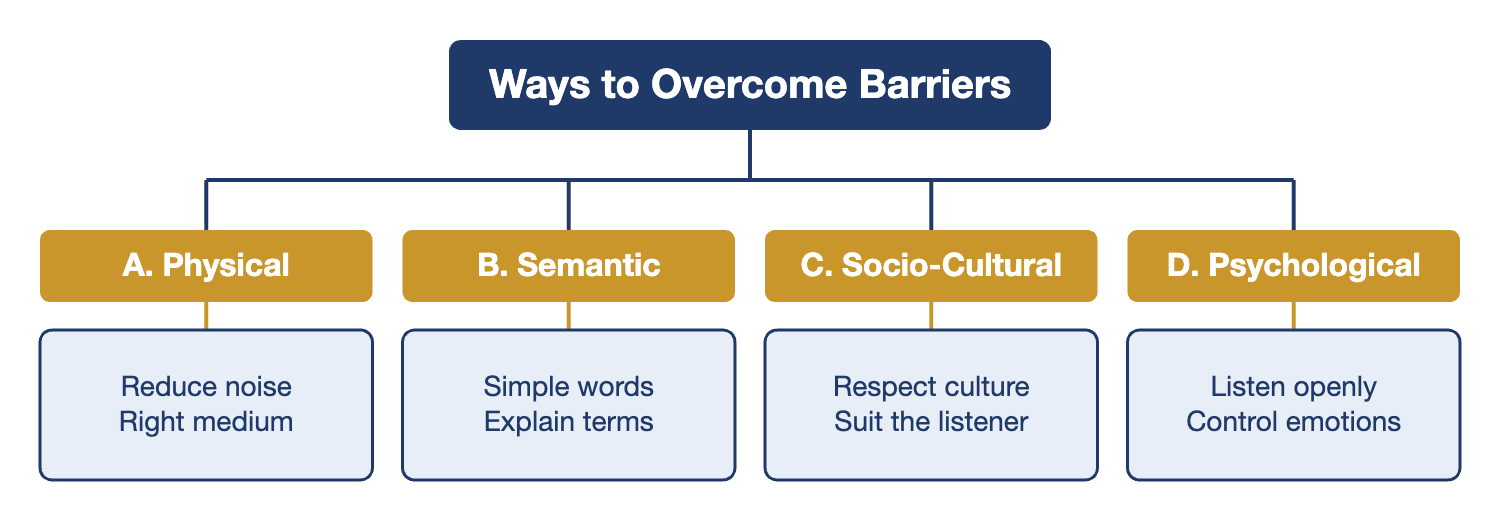
Your syllabus groups barriers into four types: physical, semantic (language), socio-cultural and psychological. So we learn the ways to overcome them under the same four heads. A few general ways work for all barriers.
In one line
Overcoming barriers to communication means removing or reducing the blocks so that the receiver gets the message correctly.
Definitions of Barriers to Communication
1. “A barrier means a hurdle, a disturbance, or an obstacle, in fact, anything which interferes with or blocks the smooth flow of communication.” – University of Mumbai, F.Y.B.M.S. Business Communication-I study material
2. “Barriers refer to obstacles or hindrances that prevent movement, flow and access of information in or outside of an organization.” –
TutorialsPoint, Effective Communication
Simple definition: To overcome barriers means to clear the road, so that the message moves smoothly from sender to receiver.
Ways to Overcome Barriers to Communication
Learn these 8 ways under the four syllabus heads.
A. Overcoming Physical (Environmental) Barriers
1. Reduce Noise and Distance
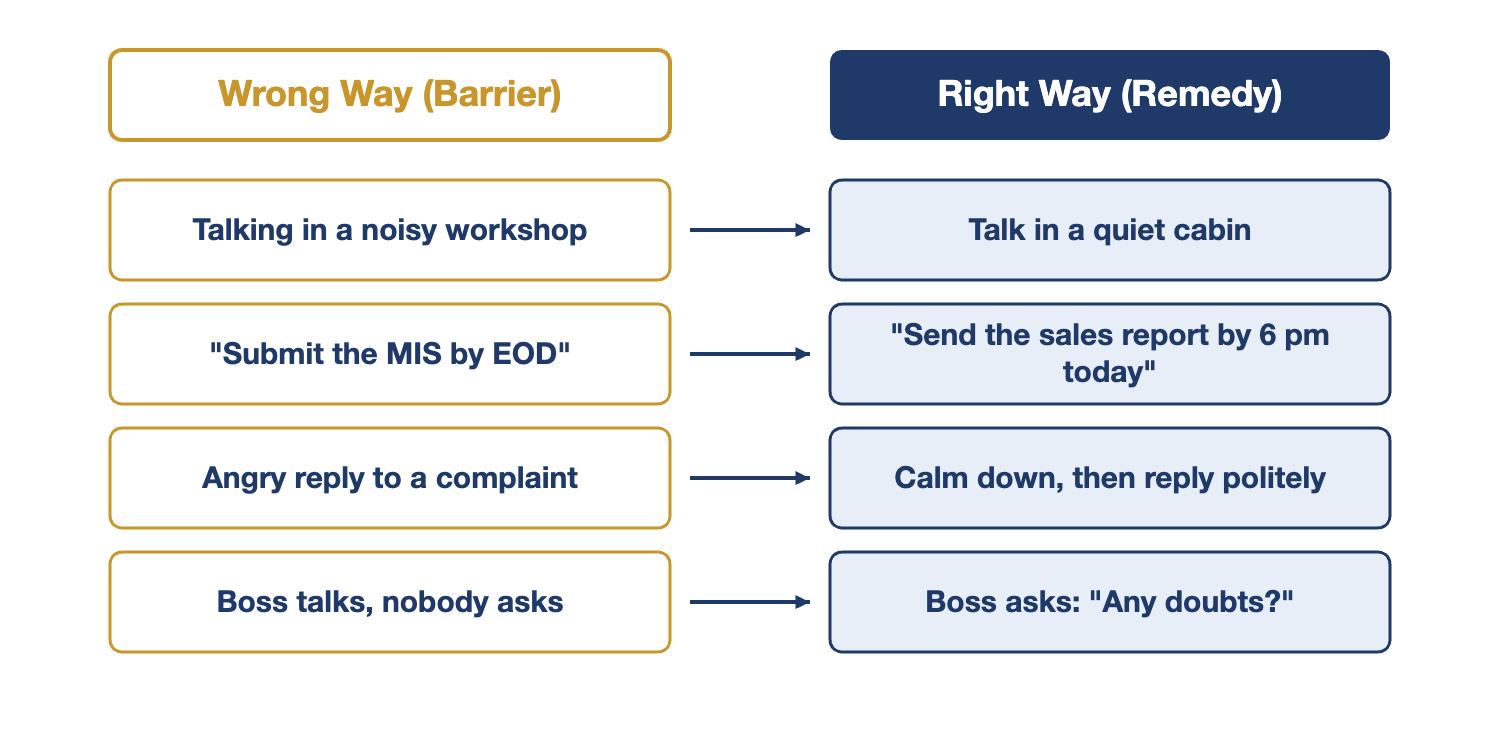
- Talk in a quiet place, away from machines and traffic.
- Keep doors closed during meetings and phone calls.
- Use a mike, a phone or email when people are far away.
Example: A supervisor in a Thane factory calls workers to a quiet cabin to explain safety rules. He does not shout over the machines.
Remember: A quiet place carries a clear message.
2. Use the Right Medium and Good Equipment
- Choose the medium that suits the message: talk, letter, email or notice.
- Check the phone, mike, projector or internet before you start.
- Keep a second way ready, like a printed copy.
Example: Before an online class, a teacher checks her internet and mike. She also shares the notes on email in case the link fails.
Remember: Check the tool before you use it.
B. Overcoming Semantic (Language) Barriers
Semantic means “related to the meaning of words”. For more on this, see our Semantic Barriers notes.
3. Use Simple and Clear Language
- Use short sentences and common words.
- Use words that the receiver knows well.
- Give one clear meaning. Avoid words with two meanings.
Example: A bank officer tells a farmer, “Pay Rs 2,000 every month for one year.” He does not say, “Your EMI tenure is twelve months.”
Remember: Simple words travel fast.
4. Avoid Jargon and Explain Terms
- Jargon means special words used only by one group, like doctors or engineers.
- If you must use a technical word, explain it the first time.
- Ask the receiver if anything is not clear.
Example: A manager says, “Send the MIS by EOD.” The new trainee looks lost. Next time he says, “Send the sales report by 6 pm today.”
Remember: Explain every new word once.
C. Overcoming Socio-Cultural Barriers
5. Respect Cultural Differences
- Learn the customs, festivals and manners of the people you work with.
- Do not joke about anyone’s religion, region, food or dress.
- Use polite greetings that suit the person.
Example: A Mumbai company has a client meeting in Chennai. The team learns a few local greetings and avoids the client’s festival days.
Remember: Respect builds a bridge between cultures.
6. Adapt the Message to the Receiver
- Keep in mind the age, education and position of the receiver.
- Use the language the receiver is most comfortable in.
- Give examples from the receiver’s own life.
Example: A sales executive explains a mobile plan in Marathi to an elderly customer in Nashik. With a young student, he uses English.
Remember: Speak the receiver’s language.
D. Overcoming Psychological Barriers
Psychological barriers come from the mind: fear, anger, worry or a closed mind. Revise them in our Psychological Barriers notes.
7. Listen with Attention and an Open Mind
- Give full attention to the speaker. Keep the phone away.
- Do not judge the speaker before he finishes.
- Do not let your old opinion about a person block the message.
Example: Meena, a new clerk, suggests a faster filing system. The office head listens to her fully before he decides.
Remember: Listen first, judge later.
8. Control Emotions and Build Trust
- Do not speak or reply when you are angry or upset.
- Wait, calm down, then reply politely.
- Be honest and keep your word, so people trust you.
Example: Rahul gets an angry email from a customer. He waits for an hour and then writes a calm, polite reply.
Remember: Cool mind, clear message.
Memory tip
Remember the four heads as “Please Speak Simply and Patiently”:
Physical – Semantic –
Socio-cultural – Psychological
Two ways under each head = 8 ways.
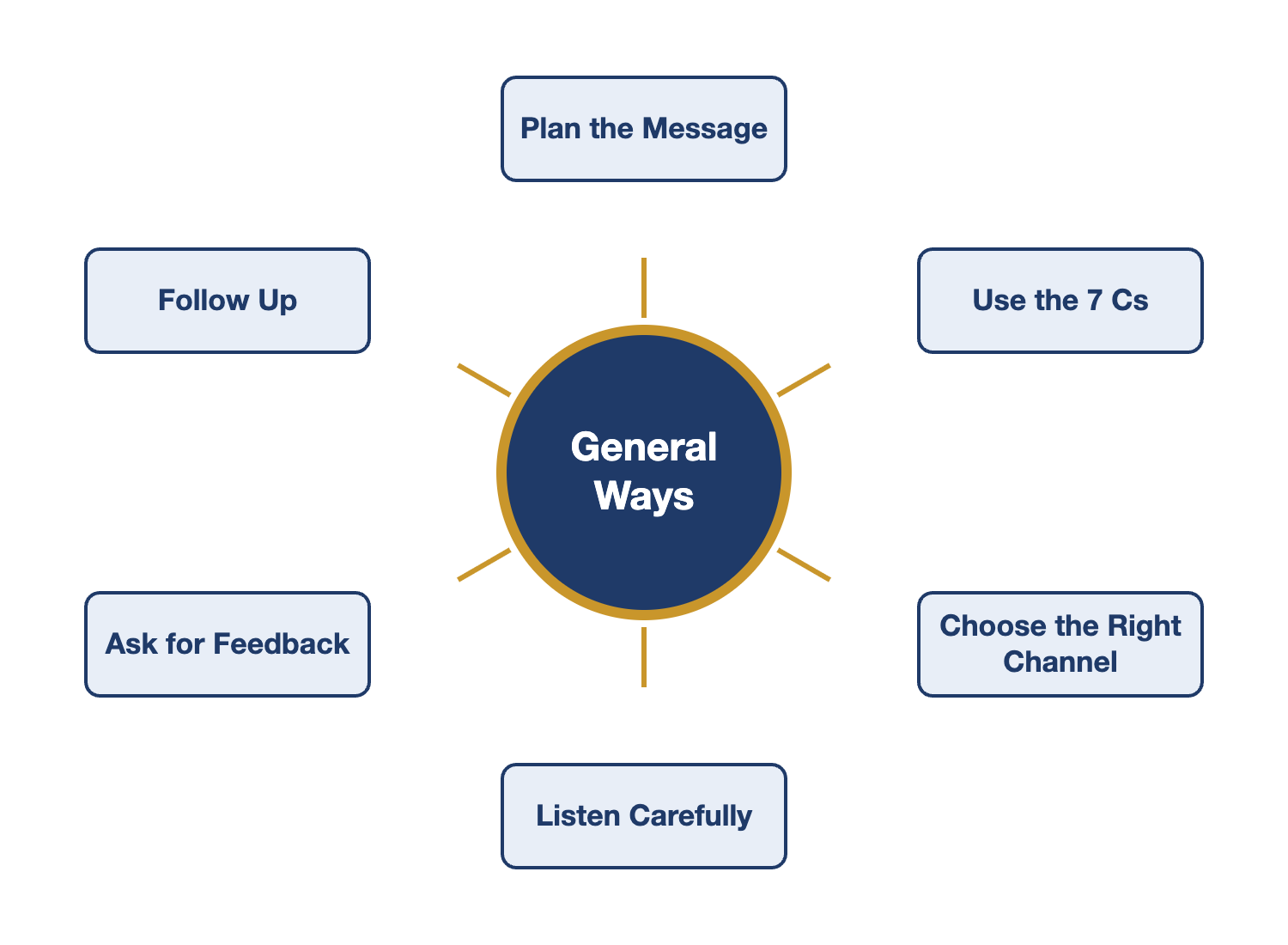
General Ways that Work for All Barriers
These steps help you overcome every type of barrier.
- Plan the message: Think before you speak or write. Know your purpose and your receiver.
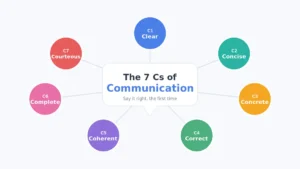
- Follow the 7 Cs: Make the message clear, concise, complete, correct, concrete, courteous and considerate.
- Choose the right channel: Use a letter for formal matters and a call for urgent ones.
- Ask for feedback: Ask, “Is it clear?” Feedback shows if the message was understood. Read more in our Feedback in Communication notes.
- Keep two-way communication: Let juniors speak freely to seniors, not only seniors to juniors.
- Follow up: Check later that the work was done as planned.
Quick Revision Table
| No. | Way | Meaning in one line | Example |
|---|---|---|---|
| 1 | Reduce noise and distance | Talk in a quiet place; use phone or email for distance | Safety talk in a quiet cabin |
| 2 | Right medium and equipment | Pick a suitable medium and check the tools | Teacher checks mike before online class |
| 3 | Simple language | Short sentences and common words | “Pay Rs 2,000 every month” |
| 4 | Avoid jargon | Explain special words the first time | “Sales report by 6 pm” not “MIS by EOD” |
| 5 | Respect culture | Respect customs, festivals and manners | Team learns local greetings |
| 6 | Suit the receiver | Match age, education and language | Plan explained in Marathi |
| 7 | Listen openly | Full attention, no early judgement | Head listens to new clerk |
| 8 | Control emotions | Calm down before you reply | Polite reply to angry email |
How to Write This Answer in the Exam
1. Start with a two-line introduction: what a barrier is and why we must overcome it.
2. Write the meaning in your own words and one definition.
3. Write the four heads: A. Physical, B. Semantic, C. Socio-Cultural, D. Psychological.
4. Under each head, write two ways with sub-headings. Give one line of explanation and one short example for each.
5. Add the general ways (feedback, 7 Cs, right channel) in a few lines.
6. End with a two-line conclusion. Draw Figure 1 as a neat diagram if time allows.
Model Answer (8–10 Marks)
Q. What are barriers to communication? How can they be overcome?
Introduction: Communication is successful only when the receiver understands the message in the same sense as the sender. Barriers spoil this flow. So every business must know the ways to overcome them.
Meaning: A barrier is anything that blocks or spoils a message. Overcoming barriers means removing or reducing these blocks so that the message reaches the receiver correctly.
Definition: “A barrier means a hurdle, a disturbance, or an obstacle, in fact, anything which interferes with or blocks the smooth flow of communication.”
Ways to overcome barriers:
A. Physical barriers
1. Reduce noise and distance: Talk in a quiet place; use phone or email for distant people. E.g. a supervisor explains rules in a quiet cabin.
2. Right medium and equipment: Choose a suitable medium and check the tools before use. E.g. a teacher checks her mike before an online class.
B. Semantic barriers
1. Simple language: Use short sentences and common words. E.g. “Pay Rs 2,000 every month” instead of “EMI tenure”.
2. Avoid jargon: Explain technical words the first time. E.g. “sales report by 6 pm” instead of “MIS by EOD”.
C. Socio-cultural barriers
1. Respect culture: Respect the customs and manners of others. E.g. a team learns the greetings of a client from another state.
2. Suit the receiver: Match the message to the age, education and language of the receiver. E.g. a plan explained in Marathi to an elderly customer.
D. Psychological barriers
1. Listen with an open mind: Give full attention and do not judge early. E.g. an office head listens fully to a new clerk’s idea.
2. Control emotions: Calm down before replying. E.g. a polite reply to an angry customer email.
General ways: Plan the message, follow the 7 Cs, choose the right channel, ask for feedback and follow up.
Conclusion: Barriers cannot be removed fully, but they can be reduced a lot. A sender who plans the message, uses simple words, respects the receiver and asks for feedback will communicate well.
Short Note (4–5 Marks)
Short note: Ways to overcome barriers to communication
A barrier is anything that blocks or spoils a message. Barriers can be overcome in these ways. Physical barriers are reduced by talking in a quiet place and using the right medium and working equipment. Semantic barriers are reduced by using simple words and explaining technical terms.
Socio-cultural barriers are reduced by respecting the customs of others and suiting the message to the receiver.
Psychological barriers are reduced by listening with an open mind and controlling emotions. In addition, the sender should plan the message, follow the 7 Cs and ask for feedback. In this way the message reaches the receiver correctly.
Important Exam Questions
These are model questions for practice.
Long answer questions
1. What are barriers to communication? Explain the ways to overcome them.
2. Explain the ways to overcome physical and semantic barriers with examples.
3. How can socio-cultural and psychological barriers be overcome? Explain.
Short notes
1. Ways to overcome semantic barriers
2. Role of feedback in overcoming barriers
3. Overcoming psychological barriers
Fill in the blanks
1. Special words used by one group of people are called …………. (jargon)
2. Semantic barriers are related to …………. (language / meaning of words)
3. Asking “Is it clear?” is a way of getting …………. (feedback)
4. Noise is an example of a ………… barrier. (physical)
5. Before replying to an angry email, you should …………. (calm down)
Conclusion
Barriers will always be there in an office, but they can be made small. Use a quiet place and the right medium. Use simple words. Respect people. Keep a calm and open mind. Then ask for feedback. If you write these points under the four heads, your exam answer will be complete.
FAQs
Q. What is the easiest way to overcome barriers to communication?
Ans. Use simple language and ask for feedback. These two steps solve most problems.
Q. How many types of barriers are in the Mumbai University syllabus?
Ans. Four: physical (environmental), semantic (language), socio-cultural and psychological.
Q. How does feedback help to overcome barriers?
Ans. Feedback shows whether the receiver understood the message. If not, the sender can explain again.
Q. Can barriers be removed fully?
Ans. No. They can only be reduced. Good planning keeps them small.
Q. How do I overcome semantic barriers?
Ans. Use common words, avoid jargon and explain any technical term the first time.