

Introduction
Every office runs on information. A manager cannot visit every branch or count every box in the warehouse herself. She depends on other people to find the facts and tell her clearly. The document that carries those facts to her is called a report.
You have already seen reports in daily life. Your college sends a progress report to your parents. A company prints an annual report for its shareholders. After a fire or an accident, an inquiry committee writes a report. In each case, someone collects facts and passes them to someone who has to decide or act.
In business, a good report saves time and leads to good decisions. A poor report wastes time and can mislead.
In these notes you will learn the meaning and definitions of a report, the features of a good report, the types of reports, the format (parts) of a report, the steps in report writing, and a short sample report. At the end you will find exam tips, important questions and FAQs.
Meaning of Report
The word report comes from the Latin word reportare, which means “to carry back”. So a report “carries back” information to the person who asked for it.
In simple words, a report is a written (or sometimes spoken) statement of facts on a particular subject, prepared for a particular reader and purpose. It usually explains what was studied, what was found, and what should be done next.
A report is different from a letter or an essay. A letter talks to a reader about any matter. An essay shares the writer’s ideas. A report presents facts in a fixed order, often with conclusions and recommendations.
Definitions of Report
- C.A. Brown: “A report is a communication from someone who has information to someone who wants to use that information.”
- Lesikar and Pettit: A business report is “an orderly, objective communication of factual information that serves some business purpose.”
Both definitions show that a report carries facts, is meant for a particular reader, and has a clear purpose.
Simple definition: A report is an orderly, factual statement on a subject, written for a reader who needs the information to understand a situation or take a decision.
Features of a Good Report
1. Factual and Accurate
A report must be based on facts, not guesses or rumours. Figures, dates and names must be checked before the report is submitted.
Example: A sales report should say “Sales fell by 12% in September”, not “Sales were quite bad this month.”
Remember: No facts, no report.
2. Objective (Unbiased)
The writer must present the facts as they are, even if they are unpleasant. Personal likes and dislikes should not colour the report.
Example: A report on late-coming should show the real figures for all staff, not only for the people the writer dislikes.
Remember: Report the truth, not your feelings.
3. Clear and Simple
The language should be simple and easy to understand. Short sentences, common words and clear headings help the reader.
Example: Write “The lift is out of order on most days” instead of “The elevator facility has been experiencing frequent operational disruptions.”
Remember: If the reader cannot understand it, the report has failed.
4. Brief but Complete
A good report gives all the necessary facts in as few words as possible. It should not leave out anything important, and it should not add anything useless.
Example: A report on a college trip need not describe the breakfast menu, but it must give the number of students, cost, problems faced and suggestions.
Remember: Short is good; incomplete is not.
5. Well Organised
The material must follow a logical order with headings and sub-headings. The reader should be able to find any point quickly.
Example: Introduction first, then findings, then conclusions, then recommendations.
Remember: Order makes a report easy to read.
6. Purposeful and Reader-Centred
Every report is written for a purpose and for a particular reader. The writer must keep both in mind throughout.
Example: A report for the Principal on library timings should focus on student needs and staff availability, not on the history of the library.
Remember: Know why and for whom you are writing.
7. Timely
A report is useful only if it reaches the reader in time to act on it.
Example: A report on admission problems is of little use if it reaches the Principal after admissions are closed.
Remember: A late report is a lost report.
8. Proper Format and Presentation
A report should follow the accepted format, with a title, date, signature and, where useful, tables or charts. Neat presentation creates a good impression.
Example: Monthly sales figures for six branches are easier to read in a table than in a long paragraph.
Remember: Good format shows a careful writer.
These features are close to the 7 Cs of communication, especially clarity, conciseness, completeness and correctness.
Types of Reports
Reports can be classified on different bases. Figure 1 shows the main classification at a glance.
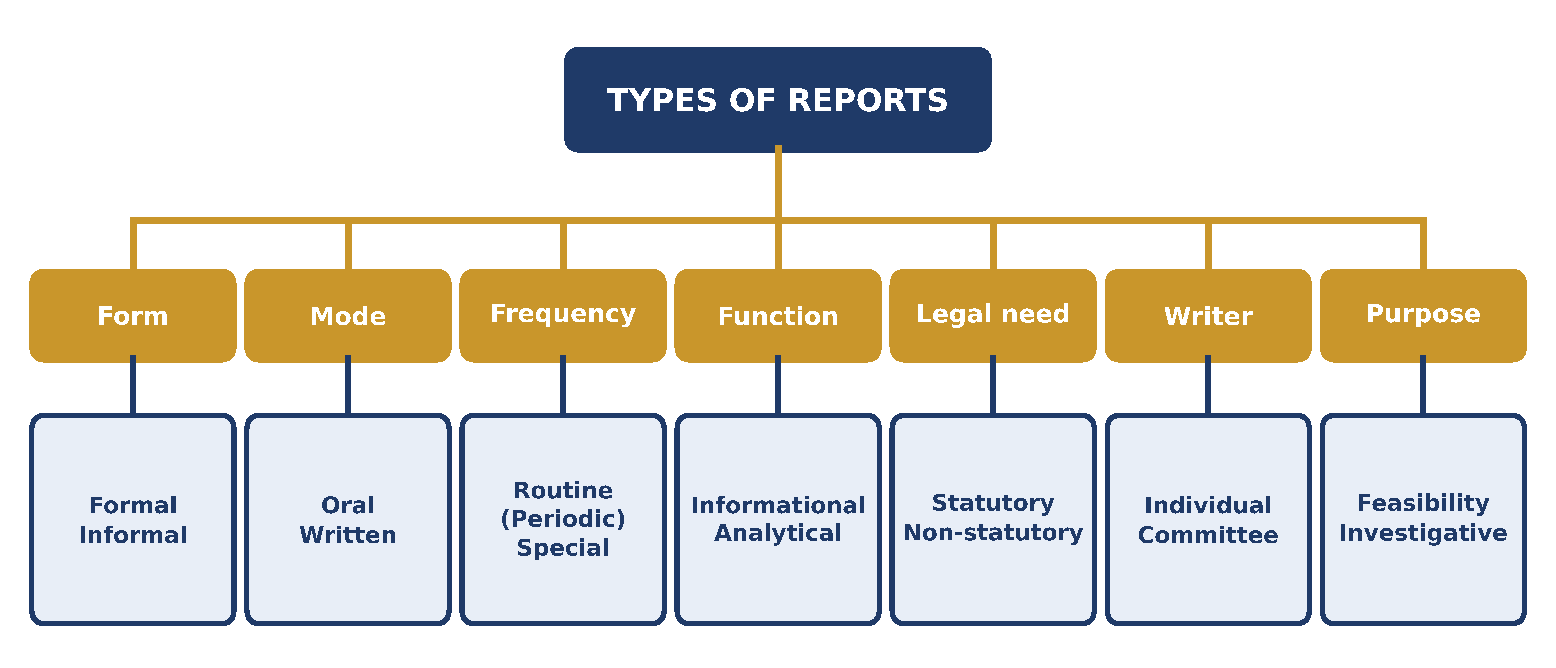
1. Formal and Informal Reports
A formal report follows a fixed format with a title page, contents, findings, conclusions and recommendations. It is usually long and written for higher authorities or outsiders. An informal report is short and written in a simple form, such as a memo, letter or email, mostly for people inside the organisation.
Example: A 30-page report on opening a new branch is formal; a half-page email to your manager about yesterday’s stock count is informal.
Remember: Formal = full format; informal = short and simple.
2. Oral and Written Reports
An oral report is given by speaking, face to face or on the phone. It is quick but leaves no permanent record. A written report is put on paper or screen. It takes more time but can be kept, checked and referred to later.
Example: A supervisor telling the manager “Machine 3 has stopped” is an oral report; the accident report filed the next day is a written report.
Remember: Oral is quick; written is permanent.
3. Routine (Periodic) and Special Reports
Routine or periodic reports are prepared at regular intervals, such as daily, weekly, monthly or yearly, in a fixed form. Special reports are prepared for one particular occasion or problem.
Example: A monthly attendance report is routine; a report on a sudden water leakage in the college building is special.
Remember: Routine = regular; special = one-time.
4. Informational and Analytical Reports
An informational report only presents facts, without analysis or suggestions. An analytical (interpretative) report presents the facts, explains what they mean, and gives conclusions and recommendations.
Example: A list of daily cash sales is informational; a report that explains why sales fell and how to improve them is analytical.
Remember: Informational tells “what”; analytical also tells “why” and “what next”.
5. Statutory and Non-statutory Reports
A statutory report is prepared because a law or rule requires it, usually in a prescribed form. A non-statutory report is not legally required; it is prepared to help management in planning and decision-making.
Example: An auditor’s report on a company’s accounts is statutory; a report on staff training needs is non-statutory.
Remember: Statutory = required by law.
6. Individual and Committee Reports
An individual report is written and signed by one person. A committee report is prepared by a group of people appointed to study a matter. It is signed by the members or the chairperson. A member who disagrees may add a note of dissent.
Example: The canteen manager’s report on monthly expenses is individual; a report by a five-member committee on the college annual day is a committee report.
Remember: One writer = individual; a group = committee.
7. Feasibility Report
A feasibility report studies whether a proposed plan or project is practical and worth doing. It looks at cost, time, resources and benefits, and recommends whether to go ahead.
Example: A report on whether the college should start a solar power system, with costs and expected savings.
Remember: Feasibility asks, “Can we do it, and should we?”
8. Investigative Report
An investigative report is written after looking into a problem, complaint or incident to find out the facts and the causes. It ends with findings and suggestions to prevent the problem in future.
Example: A report on why several students complained of food poisoning after eating in the hostel mess.
Remember: Investigative asks, “What went wrong, and why?”
Table 1: Formal vs Informal Reports
| Point | Formal report | Informal report |
|---|---|---|
| Length | Usually long | Usually short |
| Format | Fixed parts (title page, contents, findings, recommendations) | Simple memo, letter or email form |
| Language | Impersonal and formal | Simple, may be personal |
| Reader | Higher authorities, board, outsiders | Colleagues and immediate seniors |
| Example | Report on opening a new branch | Email on yesterday’s stock count |
Table 2: Individual vs Committee Reports
| Point | Individual report | Committee report |
|---|---|---|
| Prepared by | One person | A group appointed for the task |
| Signed by | The writer | Members or the chairperson |
| Language | May use “I” in informal reports | Uses “we” or impersonal language |
| Disagreement | Not applicable | A member may add a note of dissent |
| Example | Store manager’s monthly stock report | Committee report on the annual day |
Format (Structure) of a Report
A long formal report has three main sections: the beginning, the main body and the end. Short informal reports keep only the main parts. Figure 2 shows the usual order.
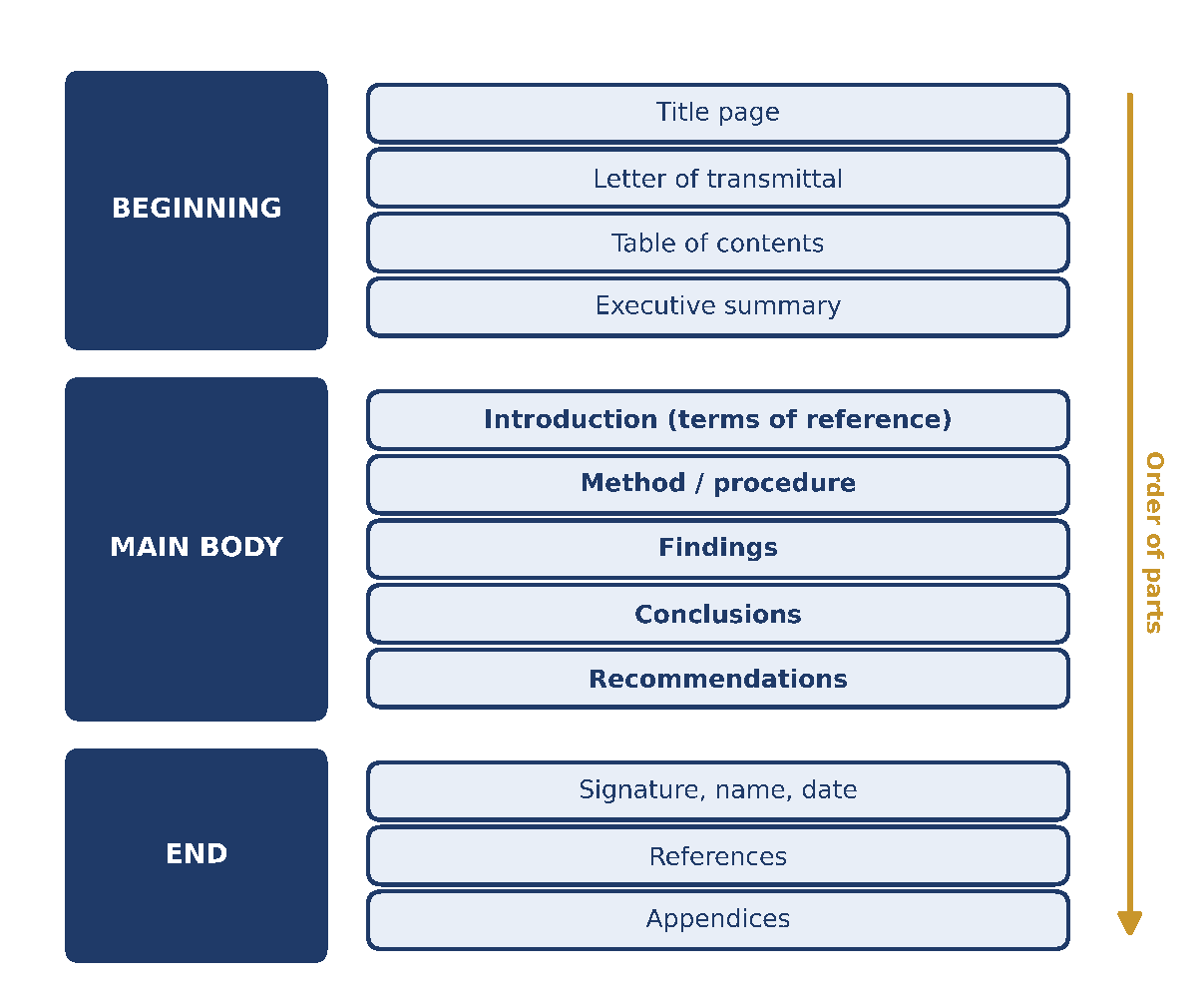
Table 3: Parts of a Report and What They Contain
| Part | What it contains |
|---|---|
| Title page | Title, name of the person or body it is for, writer’s name, date |
| Letter of transmittal | A short covering letter that hands over the report |
| Table of contents | Headings with page numbers |
| Executive summary | The whole report in a few lines: purpose, main findings, main recommendations |
| Introduction (terms of reference) | Who asked for the report, the subject, the purpose and the scope |
| Method / procedure | How the facts were collected (records, survey, interviews, visits) |
| Findings | The facts discovered, arranged under headings, with tables if needed |
| Conclusions | What the facts mean |
| Recommendations | What should be done |
| Signature, name and date | Writer’s (or chairperson’s) signature, name, designation and date |
| References and appendices | Sources used; extra material such as questionnaires and detailed figures |
Memory tip: For the main body, remember “I Must Find Clear Remedies”: Introduction, Method, Findings, Conclusions, Recommendations.
Steps in Report Writing
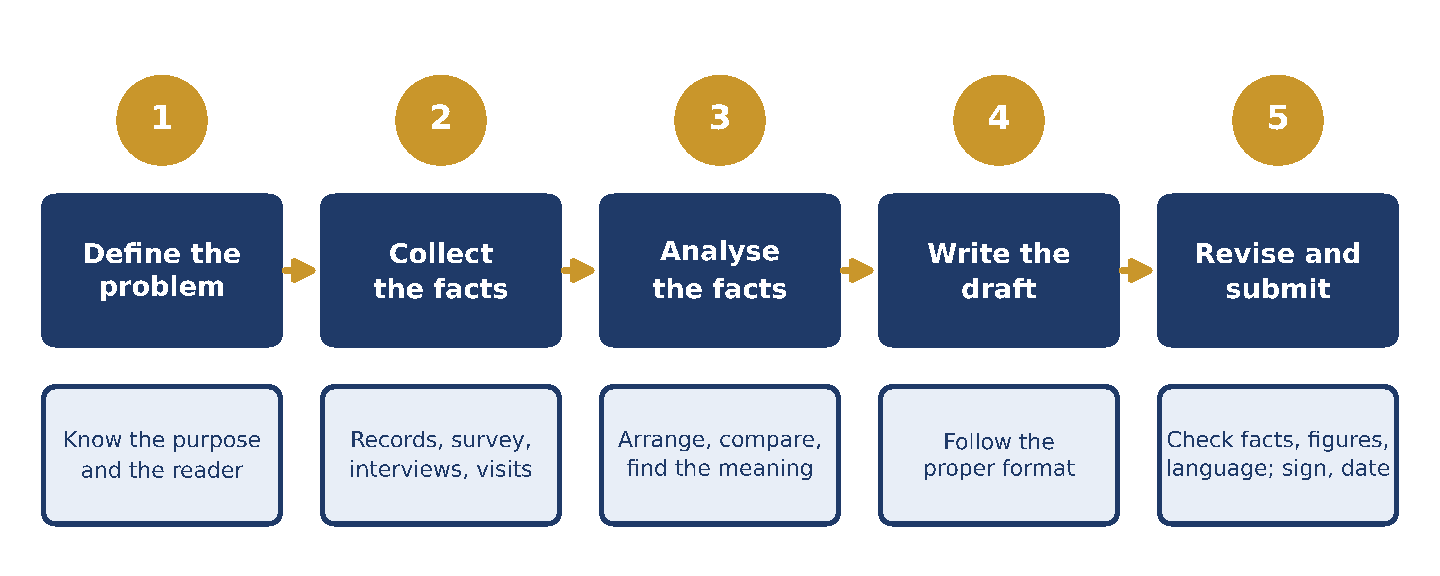
- Define the problem: Understand exactly what you must study, why, and for whom. Read the terms of reference carefully. (Example: “Find out why library use dropped in Semester I and suggest remedies.”)
- Collect the facts: Use records, surveys, interviews, observation and visits. Note every source. (Example: check the library register and ask 50 students to fill in a questionnaire.)
- Analyse the facts: Arrange and compare the facts, and find what they show. (Example: use fell after the timings were cut to 10 am–4 pm.)
- Write the draft: Follow the proper format. Draw conclusions and recommendations only from the findings. (Example: “Most students come after 4 pm” → “Keep the library open till 6 pm.”)
- Revise and submit: Check facts, figures, spelling and grammar; then sign, date and submit on time.
Remember: Recommendations must grow out of findings.
Table 4: Poor vs Good Report Writing
| Poor report line | Good report line | Why it is better |
|---|---|---|
| “Many students are unhappy with the canteen.” | “32 of 50 students surveyed (64%) said the canteen food is not fresh.” | Exact facts |
| “The manager is careless and lazy.” | “The canteen was not cleaned on 4 of the 6 days observed.” | Objective, no personal attack |
| “Something should be done soon.” | “The canteen should be cleaned daily, and a weekly check should be done by the Student Council.” | Clear, practical recommendation |
| “In my opinion, prices are too high, I think.” | “Prices of tea and snacks rose by ₹5 in July.” | Factual and confident |
A Short Sample Report (Individual Report in Memo Form)
ABC College of Commerce, Mumbai (name for illustration only)
To: The Principal
From: Sneha Patil, General Secretary, Student Council
Date: 20 October 2026
Subject: Report on students’ complaints about the college canteen1. Terms of reference: As directed by you on 6 October 2026, I studied the students’ complaints about the college canteen and now submit my report.
2. Method: I observed the canteen on six working days, collected the views of 50 students through a short questionnaire, and spoke to the canteen manager, Mr. Kulkarni.
3. Findings:
(a) 32 of the 50 students (64%) said the food is not always fresh.
(b) The canteen was not cleaned properly on 4 of the 6 days observed.
(c) There is only one water filter for about 800 students.4. Conclusion: The main complaints are about freshness, cleanliness and drinking water.
5. Recommendations:
(a) The canteen should be cleaned every day, with a weekly check by the Student Council.
(b) Food cooked in the morning should not be sold after 2 pm.
(c) One more water filter should be installed.(Signature)
Sneha Patil
General Secretary, Student Council
Extra Point for Good Marks: Importance of Reports
In your answer, you can add a short paragraph on why reports matter. Reports help management take decisions based on facts. They keep a permanent record of events. They help in controlling work by showing what has been done. They also meet legal needs, as in statutory reports. For students, writing a clear report is an important skill in internships, projects and jobs. You can also compare reports with business letters, which are another important form of written business communication.
Table 5: Quick Revision Table
| No. | Point | Key idea in one line |
|---|---|---|
| 1 | Meaning | A report “carries back” facts to the person who needs them |
| 2 | C.A. Brown | From someone who has information to someone who wants to use it |
| 3 | Lesikar and Pettit | Orderly, objective communication of facts for a business purpose |
| 4 | Features | Factual, objective, clear, brief but complete, organised, purposeful, timely, proper format |
| 5 | Formal / Informal | Full fixed format / short memo or email |
| 6 | Oral / Written | Quick, no record / permanent record |
| 7 | Routine / Special | Regular intervals / one particular occasion |
| 8 | Informational / Analytical | Only facts / facts + meaning + suggestions |
| 9 | Statutory / Non-statutory | Required by law / for management use |
| 10 | Individual / Committee | One writer / a group; note of dissent possible |
| 11 | Feasibility report | Is the plan practical and worth doing? |
| 12 | Investigative report | What went wrong, and why? |
| 13 | Main body | I Must Find Clear Remedies |
| 14 | Steps | Define → Collect → Analyse → Draft → Revise and submit |
How to Write This Answer in the Exam
For a 10/15-mark answer (e.g. “What is a report? Explain its types” or “Explain the features of a good report”):
- Begin with the meaning of a report in two or three lines.
- Give one or two definitions (C.A. Brown, Lesikar and Pettit).
- Write 6–8 points as sub-headings. Under each, write two or three lines and one short example.
- Add a table (formal vs informal) or a diagram (types of reports or structure).
- End with a short conclusion.
For a 5-mark short note (e.g. “Committee report” or “Feasibility report”): write the meaning in two lines, three or four features or parts, one example and a one-line conclusion.
Model conclusion:
A report is an orderly and factual statement that helps managers understand a situation and take the right decision. A good report is accurate, objective, clear, brief and well organised, and it reaches the reader in time. In modern business, the ability to write a clear report is an essential communication skill.
Important Exam Questions
(Model questions for practice.)
Long-answer questions
- What is a report? Explain the features of a good report.
- Explain the different types of reports with examples.
- Explain the structure (parts) of a formal report.
- Describe the steps involved in writing a business report.
- Draft a report, as the secretary of your college’s Student Council, on complaints about the college canteen.
Short notes
- Committee report
- Feasibility report
- Investigative report
- Statutory and non-statutory reports
- Executive summary
Fill in the blanks / one-line answers
- The word “report” comes from the Latin word ________. (reportare)
- A report prepared because the law requires it is called a ________ report. (statutory)
- A member of a committee who disagrees with the report may add a ________. (note of dissent)
- A report that only presents facts without suggestions is an ________ report. (informational)
- A report prepared at regular intervals is called a ________ report. (routine or periodic)
- A report that studies whether a project is practical is a ________ report. (feasibility)
- The short summary of the whole report placed at the beginning is the ________. (executive summary)
Conclusion
A report carries facts from the person who has them to the person who needs them. In business, reports help managers plan, solve problems, control work and keep records. That is why every report must be factual, objective, clear and well organised.
For exams, remember the meaning, the two definitions, the eight features, the types and the parts of a report. For life, remember one simple rule: give the reader the right facts, in the right order, at the right time. If you want to improve your written messages further, read our notes on email etiquette in business communication and the types of communication.
For further reading, see the chapter on reports in the open textbook Business Communication (Grand Valley State University).
Frequently Asked Questions
1. What is a report in simple words? A report is an orderly statement of facts on a subject, written for a reader who needs the information to understand a situation or take a decision.
2. What are the main types of reports? Formal and informal, oral and written, routine and special, informational and analytical, statutory and non-statutory, individual and committee, and feasibility and investigative reports.
3. What are the parts of a formal report? Title page, letter of transmittal, table of contents, executive summary, introduction, method, findings, conclusions, recommendations, signature and date, references and appendices.
4. What is the difference between findings and recommendations? Findings are the facts you discovered. Recommendations are the actions you suggest on the basis of those facts.
5. What is a committee report? A report prepared by a group of people appointed to study a matter. It is signed by the members or the chairperson, and a member who disagrees can add a note of dissent.
Dr. Amar Sontakke has taught English and Communication Skills since 2011. He is an Associate Professor of English at NSS College of Commerce and Economics, Mumbai.