
Table of Contents
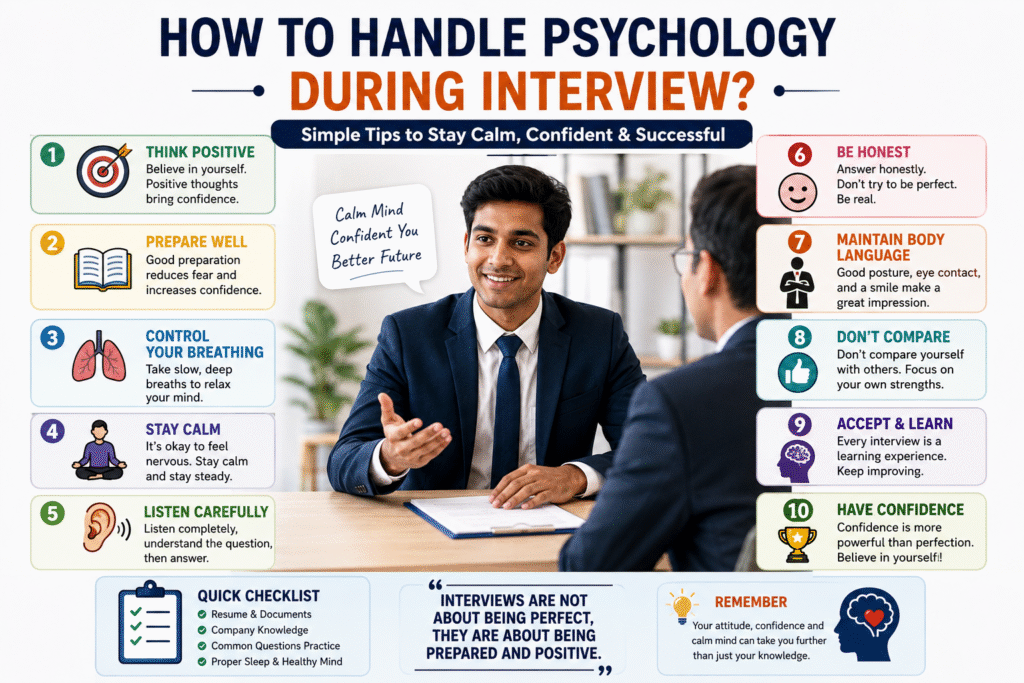
ToggleHow to Handle Psychology During an Interview?
A Simple Guide to Stay Calm, Confident, and Successful
An interview is not only about to test the knowledge of an Interviewee but also it is a test of your psychology, confidence, attitude, and emotional control. Many candidates prepare their resume and expected questions very well, but they still become nervous during the interview. On certain points they loose their confidence level. Their hands shake, voice becomes weak, and they forget simple answers.
Why does this happen?
Because their mind becomes afraid.
The good news is that interview psychology can be controlled with the right preparation and mindset. In this article, we will understand how to handle psychology during an interview in very simple language.
1. Understand One Important Truth
There are many big misunderstandings the candidates keep with him during the Interview. Most candidates think:
“The interviewer is very dangerous.”
“If I make one mistake, everything is finished.”
“They will judge me.”
This thinking creates fear.
Remember this simple truth:
The interviewer is also a human being.
They are not searching for a perfect robot. They are searching for:
- A confident person
- A positive attitude
- Communication skills
- Honest answers
- Problem-solving ability
Even if you make small mistakes, calm behavior can still impress them.
2. Stop Thinking About Failure
Before interviews, many students imagine negative situations:
- “What if I fail?”
- “What if I forget answers?”
- “What if they reject me?”
This creates anxiety before the interview even starts.
Instead, train your mind to think:
- “I am prepared.”
- “I will give my best.”
- “Every interview is learning.”
- “One interview cannot decide my entire life.”
Positive self-talk improves confidence naturally.
According to psychologist Albert Bandura’s Self-Efficacy Theory, people perform better when they believe in their abilities.
3. Prepare Properly to Reduce Fear
Fear mostly comes from lack of preparation.
If your preparation is strong, your confidence automatically increases.
Prepare these things carefully:
- Resume
- Self-introduction
- Educational background
- Strengths and weaknesses
- Common interview questions
- Company information
- Documents and certificates
Practice speaking in front of a mirror or mobile camera.
The more you practice, the calmer your brain becomes.
4. Control Your Breathing
During interviews, nervous candidates breathe very fast. This increases stress inside the body.
Before entering the interview room:
- Take slow deep breaths
- Inhale slowly for 4 seconds
- Hold for 2 seconds
- Exhale slowly
This simple technique relaxes the brain and body.
Many psychologists recommend breathing exercises for anxiety control because breathing directly affects emotions.
5. Do Not Try to Become “Perfect”
Many candidates think:
“I must answer everything perfectly.”
This creates pressure.
Even experienced professionals cannot answer every question perfectly.
If you do not know an answer:
- Stay calm
- Smile politely
Say honestly:
“I am not fully aware of this concept, but I would like to learn it.”
Interviewers often appreciate honesty more than fake confidence.
6. Maintain Positive Body Language
Psychology is not only inside the mind. Your body language also affects confidence.
Good body language includes:
- Sitting straight
- Eye contact
- Gentle smile
- Calm hand movement
- Clear voice
Avoid:
- Looking down continuously
- Shaking legs
- Folding arms aggressively
- Speaking too fast
Research by psychologist Amy Cuddy shows that confident body posture can positively influence confidence levels.
7. Listen Carefully Before Answering
Many candidates become nervous and answer quickly without understanding the question properly.
Take 2–3 seconds before answering.
This gives benefits:
- Better understanding
- More organized answers
- Reduced nervousness
A calm speaker always appears more confident.
8. Do Not Compare Yourself with Other Candidates
In waiting rooms, some candidates speak fluent English, discuss technical topics, or show overconfidence. This creates pressure.
Remember:
- Every candidate has different strengths.
- Communication is important, but attitude is equally important.
- Many silent candidates also get selected.
Focus only on your own preparation.
Comparison destroys confidence.
9. Accept Rejection as Part of Growth
Sometimes rejection happens even after a good interview.
This does not mean:
- You are useless
- You are not talented
- Your future is finished
Sometimes companies reject candidates because of:
- Limited vacancies
- Experience mismatch
- Internal hiring
- Different expectations
Every interview gives:
- Experience
- Confidence
- Learning
- Improvement
Successful people also faced many rejections before success.
10. Sleep Properly Before the Interview
Many candidates study the entire night before interviews.
This creates:
- Stress
- Weak memory
- Low concentration
- Anxiety
A fresh brain performs much better than a tired brain.
Sleep properly before the interview day.
11. Keep a Growth Mindset
Psychologist Carol Dweck explains the concept of “Growth Mindset.”
It means:
Skills and confidence can improve with practice.
So if your first interview goes badly, do not lose hope.
Every interview improves:
- Communication
- Confidence
- Professional behavior
- Emotional control
Interview skills are learned step by step.
12. Remember: Confidence Is More Powerful Than Perfection
Interviewers usually remember:
- Your confidence
- Your communication
- Your attitude
- Your honesty
- Your positivity
Not every small technical mistake.
A calm and confident candidate often creates a stronger impression than a nervous “perfect” candidate.
Final Thoughts
Interview psychology is all about controlling fear, building confidence, and staying mentally calm. Nervousness is normal. Almost every candidate feels pressure before interviews.
But preparation, positive thinking, breathing control, and practice can help you perform much better.
Always remember:
Interviews are not life-ending exams.
They are opportunities to learn, improve, and grow.
Believe in yourself, stay calm, and give your best effort.
Success will gradually come.
References
- Bandura, Albert – Self-Efficacy Theory
- Carol Dweck – Mindset: The New Psychology of Success
- Amy Cuddy – Research on Body Language and Confidence
- Daniel Goleman – Emotional Intelligence
- American Psychological Association (APA) – Stress and Anxiety Management Studies