A Short Story Before We Begin
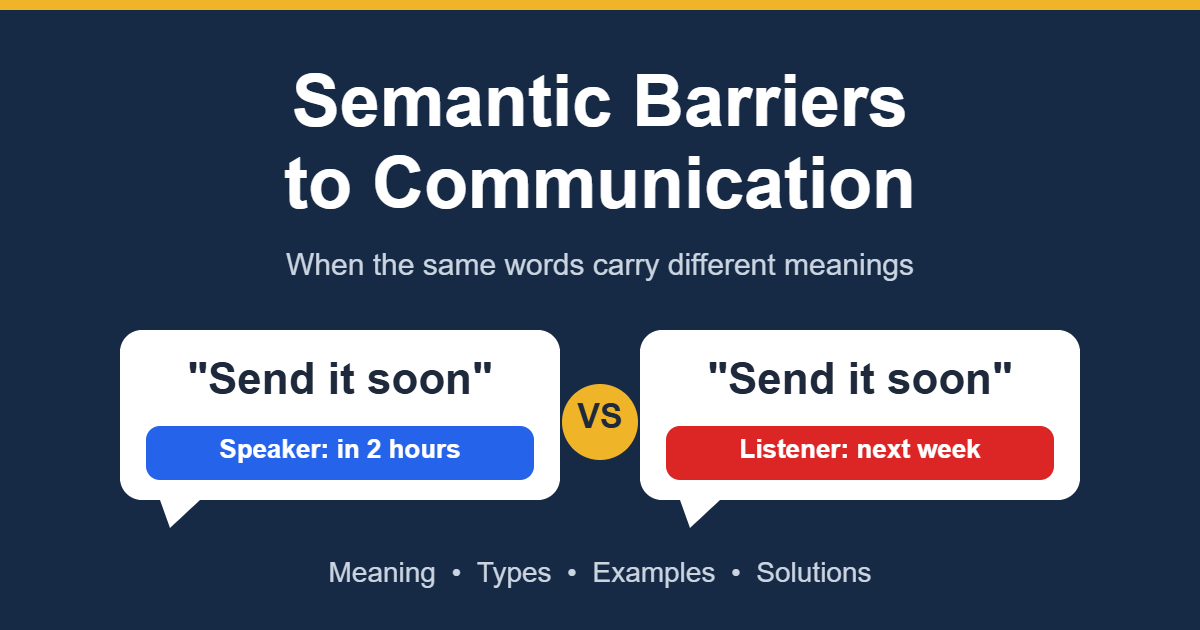
A manager once told his new employee, “Finish this report soon.”
The employee smiled, nodded, and thought, “Okay, I’ll finish it by the end of the week.”
But the manager needed the report in two hours. He had a meeting.
Two hours later, the report was not ready. The manager was angry. The employee was confused. “But you said soon,” he thought. “I am doing it soon.”
Notice something interesting here. Both people spoke the same language. Both used the same word — soon. Neither of them lied. Yet the message completely failed.
Why?
Because the word soon meant different things to each person. To the manager, soon meant right now. To the employee, soon meant in a few days. The word was the same, but the meaning was not.
This little gap — the gap between the meaning a speaker sends and the meaning a listener receives — is exactly what we call a semantic barrier to communication. And once you understand it, you will start noticing it everywhere: in classrooms, in homes, in offices, and even in text messages between friends.
Let’s understand it properly, step by step, in the simplest way possible.
What Are Semantic Barriers to Communication?
The word semantic comes from semantics, which simply means the study of meaning in language. So a semantic barrier is a problem connected to meaning.
A semantic barrier to communication is any problem that stops people from understanding the correct meaning of a message. The message is sent. The words reach the other person. But the meaning gets lost, twisted, or misunderstood on the way.
Here is the important point to remember: in a semantic barrier, the words do arrive. Nothing physical is blocking them. There is no loud noise, no broken phone, no bad signal. The problem is inside the meaning of the words themselves.
One-line explanation: A semantic barrier is when people hear the same words but understand different meanings.
Everyday example: A friend says, “I’ll be there in a minute.” You wait one minute. They arrive after fifteen. For them, a minute meant very soon. For you, it meant sixty seconds. Same words, different meaning — that is a semantic barrier.
Definition of Semantic Barrier
Let’s look at a clear, academic definition that you can use in exams:
Semantic barriers are obstacles in communication that arise from problems in language and meaning, such as the wrong choice of words, ambiguous expressions, technical terms, or differences in the way words are understood by the sender and the receiver.
That definition is correct and exam-safe. But let’s also say it in extremely simple English:
A semantic barrier happens when the words used create confusion about their meaning, so the listener understands something different from what the speaker meant.
If you remember just one idea, remember this: a semantic barrier is a “meaning problem,” not a “sound problem.”
Why Do Semantic Barriers Happen?
Semantic barriers happen for very human reasons. We all carry our own words, habits, and experiences, and we assume everyone understands words the way we do. That assumption is where the trouble starts.
Here are the main reasons, explained simply.
Words often have more than one meaning. Think about the word bank. It can mean a place that keeps money, or the side of a river. If the context is not clear, the listener may pick the wrong meaning.
People use difficult or technical words that others do not know. A doctor, a lawyer, or an engineer may use special terms every day. To them, those words feel normal. To an outsider, they sound like a foreign language.
Some messages are simply vague. Words like soon, some, later, big, cheap, and good are not specific. Each person fills in the meaning in their own way.
People come from different regions, cultures, and backgrounds. The same word can carry a different feeling or meaning in different places. What is polite in one culture may sound rude in another.
Sometimes the wrong word is chosen by mistake, or a word is used carelessly. A small wrong word can change the whole meaning of a sentence.
And finally, our emotions and assumptions shape how we understand words. When we are worried, tired, or in a hurry, we often “hear” what we expect rather than what was actually said.
Types of Semantic Barriers to Communication
Now let’s look at the main types of semantic barriers to communication. For each one, you will get a simple explanation, a real example, how the misunderstanding happens, and a quick fix.
1. Ambiguity (Unclear Meaning)
What it means: Ambiguity is when a sentence can be understood in more than one way.
Example: A teacher writes on the board, “Read the first three chapters and the notes.” Does she mean the notes for the first three chapters, or all the notes in the book?
How the problem starts: The sentence is not clear enough, so students guess — and different students guess differently.
Simple fix: Add detail. “Read chapters 1 to 3 and the class notes for those three chapters only.”
2. Words With Multiple Meanings
What it means: Many English words have several meanings. The listener may choose the wrong one.
Example: A boss says, “Please table this discussion.” In British English, table means bring it up for discussion now. In American English, it often means postpone it. Two people can understand completely opposite things.
How the problem starts: The word carries two meanings, and each person picks the one they know best.
Simple fix: Use words that have only one clear meaning, or explain what you mean: “Let’s postpone this discussion to Friday.”
3. Use of Jargon (Special Group Words)
What it means: Jargon is special vocabulary used by a particular profession or group. Inside the group it saves time; outside the group it confuses people.
Example: A software engineer tells a customer, “We’ll just push a hotfix to the prod server.” The customer has no idea what that means.
How the problem starts: The speaker forgets that the listener is not part of their group.
Simple fix: Speak to your listener’s level. “We’ll quickly fix the problem on the live website.”
4. Technical Language
What it means: This is closely related to jargon. Technical language means expert terms from fields like medicine, law, science, or finance.
Example: A doctor says, “Your BP is a bit elevated and we may need to monitor your lipid profile.” An anxious patient hears only serious-sounding words and panics.
How the problem starts: The expert uses precise terms, but the listener cannot translate them.
Simple fix: Explain in plain words. “Your blood pressure is a little high, and we should check your cholesterol.”
5. Difficult Vocabulary
What it means: Using long, heavy, or rare words when simple ones would do.
Example: A notice says, “Employees must not procrastinate in the submission of requisite documentation.” Many readers will simply skip it.
How the problem starts: Big words look impressive but block understanding.
Simple fix: Write simply. “Please submit the required documents on time.”
6. Language Differences
What it means: People who speak different first languages, or the same language in different ways, may understand words differently.
Example: In one region, “just now” means a moment ago. In another, it means in a short while from now. A team spread across regions can get badly confused.
How the problem starts: Each speaker uses their local meaning without realising others use another.
Simple fix: Confirm the meaning, and prefer clear, standard wording that everyone shares.
7. Poor Choice of Words
What it means: Choosing a word that does not truly say what you mean.
Example: A shopkeeper says a phone is “cheap.” The customer hears “low quality” and walks away. The shopkeeper only meant “affordable.”
How the problem starts: The wrong word carries the wrong feeling.
Simple fix: Pick words carefully. “This phone is affordable and good value.”
8. Misinterpretation
What it means: The listener understands the message in a way the speaker never intended, often because of their own mood or expectations.
Example: A friend texts, “Okay.” You read it as cold and angry, though your friend simply meant “yes, fine.”
How the problem starts: Short messages leave room for the reader’s imagination to fill in feelings.
Simple fix: Add a little warmth or detail. “Okay, sounds great — see you then!”
9. Denotative and Connotative Differences
What it means: Every word has a denotation (its dictionary meaning) and a connotation (the feeling or idea attached to it). Two people may agree on the dictionary meaning but disagree on the feeling.
Example: Calling someone “aggressive” has the same dictionary meaning for everyone, but for one listener it sounds like a compliment (strong and confident) and for another it sounds like an insult (rude and forceful).
How the problem starts: The hidden feeling of the word differs from person to person.
Simple fix: Choose words whose feeling matches your true intention, and explain if needed.
10. Abbreviations and Unfamiliar Expressions
What it means: Short forms, slang, and idioms can confuse people who do not know them.
Example: A manager writes, “Send the file ASAP, and let’s touch base EOD.” A new employee may not know that EOD means end of day.
How the problem starts: The short form is clear to the writer but unknown to the reader.
Simple fix: Write the full form at least once. “Please send the file as soon as possible, and let’s talk by the end of the day.”
Real-Life Examples You Will Recognise
Let’s slow down and look at a few examples in a simple format. This is exactly the kind of thing that helps in exams and in real life.
Example 1 — Teacher and Student
What was said: “Submit your assignment soon.”
What the teacher meant: Submit it by tomorrow.
What the student understood: Submit it sometime this week.
Problem: The word soon was not specific.
Lesson: Use clear, exact words like dates and times.
Example 2 — Doctor and Patient
What was said: “Take this medicine as needed.”
What the doctor meant: Take it only when you have pain.
What the patient understood: Take it whenever you remember.
Problem: As needed was too vague for a worried patient.
Lesson: Give clear, simple instructions.
Example 3 — Manager and Employee
What was said: “Make the report a little more professional.”
What the manager meant: Fix the formatting and remove spelling mistakes.
What the employee understood: Rewrite the whole thing.
Problem: A little more professional meant different things to each person.
Lesson: Explain exactly what you want changed.
Example 4 — Customer and Salesperson
What was said: “This plan is basically free.”
What the salesperson meant: It is very cheap.
What the customer understood: It costs nothing at all.
Problem: The word free created a false expectation.
Lesson: Say the real price clearly.
Example 5 — Parent and Child
What was said: “Come home early.”
What the parent meant: By 7 p.m.
What the child understood: By 10 p.m.
Problem: Early has no fixed time.
Lesson: Give a specific time.
Notice how in every single case, the words were normal and the people were sincere. The barrier was hidden inside the meaning.
Semantic Barriers in Business Communication
Semantic barriers matter everywhere, but in a workplace they can be expensive. In business, unclear words do not just cause confusion — they cause delays, mistakes, lost money, and even conflict between people.
Think about how much communication happens at work. There are emails flying back and forth, meetings full of instructions, reports that must be read correctly, and presentations where one wrong word can change the whole message. Add customer service, where a single unclear sentence can lose a customer, and team communication, where members may sit in different cities or countries.
Here are some common workplace situations.
In emails, tone and meaning are easily lost. A short line like “Please handle this” leaves the reader guessing what handle means and how urgent it is.
In meetings, a manager might say, “Let’s aim to wrap this up quickly.” Some team members think this week and others think this month.
In instructions, vague words are dangerous. “Order enough stock” — but how much is enough? One person orders 50 units, another orders 500.
In customer service, saying “Your refund will be processed shortly” can upset a customer if shortly to them means today but to the company means in seven working days.
When these small meaning-gaps pile up, the results are serious. Unclear language can lead to mistakes in work, delays in projects, conflict between colleagues, financial loss for the company, poor teamwork, and unhappy customers. This is why good companies train their staff to write and speak with clear, specific, simple language.
Effects of Semantic Barriers
Let’s put the harm in one clear list so you can see it at a glance. Semantic barriers can cause:
- Misunderstanding — people simply get the wrong idea.
- Confusion — no one is sure what to do next.
- Conflict — people blame each other for a mistake that was really a meaning-gap.
- Wrong decisions — choices are made on incorrect information.
- Reduced productivity — time is wasted redoing work.
- Poor relationships — repeated misunderstandings create distance and frustration.
- Loss of time — messages have to be explained again and again.
- Loss of money — mistakes and delays cost the business.
- Workplace problems — teams stop trusting each other’s words.
A tiny example shows the chain reaction. A manager writes “ship it by Friday.” The team in another country reads Friday in their own week and delivers a day late. The client is upset. The company loses the order. All of that from one word understood two ways.
How to Overcome Semantic Barriers to Communication
The good news is that semantic barriers to communication are very fixable. You do not need special tools — you only need care and clarity. Here are practical solutions you can start using today.
Use simple language. Choose everyday words. If a short word works, use it instead of a long one.
Choose your words carefully. Before you speak or send a message, ask yourself, “Could this be understood in another way?”
Avoid unnecessary jargon. Keep special terms for people who understand them. With everyone else, use plain words.
Explain technical terms. If you must use an expert word, give a short, simple meaning right after it.
Be specific. Replace vague words with exact ones. Instead of soon, say by 5 p.m. today. Instead of some, give a number.
Ask for feedback. Invite the listener to repeat the message in their own words. This quickly shows whether they understood.
Confirm understanding. A simple “Just to confirm, you’ll send it by Monday morning, right?” prevents many problems.
Listen carefully. Communication is two-way. Pay full attention so you catch the real meaning of what others say.
Consider the receiver’s background. Think about the other person’s language, age, culture, and knowledge, and adjust your words to fit them.
Avoid ambiguous expressions. Stay away from sentences that can be read in two ways.
Use examples. A quick example makes an abstract idea instantly clear.
Encourage questions. Let people feel free to ask “What do you mean?” without embarrassment.
Summarise important information. At the end of a long message or meeting, restate the key points in one or two simple lines.
Do these consistently, and most semantic barriers to communication simply disappear.
Semantic Barriers vs Other Communication Barriers
Students often mix up the different kinds of barriers. This simple table makes the difference clear.
| Type of Barrier | Meaning | Example |
|---|---|---|
| Semantic Barrier | A problem with the meaning or interpretation of words | An ambiguous word like “soon” |
| Physical Barrier | A problem caused by the surroundings or environment | Loud noise, distance, poor phone signal |
| Psychological Barrier | A problem caused by emotions or mental state | Fear, stress, anger, lack of attention |
| Cultural Barrier | A problem caused by differences in culture | Different customs, gestures, or values |
The easy way to remember it: a semantic barrier is about meaning, a physical barrier is about the environment, a psychological barrier is about feelings, and a cultural barrier is about background.
Difference Between a Language Barrier and a Semantic Barrier
This is a very common exam confusion, so let’s clear it up carefully.
A language barrier happens when people simply do not share the same language, or one person is not fluent in it. The words themselves are not understood.
A semantic barrier happens when people do share the language and do understand the words, but they understand the meaning differently.
| Point | Language Barrier | Semantic Barrier |
|---|---|---|
| Main problem | People do not know or speak the same language well | People know the language but understand the meaning differently |
| Are the words understood? | No — the words themselves are unknown | Yes — but the meaning is misread |
| Example | An English speaker talking to someone who only speaks French | Two English speakers arguing over what “soon” means |
| Simple fix | Use a translator or a common language | Use clearer, more specific words |
A quick way to remember: a language barrier is “I don’t know these words,” while a semantic barrier is “I know these words, but I understood them differently.”
Why Students Should Understand Semantic Barriers
You might be wondering, “Why should I, as a student, care about this?” The answer is that clear communication helps you in almost everything you do.
In exams, this is a common question in Business Communication and English papers, and knowing it well earns easy marks. In presentations, choosing clear words keeps your audience with you instead of confusing them. In group discussions, understanding meaning helps you respond to what people actually said, not what you assumed. In interviews, clear and specific answers make a strong impression. In classroom communication, you understand teachers better and ask better questions. In written communication, whether an essay or an email, precise words make your writing powerful. And in your future job, the ability to communicate without misunderstandings is one of the most valued skills an employer can find.
In short, learning about semantic barriers to communication is not just theory. It is a life skill.
Exam-Ready Section
Semantic Barriers to Communication — Short Answer
Semantic barriers are obstacles in communication caused by problems of meaning. They occur when the sender and the receiver understand words differently, because of ambiguity, jargon, technical terms, poor word choice, or language differences. Even when the words are received clearly, the meaning is misunderstood, leading to confusion and mistakes.
Semantic Barriers to Communication — 5-Mark Answer
Meaning: Semantic barriers are problems in communication that arise from the meaning of language. The word semantic refers to meaning, so these barriers appear when the sender’s intended meaning is different from the meaning the receiver understands.
Main causes / types: They are caused by ambiguity (unclear sentences), words with multiple meanings, use of jargon and technical language, difficult vocabulary, differences in language and region, poor choice of words, and differences between the dictionary meaning (denotation) and the emotional meaning (connotation) of words.
Effects: They lead to misunderstanding, confusion, wrong decisions, conflict, delays, loss of time and money, and weak relationships, especially in business.
How to overcome them: They can be reduced by using simple and specific language, avoiding unnecessary jargon, explaining technical terms, asking for and confirming understanding, considering the receiver’s background, and giving examples.
Conclusion: Communication succeeds only when the sender and the receiver share the same meaning. Removing semantic barriers to communication makes communication clear, accurate, and effective.
Semantic Barriers to Communication — One-Line Definition
A semantic barrier is an obstacle in communication that occurs when the sender and the receiver understand the same words to have different meanings.
Conclusion
Semantic barriers remind us of one simple truth: sending words is not the same as sharing meaning. Two people can speak the same language, use the same words, and still walk away understanding completely different things.
The good news is that these barriers are easy to fix once you notice them. Choose simple words. Be specific. Explain difficult terms. And always check that the other person understood what you actually meant.
Remember this the next time you speak, write, or send a quick message: communication becomes truly effective only when the speaker and the listener understand the same meaning. Say what you mean, mean what you say, and make sure it lands the way you intended.
Related Lessons on Communication
To understand semantic barriers to communication in more depth, also read these guides: Barriers to Communication, Physical Barriers of Communication, and Listening Skills.
Frequently Asked Questions
1. What are semantic barriers to communication?
Semantic barriers are problems of meaning. They happen when people use the same language but understand the words differently, so the message is misunderstood even though it was received.
2. What is an example of a semantic barrier?
A boss says “finish this soon.” She means within two hours, but the employee thinks it means within a few days. The word “soon” carried two different meanings — that is a semantic barrier.
3. What are the main types of semantic barriers to communication?
The main types are ambiguity, words with multiple meanings, jargon, technical language, difficult vocabulary, language differences, poor choice of words, misinterpretation, denotative-connotative differences, and unfamiliar abbreviations.
4. What causes semantic barriers to communication?
They are caused by unclear or vague words, difficult or technical terms, jargon, careless word choice, differences in language and culture, and the fact that people often “hear” what they expect rather than what was said.
5. How can semantic barriers to communication be overcome?
Use simple, specific language, avoid unnecessary jargon, explain technical terms, ask the listener to confirm what they understood, consider their background, and use examples to make meaning clear.
6. What is the difference between semantic and language barriers?
A language barrier means people do not share or know the same language. A semantic barrier means they know the language but understand the meaning of the words differently.
7. Why are semantic barriers to communication important in business communication?
At work, unclear words cause mistakes, delays, conflict, financial loss, and unhappy customers. Clear, specific language saves time and money and keeps teams working smoothly.
8. How does jargon create a semantic barrier?
Jargon is special vocabulary known only to a certain group. When a speaker uses it with someone outside the group, the listener cannot understand, and the meaning is lost.
9. How does ambiguity affect communication?
Ambiguity means a sentence can be understood in more than one way. Different people guess different meanings, which leads to confusion and wrong actions.
10. How can students avoid semantic barriers to communication?
Students should use simple and exact words, explain difficult terms, confirm that others understood them, and ask questions when they themselves are unsure of a meaning.
Quick Revision
- A semantic barrier is a meaning problem, not a sound problem.
- The word “semantic” means related to meaning.
- Definition: it happens when the sender and receiver understand words differently.
- Common types: ambiguity, multiple meanings, jargon, technical language, difficult words, language differences, poor word choice, denotation vs connotation.
- Vague words like soon, some, later, cheap, good often cause trouble.
- Effects: misunderstanding, confusion, conflict, delays, loss of time and money.
- In business, unclear language causes mistakes and unhappy customers.
- Best cure: be simple, be specific, and confirm understanding.
- Language barrier = “I don’t know the words.” Semantic barrier = “I know the words but understood them differently.”
- Communication works only when both people share the same meaning.