Picture this. A teacher is explaining an important lesson. A student sits in the front row, eyes open, looking straight at her, the perfect student. Five minutes later, the teacher asks him a simple question about what she just said. He goes blank. His ears were working the whole time. So what went wrong?
Here is the answer, and it is the heart of this article. The student was hearing the teacher, but he was not listening to her. Those two things are not the same.
Most people think hearing and listening mean the same thing. They do not. Once you understand the real difference, you will look at every conversation differently. Let us understand it together, step by step.
What is Listening?
Listening is the process of receiving sounds, paying attention, understanding their meaning, and responding in the right way. It is an active mental activity (the dictionary meaning of “listen” even stresses paying attention). Your ears do the first job, but your mind does the real work.
When you truly listen, several things happen almost at once:
- You receive the sound — the words reach your ears.
- You pay attention — you focus on the speaker, not your own thoughts.
- You understand and interpret — you catch the meaning and the intention behind the words.
- You remember the important parts — you store what matters.
- You respond appropriately — you reply, ask a question, or take action.
Hearing is only the first step. Everything after it is listening. That is why you can hear a hundred sentences and remember nothing, or listen to one and never forget it.
Listening Meaning in Simple Words
Let me give you a definition you can memorize easily:
Listening means paying attention to what someone says, understanding the meaning, and responding properly.
Break it into three parts. First, paying attention — your focus is on the speaker, not wandering to lunch or your phone. Second, understanding the meaning — you catch what the person is really trying to say, not just the words. Third, responding properly — you reply in a way that shows you understood.
If any one part is missing, real listening has not happened. Remember it like this: attention + understanding + response = listening.
Is Listening the Same as Hearing?
This is the most important section, so read it slowly. Hearing and listening are not the same.
Hearing
Hearing is a natural physical ability. It happens through the ears, by itself, without your attention, even when you are asleep or busy.
For example, right now you can probably hear a fan, traffic, or people talking somewhere. You were not trying to. Your ears caught it on their own. That is hearing.
Listening
Listening is a skill that takes effort. It needs your attention, understanding, mental effort, interest, interpretation of the meaning, and often a response.
For example, when your friend tells you about a problem and you focus, understand their feelings, and reply with care, that is listening.
Here is a simple comparison you can keep in mind:
| Hearing | Listening |
|---|---|
| Happens naturally | Requires attention |
| Uses the ears | Uses ears + mind |
| May happen without understanding | Requires understanding |
| Usually passive | Active process |
| Does not always require concentration | Requires concentration |
Here is a quick example. You study while music plays; you hear the songs but cannot recall a single line later. Your ears caught the sound, but your mind never listened.
Hearing is easy and automatic. Listening is a choice you make with your mind.
What is Listening Skill?
A listening skill is your ability to listen well, on purpose, in different situations. We call it a communication skill because communication is a two-way street. Many people think communication is only about speaking well, but that is half the truth. Communication has two sides, a speaker and a listener. If the speaker talks beautifully but the listener does not listen, the message is lost.
This gives us one of the most important lines in the whole article:
A good communicator is not only a good speaker but also a good listener.
Most of us listen more than we speak every day, yet listening is the skill almost nobody is taught. That is why learning it gives you a big advantage.
Why is Listening Important?
Good listening quietly improves almost every part of your life:
- Education — you understand lessons faster and revise less.
- Classroom learning — you catch the teacher’s hints about what matters for the exam.
- Business — you learn exactly what customers want and sell more.
- Workplace — you make fewer mistakes by following instructions correctly the first time.
- Interviews — you answer the actual question asked, not a different one.
- Group discussions — you build on others’ points and sound intelligent.
- Meetings — you understand decisions and avoid repeating others.
- Friendships — friends feel valued, and the bond grows stronger.
- Family — many family fights happen simply because people do not listen.
- Leadership — people follow leaders who make them feel heard.
- Customer service — a customer who feels listened to stays loyal.
- Conflict management — most arguments cool down when one person truly listens.
- Personal development — the more you listen, the more you learn from everyone.
In every example, listening did not cost money or talent. It only needed attention.
Types of Listening
We do not listen the same way in every situation. Here are the main types of listening, each with a quick example:
- Active Listening — full attention with a response. Example: taking notes and asking a question in a lecture.
- Passive Listening — hearing without much effort. Example: songs playing softly while you cook.
- Critical Listening — judging the message. Example: deciding if an advertisement’s claims are true.
- Empathetic Listening — listening to feelings. Example: comforting a friend who is upset.
- Appreciative Listening — listening for enjoyment. Example: enjoying your favourite singer.
- Selective Listening — catching only some parts. Example: waking up only when the teacher says “this is in the exam.”
- Comprehensive Listening — listening to fully understand. Example: following directions to a new place.
- Informational Listening — listening to learn facts. Example: watching a news report or tutorial.
You already use many of these every day. Knowing them helps you pick the right one for each moment.
What is Active Listening?
Active listening is the highest form of listening. It means listening with full attention and showing the speaker you are truly with them.
A passive listener sits quietly. An active listener is fully involved, even without saying much. In practice it means:
- Looking at the speaker and paying complete attention
- Not interrupting
- Asking questions and clarifying doubts
- Showing interest through your face and posture, and nodding when appropriate
- Taking short notes if useful
- Summarizing what was said and giving suitable feedback
Here is how it looks in real life. In the classroom, you keep eye contact, note key points, and ask a doubt at the end. At work, you repeat a task back to confirm before you start, so no mistakes happen. At home, you put your phone down and let your sister finish about her bad day, so she feels loved.
Active listening is powerful because it does two jobs at once. It helps you understand better, and it makes the other person feel valued.
Characteristics of a Good Listener
What separates a good listener from a poor one? Here are the main qualities:
- Attention — full focus on the speaker.
- Patience — letting the speaker finish without rushing.
- Open-mindedness — listening even to ideas you disagree with.
- Empathy — trying to feel what the speaker feels.
- Concentration — keeping distractions away.
- Curiosity — genuinely wanting to understand more.
- Respect — treating the speaker’s words as important.
- Understanding — focusing on meaning, not just words.
- Asking relevant questions — to clarify, not to interrupt.
- Giving feedback — nodding or replying so the speaker feels heard.
- Avoiding interruption — not cutting the speaker off midway.
- Remembering — holding on to what truly matters.
You do not need all twelve. Improving even three or four makes you a noticeably better listener.
Barriers to Effective Listening
Sometimes we want to listen but still fail. These blocks are called barriers to listening:
- Noise — traffic or chatter drowns out the speaker.
- Distractions — a nearby TV pulls your eyes away.
- Mobile phones — one notification breaks your focus.
- Lack of concentration — your mind drifts after a few minutes.
- Lack of interest — a boring topic makes you switch off.
- Emotional stress — worry fills your mind.
- Prejudice — you have already decided the speaker is wrong.
- Assumptions — you think you know what they will say.
- Language or accent — the speaker is hard to follow.
- Difficult vocabulary — hard words break your understanding.
- Fast speaking — too quick to keep up with.
- Daydreaming — your imagination wanders off.
- Selective listening — you catch only the parts you like.
- Information overload — too much at once, and your mind gives up.
- Planning your reply too early — you prepare your answer and miss the rest.
That last one is the most common of all. We get so busy preparing our reply that we stop hearing the other person. Good listeners listen first and reply later.
Difference Between Listening and Hearing
Here is a second, sharper comparison, very useful for exams.
| Point | Hearing | Listening |
|---|---|---|
| Meaning | Catching sound with the ears | Understanding the message with attention |
| Nature | Physical and natural | Mental and skilled |
| Attention | Not required | Required |
| Understanding | May not happen | Always aimed for |
| Mental effort | Very little | High |
| Purpose | Just to receive sound | To understand and respond |
| Response | Usually none | Usually a reply or action |
| Example | You hear rain outside | You listen to a friend’s advice |
One line to remember forever: Hearing is receiving sound. Listening is understanding the person behind the sound.
How to Improve Listening Skills
Good news. Listening is a skill, and every skill improves with practice. Here are practical techniques.
- Give the speaker your full attention. Turn toward them and stop what you are doing.
- Put your phone away. Out of sight, out of mind.
- Do not interrupt. Let the person finish, then speak.
- Look at the speaker. Eye contact keeps your mind from wandering.
- Listen for the main idea. Ask, “What do they really want me to know?”
- Ask questions. “Do you mean…?” shows you are following.
- Take short notes. A few keywords help you focus and remember.
- Repeat important information. “So the meeting is at 4, right?” confirms you got it.
- Avoid quick judgments. Hear the full story before you decide.
- Keep an open mind. Be ready to learn something new.
- Watch tone and body language. Voice and face often say more than words.
- Practise with English conversations. It trains your ear and your language.
- Listen to podcasts. Pick topics you like and summarize each one.
- Watch educational videos carefully. Pause and repeat parts you missed.
- Summarize what you heard. Saying the main points in your own words locks them into memory.
Pick two or three and use them this week. Small steps build strong skills.
Listening Skills in Communication
To see why listening matters, look at how communication works:
Sender → Message → Listening → Understanding → Feedback
A sender turns an idea into a message and speaks. But the message only becomes useful when the listener listens, understands, and gives feedback.
Here is the surprising part. Communication can fail even when the speaker speaks perfectly. If the listener is distracted, the clearest message lands nowhere. Think of a game of catch: if the other person is not ready, even a perfect throw drops. In communication, listening is the catch.
Listening Skills for Students
For students, listening is a superpower. It helps you:
- Understand lectures the first time, so you study less later.
- Remember lessons, because attention improves memory.
- Ask better questions and clear your doubts.
- Perform better in exams by catching what teachers stress.
- Improve English, pronunciation, and vocabulary from real use.
- Avoid misunderstandings about assignments and deadlines.
A real example. Two students hear the same lecture. One listens actively and notes a formula the teacher repeated twice. In the exam, that formula appears, and she is ready. The other “was there” too, but missed it. Same class, different result, all because of listening.
Listening Skills in the Workplace
At work, listening can decide who succeeds:
- Meetings — you understand decisions and act correctly.
- Interviews — you answer the exact question asked.
- Teamwork — you understand teammates and avoid clashes.
- Customer communication — you learn what customers truly need.
- Leadership — your team trusts you because you hear them out.
- Problem-solving — you gather full information before deciding.
- Conflict resolution — you calm tension by letting people feel heard.
- Following instructions — you do the task right the first time.
A simple example. A manager explains a new process. One employee repeats it back to confirm; another only nods along. The next day, the second does it wrong and wastes hours. Listening saved time for one and cost time for the other.
Example of Good Listening and Poor Listening
Let me show you the difference with a short conversation.
Poor listening:
Riya: “I’m really stressed about my exam tomorrow.”
Sam: (looking at his phone) “Yeah, cool. Hey, did you watch that new movie?”
Sam heard the words, but he did not listen. He missed Riya’s feelings completely and changed the topic. Riya feels ignored.
Good listening:
Riya: “I’m really stressed about my exam tomorrow.”
Sam: (putting his phone down, looking at her) “You sound worried. Which subject is stressing you the most? Maybe we can go over it together.”
Same start, very different result. What changed? Sam stopped multitasking, focused on Riya, caught her emotion, and replied to her need instead of his own. That is the whole art of listening in one small moment.
Simple Everyday Examples of Listening
Listening is happening all around you:
- Teacher and student — the student follows the lesson and asks a doubt.
- Parent and child — a parent listens to why the child is upset.
- Doctor and patient — the doctor listens to the symptoms before advising.
- Manager and employee — the manager listens to an idea in a meeting.
- Customer and salesperson — the salesperson learns what the customer needs.
- Friends talking — one listens while the other shares good news.
- Interviewer and candidate — the candidate listens fully before answering.
- Husband and wife — one partner listens to the other’s day without interrupting.
In each case, listening is the invisible thread that makes the relationship work.
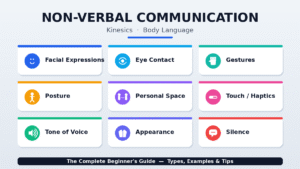
Listening Skills and Body Language
Your body speaks even when you are silent. Good listeners show it through body language:
- Eye contact — shows you are present.
- Facial expressions — reflect the message.
- Nodding — says “I understand, please continue.”
- Posture — leaning slightly forward signals attention.
- Avoiding distractions — not glancing at your phone shows respect.
But here is an honest warning. Looking at someone does not always mean you are listening. Remember the student from our opening story? He looked perfect but heard nothing. Real listening happens in the mind, so body language should reflect true attention, not fake it.
Listening Skills and Empathy
Empathy means understanding how another person feels, and it is at the heart of good listening.
Imagine someone says, “I am having a very difficult day.” Look at the different responses:
- Ignoring them — you keep scrolling. They feel invisible.
- Unwanted advice — “Just don’t think about it.” They feel unheard.
- Changing the topic — “Anyway, what’s for dinner?” They feel dismissed.
- Actually listening — “That sounds hard. Do you want to talk about it?” They feel understood.
Only the last is true, empathetic listening. Often people do not want solutions. They just want to feel heard. Listening with empathy is one of the kindest things you can offer.
Common Listening Mistakes
We all make listening mistakes, and each has a simple fix:
- Interrupting — wait for a natural pause before speaking.
- Checking the phone — keep it away during important talks.
- Thinking about your answer — understand first, reply later.
- Judging too quickly — hear the full story before deciding.
- Pretending to listen — give real attention or ask to talk later.
- Assuming what the speaker means — ask instead of guessing.
- Getting distracted — reduce noise and turn toward the speaker.
- Ignoring emotions — notice the feeling behind the words.
- Not asking for clarification — say “Can you explain that again?”
Fixing even a couple of these makes people enjoy talking to you more.
Listening Skills Examples for Students
Here are short, exam-friendly examples for Business Communication, Soft Skills, or English answers:
- Repeating the teacher’s instructions before a project shows active listening.
- Judging whether a debate argument is logical is critical listening.
- Comforting a stressed classmate is empathetic listening.
- Following step-by-step lab instructions is comprehensive listening.
- Watching a documentary to gather facts is informational listening.
Frequently Asked Questions
What is listening?
Listening is receiving sound, paying attention, understanding the meaning, and responding properly. It is an active mental activity, not just catching sound with the ears.
What is listening skill?
Listening skill is your ability to listen well on purpose. It is a key communication skill, since good communication needs a good listener as well as a good speaker.
What is the difference between hearing and listening?
Hearing is a natural physical ability that happens without effort. Listening needs attention, understanding, and usually a response. Hearing is passive; listening is active.
Why is listening important?
Listening helps you understand others, learn faster, avoid mistakes, build strong relationships, and solve problems in studies, work, and personal life.
What are the types of listening?
Common types include active, passive, critical, empathetic, appreciative, selective, comprehensive, and informational listening.
What is active listening?
Active listening means listening with full attention while showing you understand, through eye contact, questions, nodding, and summarizing.
What makes a good listener?
A good listener gives attention, stays patient, keeps an open mind, shows empathy, avoids interrupting, and remembers important points.
What are the barriers to listening?
Common barriers include noise, distractions, phones, lack of interest, stress, assumptions, fast speaking, and planning your reply too early.
How can students improve listening skills?
By focusing fully, keeping phones away, taking short notes, asking questions, summarizing lessons, and practising with English videos and podcasts.
Is listening a communication skill?
Yes. It is one of the four communication skills, along with speaking, reading, and writing. Communication fails if the listener does not listen well.
What are examples of listening?
A student following a lecture, a doctor hearing symptoms, and a manager listening to an employee’s idea are all examples of listening.
Why is listening important in business communication?
It helps you understand customers, follow instructions, avoid costly mistakes, lead teams, and resolve conflicts, all of which improve results.
What is the difference between active and passive listening?
Active listening involves full attention and a response. Passive listening means hearing with little effort and usually no response.
Key Takeaways
- Hearing and listening are not the same thing.
- Hearing happens through the ears. Listening happens through the ears, mind, attention, and understanding.
- Listening means attention plus understanding plus a proper response.
- Active listening is the strongest form and makes people feel valued.
- Barriers like noise, phones, and early replies block good listening.
- Listening can be improved with simple daily practice.
- Good listening improves studies, work, and relationships.
- A good communicator is not only a good speaker but also a good listener.
Conclusion
We began with a student who looked like he was listening but heard nothing. Now you know what went wrong. His ears were open, but his mind was somewhere else.
Listening is not something that happens to you. It is something you do, a choice you make with your attention every time someone speaks. And anyone can get better at it. You do not need talent, money, or training, only the will to slow down, focus, and truly understand the person in front of you.
So next time someone speaks to you, give them more than your ears. Give them your attention. Hearing is receiving sound, but listening is understanding the person behind the sound. Learn to listen well, and you will learn from every person you ever meet.