
Barriers to communication are obstacles that stop a message from being sent, received or understood the way it was intended. This guide explains the seven main barriers to communication in simple language, with clear examples, practical ways to overcome them, and the exam questions students are most often asked.
Prepared by Dr. Amar Sontakke, Associate Professor of English. Reading time: about 8 minutes.
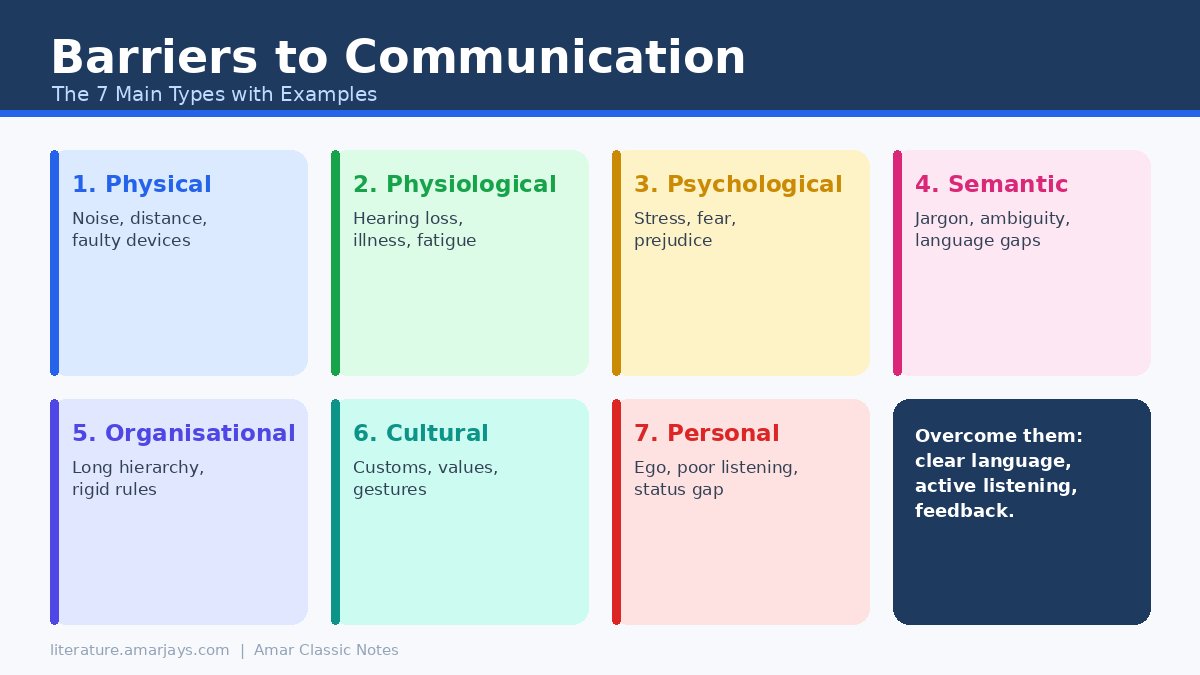
Quick answer: A barrier to communication is any obstacle that stops a message from being sent, received or understood as intended. The main barriers to communication are physical, physiological, psychological, semantic (language), organisational, cultural and personal. Effective communication means identifying these barriers and removing them through clear language, active listening and feedback.
What Is a Communication Barrier?
Communication is successful only when the receiver understands the message the way the sender intended. Anything that distorts, blocks or delays this shared understanding is a barrier to communication (also called noise). Barriers can occur at any stage — while forming the message, transmitting it, or interpreting it. Because the barrier can appear at any point, even a well-planned message can fail if a single link in the chain breaks.
The 7 Types of Barriers to Communication
Most textbooks group the barriers to communication into seven broad types. Learn one clear example for each and you can answer almost any question on the topic.
- Physical barriers. Environmental obstacles such as distance, noise, faulty equipment, closed doors or a poor network. Example: a video call breaking up during an online lecture. (See our detailed note on physical barriers of communication.)
- Physiological barriers. Problems of the body or senses — hearing loss, poor eyesight, illness, tiredness or a speech difficulty. Example: a student with an ear infection missing part of a lesson.
- Psychological barriers. Barriers in the mind — stress, fear, anger, prejudice, low confidence or lack of attention. Example: an anxious candidate not “hearing” an interviewer’s question properly.
- Semantic or language barriers. Problems of meaning and words — different languages, jargon, technical terms, ambiguous words or poor pronunciation. Example: using legal jargon with a general audience.
- Organisational barriers. Obstacles built into an institution — a long chain of command, rigid rules, information overload or unclear channels. Example: a message getting distorted as it passes through many levels of management.
- Cultural barriers. Differences in customs, values, gestures and etiquette across cultures. Example: a gesture that is polite in one country but offensive in another.
- Personal / attitudinal barriers. Individual factors such as ego, poor listening habits, lack of interest, or a superior–subordinate gap that discourages open talk.
How to Overcome Barriers to Communication
Once you can spot the barriers to communication, removing them is mostly about habits. Use simple, clear language and avoid unnecessary jargon. Practise active listening and give the speaker your full attention. Always seek and give feedback to confirm understanding. Choose the right medium for the message, reduce physical noise, be culturally sensitive, and build an atmosphere of trust and openness so people speak freely. For a broader academic overview of how messages are shared, you can also read the general entry on communication on Wikipedia.
Communication Process (Quick Recall)
Sender → Encoding → Message → Channel → Receiver → Decoding → Feedback. A barrier to communication can strike at any of these stages; noise is the general term for interference across the whole process. If you need a refresher, see our note on the communication process and its elements.
Why Overcoming Barriers to Communication Matters
Removing barriers to communication is not just an academic exercise. In classrooms, workplaces and daily life, clear communication saves time, prevents mistakes and builds stronger relationships. When a message is understood exactly as intended, decisions are faster, conflicts are fewer and people feel respected. Students who master this topic can also apply it in group discussions, interviews and presentations, where a single misunderstanding can change the outcome. In short, learning to spot and remove these obstacles improves both marks and real-world confidence.
Types of Noise in Communication
“Noise” is the general term for anything that disturbs a message as it travels from sender to receiver. Noise is closely linked to the barriers explained above, and examiners often ask about it separately:
- Physical noise: external sounds such as traffic, machines or a poor phone line.
- Physiological noise: bodily problems like illness, hunger or hearing difficulty.
- Psychological noise: inner distractions such as stress, worry or day-dreaming.
- Semantic noise: confusion caused by difficult words, jargon or wrong grammar.
7 Practical Ways to Overcome Barriers to Communication
Use these seven habits to keep your message clear and reduce misunderstanding in any situation:
- Use simple language. Avoid heavy jargon and choose words your listener already knows.
- Listen actively. Give the speaker full attention and do not interrupt.
- Ask for feedback. Check that the receiver has understood before moving on.
- Pick the right channel. Choose a call, email or face-to-face meeting to suit the message.
- Reduce noise. Move to a quieter place or fix any faulty device.
- Be culturally aware. Respect differences in customs, language and body language.
- Build trust. Create an open atmosphere so people feel safe to speak honestly.
Applied together, these habits remove most everyday barriers to communication and make both speaking and writing more effective.
Barriers to Communication in the Digital Age
Modern tools like email, chat apps and video calls have removed some old barriers but created new ones. A weak internet connection, a muted microphone or a frozen screen are today’s version of physical noise. Text messages remove tone of voice, so a short reply can feel rude even when it is not, creating a fresh semantic barrier. Information overload is also common, as people receive far more messages than they can read carefully. To keep communication clear online, reply promptly, use complete sentences, turn the camera on for important talks, and confirm that the other person has understood. Being aware of these digital barriers to communication is now an essential skill for both students and professionals.
Verbal and Non-Verbal Barriers to Communication
Barriers can appear in both what we say and how we say it. Verbal barriers come from the words themselves — wrong vocabulary, unclear grammar, a fast pace or a strong accent that the listener cannot follow. Non-verbal barriers come from body language, facial expressions, gestures and tone of voice that do not match the words. For example, a teacher who says “I am happy to help” while frowning and looking away sends a mixed message. Good communicators keep their words, tone and body language in agreement so the receiver is not confused.
Common Mistakes Students Make in This Topic
When answering questions on barriers to communication, students often lose marks for small, avoidable errors. Keep these points in mind:
- Listing only three or four barriers instead of all seven main types.
- Giving a definition but forgetting to add a clear, real-life example.
- Mixing up semantic (language) barriers with psychological (mental) barriers.
- Writing about problems only, and not suggesting ways to overcome them.
- Ignoring the link between noise, the communication process and these barriers.
Reading each barrier with one example and one solution, as shown in the table above, is the fastest way to revise and score well.
Barriers to Communication and Their Solutions (Quick Table)
This quick table maps each of the seven barriers to communication to a real example and a practical solution, so you can revise the whole topic at a glance before an exam.
| Barrier | Example | How to Overcome It |
|---|---|---|
| Physical | Noise, distance or a weak phone signal | Reduce noise, choose a better channel or meet in person |
| Physiological | Hearing loss, illness or tiredness | Use hearing aids, repeat key points and pick a good time |
| Psychological | Fear, stress or prejudice | Build trust, stay calm and listen without judging |
| Semantic (language) | Jargon or ambiguous words | Use simple words and confirm the meaning with feedback |
| Organisational | Long chain of command or information overload | Shorten the channels and keep messages clear and brief |
| Cultural | Different customs, values or gestures | Learn cultural norms and stay respectful |
| Personal / attitudinal | Ego or poor listening habits | Practise active listening and keep an open mind |
Real-Life Examples of Barriers to Communication
Seeing the barriers to communication in everyday situations makes them much easier to remember for exams and viva questions:
- Classroom: a student at the back cannot hear the teacher because of traffic noise outside the window (physical barrier).
- Office: a manager uses heavy technical jargon that new staff do not understand (semantic barrier).
- Interview: a well-prepared candidate freezes because of nervousness and cannot answer clearly (psychological barrier).
- Hospital: a patient and a doctor who speak different languages struggle to share symptoms (semantic and cultural barrier).
- Team meeting: junior members stay silent because they fear disagreeing with a senior (personal and organisational barrier).
Summary
Barriers to communication are obstacles that break the link between sender and receiver. They may be physical, physiological, psychological, semantic, organisational, cultural or personal. Good communicators reduce these barriers through clarity, listening, feedback, the right channel and mutual respect.
Key Points for Exams
- Definition: any obstacle that blocks or distorts a message (noise).
- Learn the seven types of barriers to communication with one example each.
- Remember at least five remedies: clear language, active listening, feedback, correct channel, cultural sensitivity.
- Link barriers to the communication process (sender–receiver model).
- Distinguish semantic (meaning) from physical (environment) barriers — a common exam trap.
Five Likely Exam Questions and Answers
1. Define a barrier to communication and give two examples.
A barrier is any obstacle that prevents a message from being correctly sent, received or understood. Examples: noise in the environment (physical) and technical jargon the listener does not understand (semantic).
2. Explain psychological barriers with an example.
Psychological barriers arise in the mind of the sender or receiver — fear, stress, prejudice or inattention. Example: a nervous student who cannot express answers clearly in a viva, though he knows the subject.
3. What is the difference between physical and semantic barriers?
Physical barriers come from the environment (noise, distance, faulty devices). Semantic barriers come from language and meaning (jargon, ambiguity, wrong words). One blocks transmission; the other blocks interpretation.
4. Suggest any five measures to overcome barriers to communication.
Use simple language; practise active listening; give and seek feedback; choose the right channel; and show cultural sensitivity while building trust.
5. What are organisational barriers?
They are obstacles created by an organisation’s structure — a long chain of command, rigid rules, unclear channels and information overload — which distort or delay messages as they move through the hierarchy.
Frequently Asked Questions on Barriers to Communication
What are the main types of barriers to communication?
The seven main barriers to communication are physical, physiological, psychological, semantic, organisational, cultural and personal barriers. Each one blocks the message at a different stage of the communication process.
How can we overcome barriers to communication?
Use clear and simple language, listen actively, ask for and give feedback, choose the right channel, and build a respectful, trusting environment where people feel free to speak.
Which barrier to communication is the hardest to remove?
Psychological and attitudinal barriers are usually the hardest, because they involve emotions, ego and mindset rather than just the physical setting, so they take time and trust to overcome.
Are noise and barriers to communication the same thing?
They are closely related but not identical. Noise is any disturbance that interferes with a message, while a barrier is any obstacle that stops the message from being sent, received or understood. Noise is one common cause of these barriers.
Why is feedback important in removing barriers?
Feedback tells the sender whether the receiver understood the message correctly. Without feedback, mistakes go unnoticed, so feedback is one of the simplest and most powerful ways to overcome barriers to communication.
Related Notes
- Barriers to Listening: Notes and Exam Questions
- Types of Listening with Examples
- 7 Cs of Communication: The Complete Guide
- Non-Verbal Communication (Body Language)
Studying Business Communication? Explore the full Communication Skills notes to master every topic step by step.