Introduction
We communicate all day. We talk to friends, answer questions in class, send messages on WhatsApp and write emails. But not every message works. Sometimes the other person does not understand us. Sometimes they understand something different. Sometimes they simply ignore the message.
Communication becomes effective only when the receiver understands the message in the same way the sender meant it, and responds to it properly. To make this happen, we follow some basic rules. These rules are called the principles of effective communication.
In business, these principles are even more important. A wrong figure in a report, an unclear instruction to a worker or a rude reply to a customer can cost money, time and goodwill. That is why every B.Com and BMS student studies this topic, and why it is a common question in university examinations.
In these notes, you will learn the meaning and definitions of communication, the 12 main principles of effective communication with examples, and how to write this answer in your exam.
Meaning of Communication
The word communication comes from the Latin word communis, which means common. So communication means making an idea or information common between two or more people.
In simple words, communication is the process of sharing facts, ideas, feelings or instructions from one person (the sender) to another person (the receiver) through a medium, so that the receiver understands and responds.
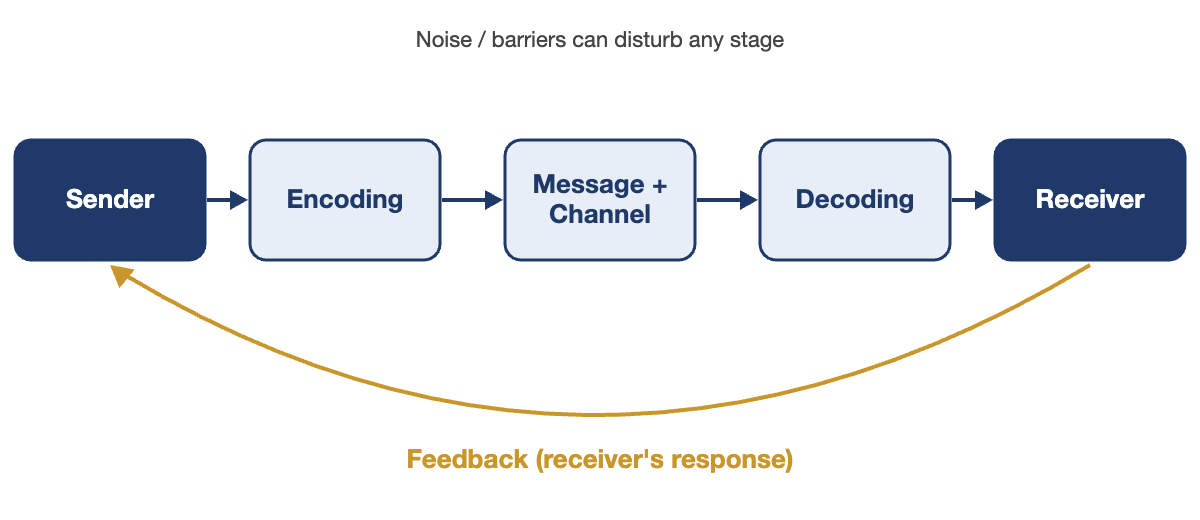
For the full process (sender, message, encoding, channel, receiver, decoding and feedback), read my notes on the meaning, process and elements of communication.
Definitions of Communication
Some important definitions given by experts are:
- Keith Davis: “Communication is the process of passing information and understanding from one person to another.”
- Louis A. Allen: “Communication is the sum of all the things one person does when he wants to create understanding in the mind of another. It is a bridge of meaning.”
- Newman and Summer: “Communication is an exchange of facts, ideas, opinions or emotions by two or more persons.”
All three definitions agree on one point: communication is complete only when understanding is created in the receiver’s mind.
What are the Principles of Effective Communication?
Definition: The principles of effective communication are the basic guidelines that a sender should follow so that the message reaches the receiver correctly, is understood in the right sense, and brings the desired response.
These principles work like traffic rules. Traffic rules help vehicles reach their destination safely. In the same way, the principles of communication help a message reach the receiver’s mind safely, without confusion.
Different textbooks give different numbers of principles, from seven to fifteen. The 12 principles given below are the ones that appear most often in B.Com and BMS syllabi. Figure 2 shows all twelve at a glance.

12 Principles of Effective Communication
1. Principle of Clarity
The sender must first be clear about what he wants to say and why. Only then can he express it clearly. The message should use simple, familiar words and short sentences, so that it has only one meaning.
Example: “Submit the report soon” is unclear. “Submit the sales report by 5 pm on Friday” is clear.
Remember: A clear thought gives a clear message.
2. Principle of Completeness
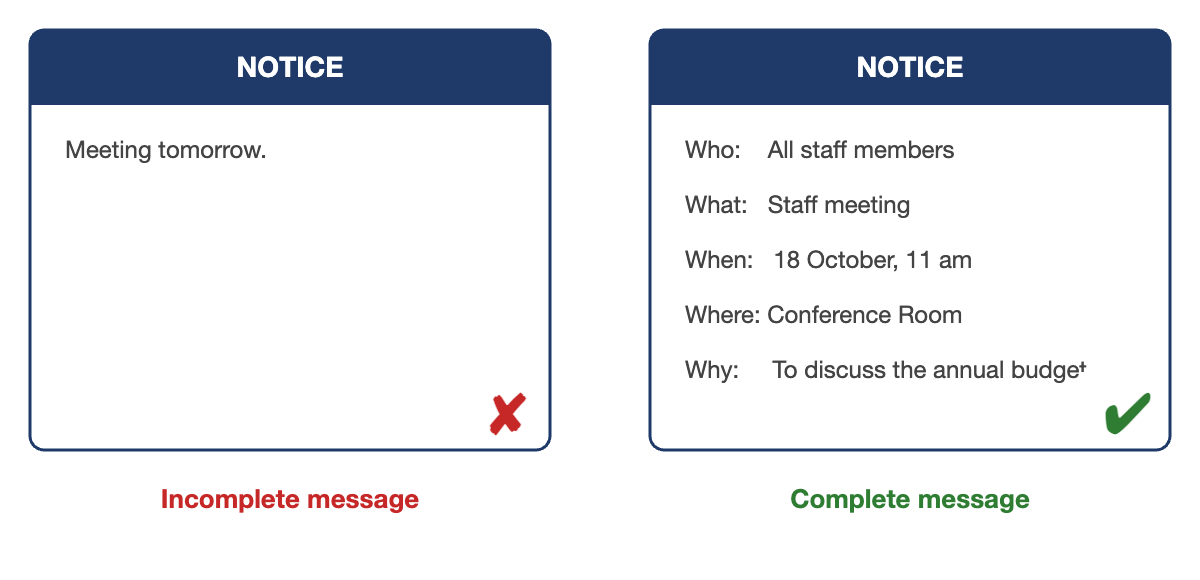
The message should contain all the information the receiver needs to understand it and act on it. An incomplete message leads to doubts, questions and delays. A simple way to check completeness is to ask the five questions: Who? What? When? Where? Why?
Example: A notice saying “Meeting tomorrow” is incomplete. “Staff meeting tomorrow, 18 October, at 11 am in the Conference Room, to discuss the annual budget” is complete.
Remember: Leave no question unanswered.
3. Principle of Conciseness
Conciseness means saying what is necessary in as few words as possible, without leaving out anything important. Busy readers do not like long, repeated or unnecessary words.
Example: “Due to the fact that” can be written as “because”. “At this point of time” can be written as “now”.
Remember: Short, but not incomplete.
4. Principle of Correctness
The facts, figures, names, dates and spellings in the message must be accurate. The language and grammar should also be correct. A single wrong figure can create a big loss, and it also damages the sender’s reputation.
Example: Writing ₹24,000 instead of ₹2,400 in a quotation can lose the customer or cause a serious loss.
Remember: Check before you send.
5. Principle of Consideration
The sender should keep the receiver in mind: his needs, knowledge, background and feelings. This is called the “you-attitude”. The message should focus on what the receiver gains, not only on what the sender wants.
Example: Instead of “We have extended our office hours”, write “You can now visit us till 8 pm.”
Remember: Think from the receiver’s side.
6. Principle of Courtesy
Courtesy means being polite, respectful and friendly in communication, even when we disagree or have to say no. Words like please, thank you and sorry, used sincerely, build goodwill.
Example: “You failed to send the payment” sounds rude. “We have not yet received your payment. Kindly send it at the earliest” is courteous.
Remember: Polite words, firm facts.
7. Principle of Concreteness
The message should be specific and definite, not vague or general. Use exact facts, figures and examples, so the receiver gets a clear picture.
Example: “Our sales increased a lot” is vague. “Our sales increased by 20% in the last quarter” is concrete.
Remember: Facts and figures, not guesses.
8. Principle of Attention
A message works only when the receiver pays attention to it. The sender should choose a good time, a proper tone and an interesting start. Physical, mental or emotional disturbances in the receiver can block attention.
Example: Important instructions given to employees during a noisy lunch break may not get their attention. The same instructions given in a short meeting will.
Remember: No attention, no communication.
9. Principle of Timeliness
The message should reach the receiver at the right time. A message that comes too late becomes useless, and one that comes too early may be forgotten.
Example: Informing students about a change in the exam timetable one day before the exam is too late. It should be done at least a week earlier.
Remember: The right message at the right time.
10. Principle of Consistency
The message should not contradict earlier messages, or the policies and goals of the organisation. If messages keep changing, receivers become confused and lose trust in the sender.
Example: If the HR department announces one leave rule today and a different rule next week without explanation, employees will not trust either notice.
Remember: Same facts, same message.
11. Principle of Right Medium
The sender must choose the most suitable medium (channel) for the message: face-to-face talk, phone call, meeting, letter, email, notice or WhatsApp. The choice depends on how urgent, important, confidential or detailed the message is.
Example: A promotion letter should be given in writing. An urgent safety warning should be given orally or by an alarm, not by a letter.
| Situation | Suitable medium | Reason |
|---|---|---|
| Urgent safety warning | Alarm, announcement | Fast; reaches everyone at once |
| Appointment or promotion | Letter | Written record; formal |
| Daily work update | Email or WhatsApp group | Quick; can be read later |
| Sensitive or personal matter | Face-to-face talk | Private; allows immediate feedback |
| Rule for all staff | Notice or circular | Same message for everyone |
Remember: The right road for the right message.
12. Principle of Feedback
Feedback is the receiver’s response to the message. It tells the sender whether the message was understood correctly. Without feedback, communication remains incomplete. The sender should ask questions, invite doubts and observe the receiver’s reaction.
Example: After explaining a new process, a manager asks, “Can you tell me the first three steps?” The answer shows whether the staff has understood. Read more in my notes on feedback in communication.
Remember: Feedback completes the circle.
Poor Message vs Effective Message
The table below shows how the same message changes when we follow the principles.
| Principle | Poor message | Effective message |
|---|---|---|
| Clarity | “Submit the report soon.” | “Submit the sales report by 5 pm on Friday.” |
| Completeness | “Meeting tomorrow.” | “Staff meeting, 18 October, 11 am, Conference Room, on the annual budget.” |
| Conciseness | “Due to the fact that the bus was late…” | “Because the bus was late…” |
| Correctness | “Price: ₹24,000” (actual ₹2,400) | “Price: ₹2,400” (checked) |
| Consideration | “We have extended our office hours.” | “You can now visit us till 8 pm.” |
| Courtesy | “You failed to send the payment.” | “We have not yet received your payment. Kindly send it at the earliest.” |
| Concreteness | “Our sales increased a lot.” | “Our sales increased by 20% in the last quarter.” |
Balancing the Principles (an extra point for good marks)
Sometimes two principles seem to pull in opposite directions. For example, conciseness says “be short”, but completeness says “give all the information”. Timeliness says “be quick”, but correctness says “check first”.
A good communicator balances them by keeping the receiver and the purpose in mind. If the receiver knows little about the matter, give more details. If a mistake would be costly, check carefully even if it takes a little longer.
Example: A student writes to a teacher at night: “Sir, assignment?” It is short, but it is incomplete. The better message is: “Good evening, Sir. This is Riya Patil from SY B.Com A. May I submit the Business Economics assignment on Monday instead of Friday? I was unwell this week.” It is still short, but now it is also complete, clear and courteous.
Writing one such paragraph in your answer shows the examiner that you have understood the principles, not just memorised them.
Quick Revision Table
| No. | Principle | Key idea in one line |
|---|---|---|
| 1 | Clarity | Clear idea, simple words, one meaning |
| 2 | Completeness | All necessary information (Who, What, When, Where, Why) |
| 3 | Conciseness | Few words, nothing important left out |
| 4 | Correctness | Accurate facts, figures and grammar |
| 5 | Consideration | Receiver’s needs first (“you-attitude”) |
| 6 | Courtesy | Polite and respectful tone |
| 7 | Concreteness | Specific facts and figures, not vague words |
| 8 | Attention | Receiver must be attentive |
| 9 | Timeliness | Message at the right time |
| 10 | Consistency | No contradiction with earlier messages or policy |
| 11 | Right Medium | Suitable channel for the message |
| 12 | Feedback | Check that the message is understood |
Memory tip: Seven of these start with C (Clarity, Completeness, Conciseness, Correctness, Consideration, Courtesy, Concreteness). These are the famous 7 Cs of communication, explained in detail in my post on the 7 Cs of communication. The other five are A T C M F: Attention, Timeliness, Consistency, Medium, Feedback.
How to Write This Answer in the Exam
For a 10-mark or 15-mark question (“Explain the principles of effective communication”):
- Introduction (3–4 lines): Say what communication is and when it becomes effective.
- Definition: Give one definition of communication (for example, Keith Davis) and a one-line definition of the principles.
- Principles: Write 8 to 10 principles as sub-headings. Under each, write 2–3 lines of explanation and one short example.
- Extra point: Add 3–4 lines on balancing the principles.
- Conclusion (2–3 lines): Say that following these principles saves time, avoids misunderstanding and builds goodwill.
For a 5-mark short note: Write a two-line introduction, then any five principles with one line each, and a one-line conclusion.
Model conclusion: “Thus, the principles of effective communication act as a guide for the sender. When a message is clear, complete, correct, courteous and timely, and when feedback is taken, it is understood properly and brings the desired result. These principles help an organisation save time, avoid confusion and build good relations with employees and customers.”
Important Exam Questions
Long answer questions (10/15 marks)
- Define communication. Explain the principles of effective communication.
- “Communication is a bridge of meaning.” Explain this statement and discuss the principles of effective communication.
- Explain any eight principles of effective business communication with suitable examples.
Short notes (5 marks)
- Principle of Feedback
- Principle of Consideration (you-attitude)
- Principle of Completeness
- Principle of Timeliness
Fill in the blanks / one-line answers
- The word communication comes from the Latin word ________. (communis)
- The “you-attitude” is related to the principle of ________. (consideration)
- The receiver’s response to a message is called ________. (feedback)
- “Communication is a bridge of meaning” was said by ________. (Louis A. Allen)
Conclusion
The principles of effective communication are simple, but they are powerful. Clarity, completeness, conciseness, correctness, consideration, courtesy, concreteness, attention, timeliness, consistency, the right medium and feedback together make sure that a message is not only sent but also understood.
In college, these principles help you write better answers, applications and emails. At work, they help you avoid mistakes, save time and build good relations with colleagues and customers. Learn them for your exam, but more importantly, use them every time you speak or write.
Frequently Asked Questions
1. What are the principles of effective communication? They are basic guidelines that help a message reach the receiver correctly and be understood in the right sense. The main ones are clarity, completeness, conciseness, correctness, consideration, courtesy, concreteness, attention, timeliness, consistency, right medium and feedback.
2. How many principles of communication are there? There is no fixed number. Different books give between seven and fifteen. Always follow the list given in your own syllabus.
3. What is the difference between the 7 Cs and the principles of communication? The 7 Cs are one popular group of principles that start with the letter C. The full list of principles also includes points such as attention, timeliness, consistency, right medium and feedback.
4. Which is the most important principle of communication? All principles are important, but consideration (thinking about the receiver) and feedback are often called the most important, because communication is effective only when the receiver understands.
5. Who said “Communication is a bridge of meaning”? Louis A. Allen.
6. What is the you-attitude in communication? It means writing or speaking from the receiver’s point of view, focusing on the receiver’s needs and benefits. It is part of the principle of consideration.
Dr. Amar Sontakke has taught English and Communication Skills since 2011. He is an Associate Professor of English at NSS College of Commerce and Economics, Mumbai.