Imagine this. A boy named Rohan knows the answer to the teacher’s question. He knows it perfectly. His hand is halfway up. But then a small voice inside his head whispers, “What if I’m wrong? What if everyone laughs?” So he pulls his hand back down and stays quiet. Two minutes later, another student gives the exact same answer Rohan had in his mind. The teacher smiles and says, “Very good.”
Rohan didn’t fail because he didn’t know English. He didn’t fail because he didn’t know the answer. He failed because something inside his mind stopped him.
That “something” has a name. We call it a psychological barrier to communication. In fact, psychological barriers to communication affect students, teachers, and working professionals almost every single day.
Here is a question worth thinking about: if we already know the language, and we already know what we want to say, why do we still fail to communicate? Why do smart people go blank in interviews? Why do close friends misunderstand each other over one small text message? Why does a confident student suddenly freeze in front of the class?
These psychological barriers to communication are the hidden reason so many conversations go wrong. The answer is almost never about words. It is about what is happening inside our head. And that is exactly what this article is about. By the end, you will understand what psychological barriers are, spot them in your own life, and know simple ways to break through them.
What Does Communication Actually Mean?
Before we talk about barriers, let’s be clear about one thing. Communication (see the general meaning of communication) means sharing a message from one person to another so that both understand it in the same way.
It sounds simple, but it has many parts. There is a sender (the person who speaks or writes), a message (the idea), a channel (voice, text, face), and a receiver (the person who listens or reads). Communication is successful only when the message in the sender’s mind reaches the receiver’s mind without getting damaged on the way.
The problem is that the message often does get damaged. Something blocks it, changes it, or stops it completely. Anything that stops a message from being understood correctly is called a communication barrier (you can also check the dictionary meaning of “barrier”).
What Is a Communication Barrier?
A communication barrier is any obstacle that stops your message from reaching the other person clearly. It’s like static on a phone call. The words are being sent, but they don’t arrive the way you wanted.
Barriers come in many types. Some are outside us, like loud noise or a weak internet signal. Some are inside us, hidden in our thoughts and feelings. The ones hidden inside are usually the hardest to notice, and often the most powerful. Those are the psychological barriers. To see the complete picture, you can read our detailed guide on the barriers to communication.
What Are Psychological Barriers to Communication?
Here is a simple definition.
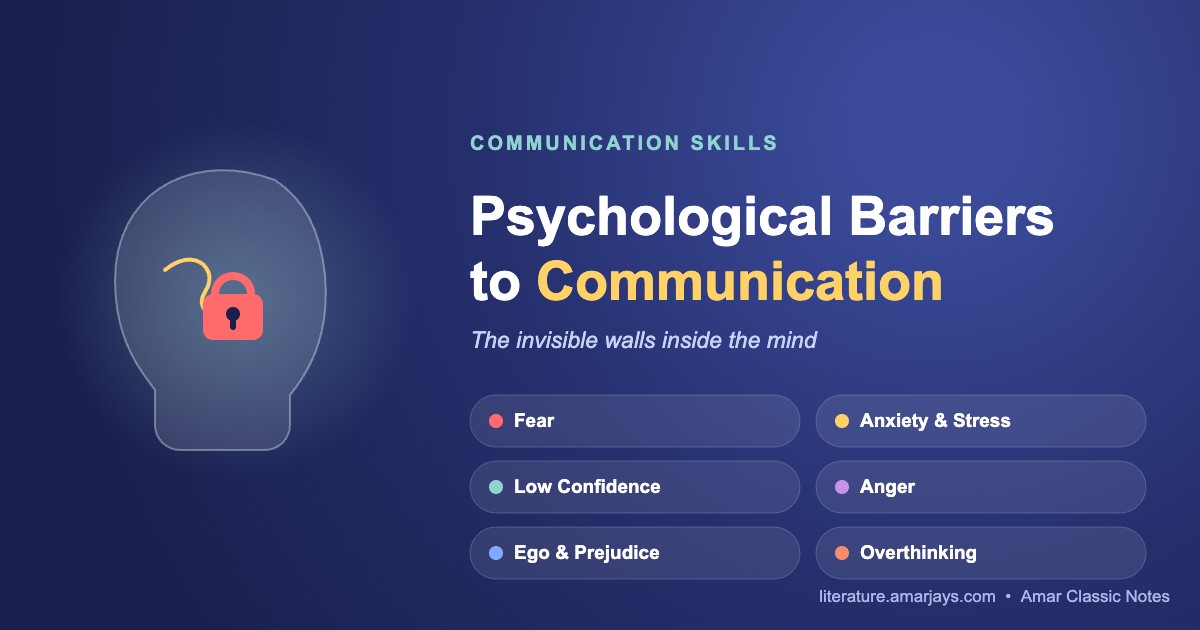
Psychological barriers to communication are the mental and emotional problems inside a person that stop them from sending or receiving a message clearly.
In plain words: these are the barriers that live in your mind, not in the room around you. Fear, stress, anger, low confidence, ego, and overthinking are all psychological barriers. Nobody can see them. There is no noise, no bad signal, no language problem. And yet the communication still breaks down.
Let’s make this crystal clear with three everyday examples:
- A girl wants to ask her teacher a doubt, but she is too shy, so she stays silent and stays confused. (The barrier is shyness / fear.)
- A man is so angry during an argument that he stops listening and only shouts. (The barrier is anger.)
- An employee reads a short email from the boss and spends the whole night worrying that the boss is upset with him, even though the email was totally normal. (The barrier is overthinking.)
In each case, the words were fine. The mind was the problem. This is the heart of psychological barriers to communication.
How Are Psychological Barriers Different From Other Barriers?
This is an important point that many students get confused about. Psychological barriers are not the only type of communication barrier. Here is how they differ from the others, in the simplest way:
- Physical barriers are in the environment — noise, distance, poor lighting, a wall between people.
- Semantic barriers are about language and meaning — difficult words, wrong grammar, unclear sentences.
- Cultural barriers come from different customs, values, and habits between people from different backgrounds.
- Technological barriers come from tools — a weak internet connection, a phone that keeps cutting off, a broken microphone.
- Psychological barriers come from inside the mind — emotions, fears, and attitudes.
The key difference is this: you can see most other barriers. You can hear the noise. You can point at the bad Wi-Fi. But you cannot see fear, stress, or ego. That invisibility is what makes psychological barriers so tricky.
The Main Types of Psychological Barriers to Communication
Now let’s look at the most common psychological barriers one by one. For each, I’ll explain the meaning in simple words, give a real example, show how it damages communication, and offer a simple solution you can actually use.
1. Fear
Meaning: Fear is the feeling that something bad will happen if you speak. Fear of mistakes, fear of judgment, fear of the wrong reaction.
Example: A student wants to ask a question in class but thinks, “What if the teacher thinks it’s a silly question?” So he stays quiet.
How it affects communication: Fear locks your mouth. You either say nothing, or you speak so softly and quickly that no one understands. Your real message never leaves your head.
Simple solution: Start small. Speak up in safe places first — with one friend, then a small group. Remind yourself that most people are too busy with their own worries to judge you.
2. Anxiety and Nervousness
Meaning: Anxiety is a worried, restless feeling before or during communication, even when there is no real danger.
Example: During an interview, a candidate’s hands shake, her mind goes blank, and she forgets answers she practised ten times at home.
How it affects communication: Anxiety scrambles your thoughts. You stumble over words, lose your train of thought, and give a weaker impression than you deserve.
Simple solution: Slow, deep breathing before you speak calms the body. Preparation also helps — the more you practise, the less power nervousness has over you.
3. Stress
Meaning: Stress is mental pressure, usually from too many problems or too much to handle at once.
Example: An employee is under pressure to finish three tasks by evening. A colleague asks a simple question, and the employee snaps rudely without meaning to.
How it affects communication: A stressed mind is a crowded mind. You misread messages, react sharply, and struggle to explain yourself calmly.
Simple solution: Handle stress before it handles your conversations. Short breaks, a walk, a glass of water, or simply saying “Give me five minutes” can protect your relationships.
4. Lack of Confidence and Low Self-Esteem
Meaning: This is the feeling that “I am not good enough” or “My opinion doesn’t matter.” Low self-esteem is a poor image of yourself.
Example: A student thinks his English isn’t good enough, so he never volunteers to answer, even when he knows the answer better than anyone.
How it affects communication: When you don’t value your own voice, you hide it. You speak less, agree with everyone, and let others decide for you.
Simple solution: Confidence grows through action, not waiting. Prepare well, focus on the message instead of yourself, and celebrate small wins. Every time you speak up, you get a little braver.
5. Anger
Meaning: Anger is a strong, hot emotion that takes over when we feel hurt, insulted, or treated unfairly.
Example: Two friends are arguing. One is so angry that he stops listening completely and just wants to “win.”
How it affects communication: Anger closes the ears and opens the mouth. You say things you don’t mean, and you miss what the other person is actually telling you.
Simple solution: Pause before you react. Even a ten-second gap — or a simple “Let’s talk about this later” — can save a relationship from a sentence you’ll regret.
6. Prejudice and Bias
Meaning: Prejudice means judging a person or their message before really listening. Bias is a fixed opinion that isn’t fair.
Example: A listener thinks, “This person is younger than me, so he can’t teach me anything,” and ignores a genuinely good idea.
How it affects communication: When you’ve already decided, you stop truly listening. Good ideas bounce off you because your mind is already closed.
Simple solution: Judge the message, not the messenger. Ask yourself, “Would I accept this idea if someone I respected had said it?”
7. Negative Attitude
Meaning: A negative attitude is a habit of expecting the worst — from people, situations, and conversations.
Example: Before a group discussion even begins, someone thinks, “This is useless, no one listens to me anyway,” and so contributes nothing.
How it affects communication: Negativity leaks out through your tone, face, and body. People sense it and pull away, which makes communication colder and shorter.
Simple solution: Enter conversations expecting something good. A small shift from “This won’t work” to “Let me try” changes how others respond to you.
8. Lack of Trust
Meaning: Trust is believing that the other person is honest and means well. Without it, every message feels suspicious.
Example: An employee doesn’t trust her manager, so when he offers helpful feedback, she hears it as an attack.
How it affects communication: Without trust, people hide the truth, hold back their real opinions, and read hidden meanings into simple words.
Simple solution: Trust is built slowly through small honest actions. Keep your promises, listen without judging, and be consistent.
9. Emotional Instability
Meaning: This is when emotions swing quickly and strongly, making it hard to stay calm and clear.
Example: A person is happy one moment, then bursts into frustration the next, confusing everyone around them.
How it affects communication: When emotions are all over the place, your message becomes unpredictable. People don’t know how to respond, so they become careful and distant.
Simple solution: Learn to name your feelings (“I’m feeling frustrated right now”). Naming an emotion is the first step to controlling it.
10. Poor Listening Caused by Mental Distraction
Meaning: This is when your body is present but your mind is somewhere else — worries, plans, your phone.
Example: A friend is telling you something important, but you’re mentally rehearsing your own reply and miss half of what they said.
How it affects communication: Communication is two-way. If you don’t truly receive the message, no real exchange happens, no matter how much talking there is.
Simple solution: Practise “full attention” listening, and build your listening skills step by step. Put the phone away, look at the speaker, and focus on understanding before replying.
11. Overthinking
Meaning: Overthinking is analysing something so much that you create problems that were never there.
Example: You send a message on WhatsApp. The person reads it but doesn’t reply for two hours. You start imagining they’re angry, when really they were just busy.
How it affects communication: Overthinking fills the gaps with fear. You react to imaginary messages instead of real ones, causing needless tension.
Simple solution: When you catch yourself spinning, ask: “Do I have real proof of this, or am I guessing?” Most of the time, you’re guessing.
12. Assumptions
Meaning: An assumption is believing something is true without checking.
Example: Two friends plan to meet “in the evening.” One assumes 5 p.m., the other assumes 8 p.m. Both end up upset and blame the other.
How it affects communication: Assumptions fill the silence with wrong information. We hear what we expect, not what was actually said.
Simple solution: When in doubt, ask. One clarifying question — “Do you mean 5 or 8?” — prevents a hundred misunderstandings.
13. Lack of Interest
Meaning: This is when a person simply doesn’t care about the topic or the conversation.
Example: A student finds a lesson boring, so his mind drifts and nothing goes in.
How it affects communication: Without interest, the message enters the ears but never reaches the mind. It’s like pouring water into a closed bottle.
Simple solution: Try to find one personal reason the topic matters to you. Curiosity is a switch — once it’s on, listening becomes easy.
14. Ego
Meaning: Ego is an over-focus on being right, being important, or being better than others.
Example: A team member refuses to accept a good suggestion simply because it came from a junior colleague.
How it affects communication: Ego turns conversations into contests. Instead of solving a problem together, people fight to protect their pride.
Simple solution: Remind yourself that the goal is understanding, not winning. Being open is a strength, not a weakness.
15. Jealousy, Insecurity and Comparison
Meaning: Jealousy is discomfort at someone else’s success. Insecurity is a deep fear that you’re not good enough. Both often come from comparing yourself to others.
Example: A student who constantly compares himself to a “better” classmate feels small, avoids speaking, and reads insults into normal comments.
How it affects communication: Insecurity makes you defensive. You misread intentions, take neutral words personally, and struggle to speak openly.
Simple solution: Compare yourself only to who you were yesterday. Your progress is your business — not a race against others.
16. Fear of Criticism and Fear of Rejection
Meaning: These are the fears of being corrected, judged, or told “no.”
Example: An employee has a brilliant idea in a meeting but says nothing, terrified that someone might criticise it.
How it affects communication: These fears make us silent when we should speak. Good ideas die inside people who are too afraid to share them.
Simple solution: Change how you see criticism and rejection. A “no” is not the end of the world — it’s simply feedback and a chance to improve.
How Psychological Barriers Affect Different Parts of Communication
Psychological barriers don’t just affect speaking. They quietly touch almost every form of communication. Here’s how:
- Speaking: Fear and low confidence make your voice shaky, soft, or completely silent.
- Listening: Anger, distraction, and prejudice stop you from truly hearing others.
- Reading: A stressed or anxious mind misreads the tone and meaning of what’s written.
- Writing: Nervousness and self-doubt make your writing unclear, over-cautious, or confusing.
- Body language: Insecurity shows in a slouched posture, avoided eye contact, and a closed-off stance.
- Interpersonal relationships: Lack of trust and ego slowly create distance between people.
- Classroom communication: Fear of being laughed at keeps students silent and unengaged.
- Workplace communication: Fear of the boss and stress block honest, useful conversations.
- Interviews: Anxiety causes blank minds and weaker answers than a person is capable of.
- Group discussions: Shyness and comparison stop people from sharing valuable points.
- Public speaking: Fear of the crowd turns confident people into nervous speakers.
- Online communication: Overthinking and missing tone create misunderstandings over text.
The pattern is clear: no matter how we communicate, our mind is always involved. And when the mind is blocked, communication suffers.
Psychological Barriers to Communication Among Students
Students face psychological barriers every single day, often without realising it. School and college are full of moments where the mind either helps you or holds you back.
Here are the most common ones:
- Fear of speaking English: Many students freeze in English class, worried about grammar mistakes or a “bad” accent.
- Examination stress: Under exam pressure, students go blank even on topics they know well.
- Fear of making mistakes: The idea that “mistakes are shameful” stops students from trying.
- Peer pressure: Some students stay quiet just to fit in with the group.
- Lack of confidence: A weak self-image makes students underestimate their own answers.
- Fear of being laughed at: One embarrassing moment can silence a student for years.
- Comparison with others: Always measuring yourself against “toppers” damages your confidence.
- Overthinking: Students replay small classroom moments again and again, feeling worse each time.
- Low participation: All of the above lead to sitting silently, even when you have great things to say.
Practical solutions for students:
The good news is that these barriers can be beaten with small, steady steps. Practise speaking English out loud at home, where no one is judging. Remind yourself that every expert was once a beginner who made plenty of mistakes. Answer at least one question in class each day, even a small one, to build the habit. Focus on your own growth instead of comparing yourself to classmates. And treat mistakes as your teachers, not your enemies — every mistake you correct makes you stronger.
Psychological Barriers to Communication in the Workplace
The workplace is another place where the mind quietly shapes every conversation. Even skilled professionals struggle when psychological barriers get in the way.
Common workplace barriers include:
- Fear of the boss: Employees hide problems or stay silent because they’re scared of the reaction.
- Workplace stress: Deadlines and pressure make people short-tempered and unclear.
- Lack of trust: When teammates don’t trust each other, honest communication disappears.
- Ego clashes: Two strong personalities fight to be right instead of solving the problem.
- Negative assumptions: People assume the worst about a colleague’s intentions.
- Fear of expressing opinions: Good ideas stay hidden because people fear looking foolish.
- Poor colleague relationships: Tension between people blocks smooth teamwork.
- Emotional reactions: Reacting in anger or frustration damages professional respect.
- Lack of meeting confidence: Talented people stay silent in meetings and go unnoticed.
- Interview nervousness: Anxiety hides a candidate’s real skills and potential.
Practical workplace solutions:
Build trust by keeping your word and being reliable in small things. Before reacting emotionally, take a short pause and respond calmly. Prepare your points before meetings so you feel ready to speak. See your manager as a person you can work with, not just an authority to fear. And ask questions instead of assuming — a quick “Just to confirm, did you mean this?” prevents big mistakes.
Psychological Barriers in Digital Communication
Something interesting happens online. When we text, email, or message, we lose tone of voice and facial expressions — two things that carry most of our real meaning in person. Our mind then fills those gaps, and it often fills them with fear and assumptions.
Here’s how psychological barriers show up in digital communication:
- WhatsApp: You see “seen” but no reply, and you assume the person is ignoring or angry with you — when they’re probably just busy.
- Email: A short, formal reply feels “cold” or rude, even though the sender was simply in a hurry.
- Social media: A harmless comment gets read as an insult because we can’t hear the person’s tone.
- Online classes: Students stay on mute and switch off cameras, hiding behind the screen out of shyness.
- Video meetings: Nervousness increases when people feel everyone is staring at their face on screen.
- Text messages: A single full stop or one-word reply gets over-analysed for hidden meaning.
Example: Priya texts her friend, “Ok.” Her friend, who is a bit insecure that day, reads it as, “She’s annoyed with me.” In reality, Priya was cooking and just typed a fast reply. One tiny word, two very different meanings — all because tone was missing and the mind filled the gap.
How to communicate better online: Assume good intentions unless you have real proof otherwise. When something feels off, ask directly instead of imagining the worst. And for anything emotional or serious, pick up the phone or talk face to face, where tone can do its job.
How to Overcome Psychological Barriers to Communication
Now for the most useful part. Here are practical strategies you can start using today. You don’t need all of them at once — pick two or three and practise them.
- Build self-confidence. Prepare well and speak up in small, safe situations first. Confidence is a muscle; it grows every time you use it.
- Think before you react. Pause for a few seconds before responding, especially when emotions are high. That small gap saves relationships.
- Control your anger. When you feel heat rising, breathe slowly and delay your response. Say “Let’s continue this later” if needed.
- Listen actively. Give the speaker your full attention. Aim to understand first, and reply second.
- Avoid assumptions. Don’t guess what someone means — ask. One question can prevent a huge misunderstanding.
- Ask questions. If something isn’t clear, say so. Asking shows interest, not weakness.
- Develop empathy. Try to see the situation from the other person’s side. Empathy softens almost every conversation.
- Accept your mistakes. Everyone makes them. Owning a mistake calmly earns more respect than hiding it.
- Practise speaking regularly. Talk in front of a mirror, record yourself, or chat with friends in English. Practice removes fear.
- Manage your stress. Rest, take breaks, and don’t hold important conversations when you’re overwhelmed.
- Develop a positive attitude. Enter conversations expecting something good rather than something bad.
- Stop unnecessary overthinking. Ask yourself, “Do I have proof, or am I imagining this?” Usually, you’re imagining it.
- Respect different opinions. You don’t have to agree with everyone, but you can listen with an open mind.
- Build trust. Keep your promises and be consistent. Trust makes honest communication possible.
- Improve emotional awareness. Learn to notice and name your feelings. When you understand your emotions, they stop controlling you.
- Focus on the message, not on yourself. When you worry less about “How do I look?” and more about “What do I want to share?”, fear naturally shrinks.
Remember: you don’t have to be perfect. You just have to keep practising. Small daily steps beat one big leap.
Psychological Barriers vs Other Communication Barriers (Comparison Table)
Here’s a simple table to see the difference at a glance:
| Type of Barrier | Meaning (in simple words) | Everyday Example |
|---|---|---|
| Psychological | Problems inside the mind, like fear or ego | A student stays silent in class out of fear |
| Physical | Problems in the surroundings | Loud traffic noise drowns out a conversation |
| Semantic | Problems with words and meaning | A difficult word confuses the listener |
| Cultural | Differences in customs and values | A gesture that is polite in one culture offends in another |
| Technological | Problems with tools and devices | A weak internet signal cuts off a video call |
Notice that only the psychological barrier is invisible. The others can be seen, heard, or pointed at. That’s what makes the mental ones so easy to miss.
A Simple Example of Psychological Barriers to Communication
Let me tell you a short story that ties everything together.
The situation: Aditi is a bright college student. Her professor announces a class presentation. Aditi has done excellent research and knows her topic better than anyone in the room.
The psychological barrier: As her turn comes closer, fear takes over. She starts thinking, “What if I forget my lines? What if they laugh at my English? What if my voice shakes?” Her heart pounds. Her mind, which was full of great points a minute ago, suddenly feels empty.
The communication problem: When she stands up, her voice is barely audible. She rushes through her slides, forgets her strongest points, and avoids eye contact with everyone.
The result: The class thinks she was “unprepared,” even though she had prepared more than anyone. She sits down feeling defeated and starts believing she is “just bad at speaking.”
The solution: Later, a kind teacher tells her the truth: her problem was never knowledge or English. It was fear and overthinking. So Aditi starts small. She practises out loud at home, presents first to two friends, then to five. She learns to breathe before speaking and to focus on her message instead of the audience. A few months later, she gives a confident presentation — the same girl, the same English, but without the mental block. The only thing that changed was inside her mind.
That’s the whole point of this article in one story. The barrier was never the world outside. It was the mind inside.
The Key Difference: “I Cannot Communicate” vs “I Am Stopping Myself”
Here’s an idea worth remembering forever.
There is a huge difference between these two sentences:
- “I cannot communicate.”
- “I am mentally stopping myself from communicating.”
The first sentence sounds like a permanent fact — as if you simply lack the ability. But it’s usually not true. Most people who “can’t communicate” actually can. They have the words, the knowledge, and the ability. What they don’t have, in that moment, is the mental permission.
The second sentence is the honest one. It says the ability is there, but something inside — fear, doubt, ego, stress — is holding it back. And here’s the hopeful part: anything you are doing to yourself, you can also learn to undo.
This is exactly why psychological barriers are so hard to notice. When the barrier is noise or bad Wi-Fi, you know what to blame. But when the barrier is your own mind, it feels like you are the problem. You’re not. Your mind is just running an old fear. And fears can be unlearned.
Frequently Asked Questions (FAQ)
1. What are psychological barriers to communication?
Psychological barriers are mental and emotional problems inside a person — like fear, stress, anger, or low confidence — that stop them from sending or receiving a message clearly.
2. What are the main psychological barriers to communication?
The main ones include fear, anxiety, stress, lack of confidence, low self-esteem, anger, prejudice, negative attitude, lack of trust, ego, overthinking, assumptions, and fear of criticism or rejection.
3. How does fear affect communication?
Fear makes people stay silent or speak nervously. Even when they know what to say, fear of mistakes or judgment stops the message from coming out clearly.
4. How does stress create communication barriers?
A stressed mind is crowded and tired. It misreads messages, reacts sharply, and struggles to explain things calmly, which leads to misunderstandings.
5. How does lack of confidence affect communication?
When people don’t value their own voice, they speak less, agree with everyone, and hide their real opinions — so their ideas never get heard.
6. What is an example of a psychological barrier?
A student who knows the answer but stays quiet out of fear of being laughed at is a classic example of a psychological barrier in action.
7. How can psychological barriers be overcome?
Through small, steady steps: building confidence, listening actively, controlling anger, avoiding assumptions, managing stress, and practising communication regularly.
8. What are psychological barriers in students?
Common ones include fear of speaking English, exam stress, fear of mistakes, peer pressure, low confidence, fear of being laughed at, and comparing themselves with others.
9. What are psychological barriers in the workplace?
These include fear of the boss, work stress, lack of trust, ego clashes, fear of sharing opinions, and nervousness during meetings and interviews.
10. What is the difference between psychological and semantic barriers?
A psychological barrier is a problem inside the mind (like fear), while a semantic barrier is a problem with words and meaning (like a difficult or confusing word).
People Also Ask
- Why do psychological barriers happen even when we know the language?
- Can psychological barriers to communication be completely removed?
- Which is the most common psychological barrier among students?
- How do emotions affect communication in daily life?
- What is the first step to overcome fear of speaking?
Conclusion
If there is one thing to carry away from this article, it’s this: good communication is not about speaking perfect English or using big words. It’s about being able to express yourself clearly, listen with real attention, understand others, and manage the mental barriers that quietly get in the way.
Almost everyone has felt that invisible wall — the frozen moment in an interview, the silence in a classroom, the misread text message. You are not alone, and you are not “bad at communicating.” You simply have a mind that sometimes gets scared, and a mind that can also be trained to be brave.
Understanding these psychological barriers to communication is the first real step toward speaking freely. So the next time fear whispers, “Stay quiet,” take a breath, and speak anyway. Every time you push through, the wall gets a little thinner. One day, you’ll look back and realise the barrier was never really there — it was just a thought you finally decided to walk past.