
It was a normal Monday morning. Rahul walked into the office, switched on his computer, and reached for his tea. Before he could take the first sip, a colleague leaned over and whispered, “Did you hear? They say the company is going to change the whole salary structure.”
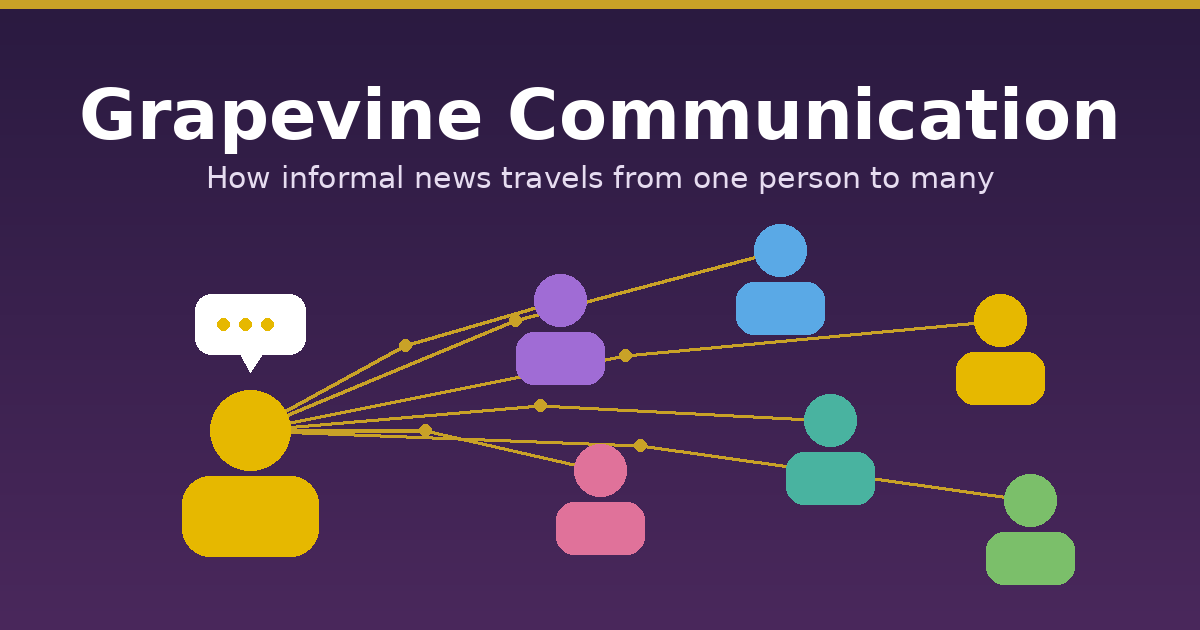
Rahul blinked. “Who said that?”
“Everyone is saying it.”
By lunchtime, the story had grown. One person said salaries would be cut. Another said only managers would get a raise. A third said the whole team might be shifted to a new city. By evening, five different people had heard five different versions of the same “news.”
Here is the strange part. Management had officially announced nothing. No email. No notice. No meeting. Yet the news travelled across the whole office in a few hours.
So how did it happen? How does information move so fast when no official message has been sent?
The answer is a fascinating part of communication called grapevine communication. In this guide, think of me as your Business Communication teacher sitting beside you, explaining this topic with real stories and simple examples. By the end, you will understand what grapevine communication is, how it works, its types, its good and bad sides, and how to handle it wisely. You will probably also think, “I have seen this happen in real life!” Let’s begin.
What Is Grapevine Communication?
Let’s keep it very simple.
Grapevine communication is the informal way in which information travels from one person to another, without following the official channels of an organization or group.
Read that again slowly. The key word is informal. Informal means unofficial, friendly, and not planned. It is the opposite of a formal notice or an official email.
Here is the idea in everyday words. In every office, college, and family, there is an “official” way to share news. In a company, the boss sends an email or the HR department puts up a notice. This is formal communication. But there is also an “unofficial” way. People chat during tea breaks. They message each other. They whisper in corridors. News jumps from friend to friend. This unofficial network is grapevine communication.
Why do people take part in it? Because we are human. We are curious. We like to know what is happening around us. We enjoy sharing news with friends. Sometimes we share because we are worried and want answers. Most of the time, people are not trying to cause harm. They are simply talking, the way people always have.
Two important points right at the start:
Is grapevine communication always false? No. Sometimes the information is completely true. Sometimes it is partly true. Sometimes it is wrong. It is a mixed bag.
Is grapevine communication always harmful? No. It can cause problems, but it can also do good. We will see both sides later.
For now, remember this simple picture: grapevine communication is people sharing information the friendly, unofficial way.
Why Is It Called Grapevine Communication?
Have you ever looked at a grapevine plant? Its branches grow in all directions. They twist, cross, and spread in a tangled, messy pattern. There is no straight line. You cannot easily predict where the next branch will go.
Informal communication looks a lot like that. It does not travel in a neat, straight line. It jumps from one person to another in a twisted, unpredictable path, just like the branches of a grapevine. That is why we use the name “grapevine.”
The term is often linked to the time of the American Civil War, when messages carried over tangled telegraph wires were said to come “through the grapevine,” and the wires themselves were sometimes called a “grapevine telegraph.” The exact history of the phrase is debated, so it is best to treat this as a commonly told background rather than a proven fact. What we can say for certain is that the picture fits perfectly: messy, spreading, and hard to trace, exactly like real informal communication.
How Does Grapevine Communication Work?
Grapevine communication works through a simple chain of people. Imagine it like this:
Person A → Person B → Person C → Person D → the whole group
Person A tells Person B something. Person B tells Person C. Person C tells a few others. Soon, many people know. But here is the interesting part: the message often changes as it travels.
Why does it change? Because each person remembers a little differently, adds their own guess, or drops a small detail. A tiny change here, a small addition there, and the message slowly becomes a different story.
Let me show you how one simple sentence can grow into something huge.
It may start as a small, careful statement:
“The manager may be transferred to another branch.”
By the time it reaches the next few people, “may be” quietly disappears:
“The manager is definitely leaving.”
A little later, someone adds their own fear:
“The manager is leaving because there are problems in our department.”
And finally, the story becomes enormous:
“The entire department might be closed down!”
Notice what happened. The first sentence was small and uncertain. The last one is dramatic and scary. Nobody lied on purpose. Each person just added a little colour. This is how a small piece of information can become a much bigger story on the grapevine. Understanding this one idea helps you see why rumours grow.
Types of Grapevine Communication
Communication experts usually describe four common patterns, or “chains,” of how grapevine information spreads. Let’s understand each one with a simple example and a small diagram. Don’t worry, the diagrams are just arrows showing who tells whom.
1. Single-Strand Chain
Simple meaning: Information passes in one straight line, from one person to the next, one by one.
How it works: A tells B. B tells C. C tells D. Each person passes it to only one more person.
Flow: A → B → C → D
Example: Priya tells only her close friend Sara that a surprise inspection may happen tomorrow. Sara tells only Aman. Aman tells only Ravi. The news moves quietly along a single line.
Where it may occur: Between people who trust each other and share news privately.
One advantage: It is easy to trace where the news started.
One problem: Because it passes through many single steps, the message can change a lot by the end, like the game of “Chinese whispers.”
2. Gossip Chain
Simple meaning: One person becomes the “news reporter” and tells the information to many people.
How it works: One active person, A, tells B, C, D, E and everyone else they meet.
Flow: A → B, A → C, A → D, A → E
Example: In every college, there is that one friendly, talkative student who seems to know everything. When they hear that the college fest date may change, they tell the whole class, one person after another. Here, one person is the centre of the spreading.
Where it may occur: When one person enjoys sharing news and knows many people.
One advantage: News reaches many people very quickly.
One problem: If that one person is wrong, everyone gets the wrong information.
3. Probability Chain
Simple meaning: Information spreads randomly. People tell whoever they happen to meet, without any plan.
How it works: A tells a few random people. Those people tell other random people. There is no fixed pattern.
Flow: A → C, A → F, C → B, F → G (random jumps)
Example: During a lunch break, Neha casually mentions to two random people that bonuses might be delayed. Those two mention it to whoever they bump into. Nobody chooses carefully; the news just bounces around by chance.
Where it may occur: In big, busy places where people meet many others by accident.
One advantage: It spreads naturally without effort.
One problem: Because it is random, some important people may never hear it, while unimportant details spread everywhere.
4. Cluster Chain
Simple meaning: One person shares information with a selected group of trusted people. Some of those people then share it with their own trusted groups.
How it works: A tells only a chosen few, say B and C. Then B tells their own small circle, and C tells another small circle.
Flow: A → B → (B’s group), A → C → (C’s group)
Example: A senior employee tells only three trusted teammates that a new project is coming. Each of those three later tells two or three of their own close friends. The news moves in small, connected clusters.
Where it may occur: This is the most common type in real workplaces, because people usually share news with those they trust.
One advantage: It spreads through trusted relationships, so people often take it seriously.
One problem: It can create “inner circles,” where some people know important news and others feel left out.
One Message, Four Stories
Now comes a really interesting part. Let me show you how the same piece of information can travel through all four patterns in one imaginary company called “BrightTech.”
The starting information is simple and honest:
“The company may introduce a new work schedule.”
Watch how four different grapevine patterns handle it.
Through the single-strand chain: Meena tells only Karan. Karan tells only Zoya. Zoya tells only Dev. By the time it reaches Dev, it has quietly become, “We will all have to work on Saturdays now.” One straight line, one changed story.
Through the gossip chain: Talkative Anil hears it and tells the entire floor by evening: “New schedule coming!” Everyone hears the same short version from the same person, fast but shallow.
Through the probability chain: Two people mention it randomly in the canteen. It bounces from table to table. Some employees hear “new schedule,” some hear “longer hours,” and some never hear it at all.
Through the cluster chain: A team leader shares it with three trusted members. Each of them shares it with their own close friends. Soon several small groups are discussing it, each with slightly different details.
Same starting message. Four different journeys. Four slightly different stories. This is exactly why, in real offices, “everyone heard something different.” I bet you have seen this happen.
Characteristics of Grapevine Communication
Let’s look at the main features of grapevine communication. Each one is explained with a quick example so it stays clear.
- It is informal. There is no official form, no signature, no notice. Example: news shared over tea, not over email.
- It is fast. It often moves faster than official messages. Example: a promotion “leaks” before the official letter arrives.
- It is flexible. It can start anywhere and go anywhere. Example: a canteen chat reaches the top floor by evening.
- It is person-to-person. It depends on people talking to people. Example: no people talking means no grapevine.
- It is difficult to control. Managers cannot fully stop it. Example: even after a “please don’t spread rumours” email, people keep talking.
- It can be inaccurate. Details change as they travel. Example: “may be transferred” becomes “is fired.”
- It is based on relationships. People share more with those they trust. Example: you tell your close friend first.
- It can spread widely. A small group can quickly become a whole office. Example: three people this morning, three hundred by evening.
- It exists alongside formal communication. Both run at the same time. Example: the official notice and the corridor whispers happen together.
- It can reflect employee feelings. It often shows the real mood. Example: lots of worried rumours may mean people feel insecure.
- It exists in every organization. No company, college, or group is free of it. Wherever there are people, there is a grapevine.
Why Do People Use Grapevine Communication?
This is one of the most human parts of the whole topic. Why do people naturally share unofficial news? Not because they are bad, but because of very normal human reasons.
- Curiosity. We simply like to know what is going on.
- Need for information. When official news is missing, people look for answers anywhere.
- Friendship. Sharing news feels like a friendly, bonding activity.
- Trust. We pass news to people we trust, and we believe news from people we trust.
- Fear and anxiety. When people are worried, they talk more to feel less alone.
- Reducing uncertainty. Not knowing is uncomfortable. Talking helps people feel they understand the situation.
- Desire to help others. Sometimes people share news genuinely to warn or help a friend.
- Desire to feel included. Knowing the “inside news” makes people feel important and connected.
- Workplace relationships. Chatting builds bonds between colleagues.
- Entertainment. Let’s be honest, a bit of news makes a boring day more interesting.
- Emotional bonding. Sharing feelings and news brings people closer.
Here is the balanced truth: most people do not spread information with bad intentions. They are curious, worried, or friendly. Understanding this helps you judge grapevine communication fairly, instead of blaming everyone who talks.
Why Does Grapevine Communication Spread So Quickly?
Have you noticed how some news spreads like fire, while other news nobody cares about? Certain things make informal information travel much faster. Here is the simple psychology behind it, no heavy theory, just plain sense.
- Uncertainty. When people don’t know what will happen, they fill the gap with talk. The less official information there is, the more the grapevine grows.
- Fear. Scary topics, like job cuts, spread fastest because people feel they must know.
- Curiosity. Interesting or surprising news makes people want to share it immediately.
- Emotional topics. Anything that touches money, jobs, relationships, or fairness spreads quickly because people care deeply.
- Personal interest. If the news affects me directly, I will pass it on fast.
- Repetition. The more times people hear something, the more they believe it, even if it was never confirmed.
- Trust between people. We accept and pass on news quickly when it comes from someone we like.
Put these together and you get a simple formula: a topic that is emotional, personal, and uncertain, shared between people who trust each other, will spread very fast. That is the secret behind a runaway rumour.
Advantages of Grapevine Communication
Many people think grapevine communication is only bad. That is not true. When used well, it has real benefits. Here are its main advantages, each with a small example.
- It is fast. News reaches people quickly, often before official messages. Example: employees learn about a new project and start preparing early.
- It reaches people widely. It can cover a whole organization in hours. Example: a helpful safety reminder spreads across the office fast.
- It reveals employee feelings. Managers can sense the real mood of the team. Example: many nervous rumours may signal that staff feel insecure.
- It strengthens social relationships. Friendly chats build bonds. Example: colleagues who share news feel closer and work better together.
- It fills information gaps. When official news is slow, the grapevine keeps people informed. Example: staff get a rough idea of upcoming changes.
- It helps people prepare for change. Early hints let people adjust their minds. Example: employees mentally get ready for a possible new schedule.
- It gives management indirect feedback. Leaders learn what people are worried about. Example: a manager hears staff are unhappy about parking and fixes it.
- It reduces feelings of isolation. Sharing news makes people feel connected. Example: a new employee feels part of the team after joining the chatter.
- It helps people understand the workplace mood. You quickly learn “how things really work here.” Example: which manager is friendly, which process is slow.
- It supports informal learning. People pick up useful tips and unwritten rules through casual talk. Example: a junior learns a shortcut from a senior over lunch.
Notice that grapevine communication is not entirely positive. But when the information is honest and the intentions are good, it can genuinely help.
Disadvantages of Grapevine Communication
Now the other side of the coin. When grapevine communication goes wrong, it can cause serious harm. Here are the main disadvantages with realistic examples.
- Rumours. Unverified stories spread as if they were facts. Example: “The company is closing” when it is not.
- False information. Wrong details travel fast and mislead people. Example: a wrong exam date confuses a whole class.
- Misunderstanding. Half-heard news creates confusion. Example: “salary review” is heard as “salary cut.”
- Fear and anxiety. People worry over things that may never happen. Example: staff panic about job losses that were never planned.
- Conflict. Wrong news can turn people against each other. Example: two colleagues fight over a rumour that one is being promoted unfairly.
- Damage to reputation. A false story can hurt a person’s good name. Example: someone is wrongly blamed for a mistake.
- Loss of trust. When rumours prove false, people trust each other less. Example: employees stop believing anything they hear.
- Workplace tension. Constant rumours make the atmosphere stressful. Example: everyone feels uneasy and distracted.
- Reduced productivity. Time spent gossiping is time not spent working. Example: an hour lost discussing a rumour instead of finishing a task.
- Unnecessary panic. A small hint becomes a big scare. Example: “the manager is upset” becomes “everyone will be fired.”
- Spread of confidential information. Private matters leak out. Example: someone’s personal issue becomes office talk.
- Personal attacks. Grapevine can turn cruel and target individuals. Example: unkind stories about a colleague’s private life.
The lesson is clear: the danger is not “people talking.” The danger is false and harmful information travelling fast and unchecked.
Is Grapevine Communication the Same as a Rumour?
This is a question that confuses many students, and it is very important for exams. The short answer is: they are related, but they are not the same.
Grapevine communication is the informal channel through which information travels. A rumour is unverified or uncertain information that has not been confirmed.
Think of it this way. The grapevine is like a road. A rumour is like one type of vehicle travelling on that road. The road (grapevine) can carry many things: true news, helpful reminders, harmless chatter, and also rumours. So a rumour can travel through the grapevine, but the grapevine is much bigger than just rumours.
Simple example: If a colleague informally tells you, “The office picnic is next Friday,” and it turns out to be true, that is grapevine communication carrying correct information, not a rumour. But if someone says, “I heard the company is shutting down,” with no proof, that is a rumour travelling on the grapevine.
So remember: all rumours may travel on the grapevine, but not everything on the grapevine is a rumour. The grapevine is the path; the rumour is one uncertain passenger.
Grapevine Communication vs Formal Communication
Let’s compare the two side by side. This table is perfect for quick revision.
| Basis | Grapevine (Informal) Communication | Formal Communication |
|---|---|---|
| Meaning | Unofficial sharing of information between people | Official sharing through proper company channels |
| Nature | Friendly, casual, unplanned | Structured, planned, professional |
| Speed | Usually very fast | Often slower, follows steps |
| Direction | Any direction, unpredictable | Follows the official chain (top to bottom, etc.) |
| Accuracy | Can be accurate or inaccurate | Usually accurate and reliable |
| Control | Hard to control | Fully controlled by the organization |
| Channel | Chats, whispers, messages, casual talk | Emails, notices, letters, official meetings |
| Record | Usually no written record | Usually documented and recorded |
| Example | “I heard the manager is leaving.” | An official transfer letter from HR |
Both types exist in every organization at the same time. Formal communication is the official backbone. Grapevine communication is the human, unofficial layer running alongside it.
Grapevine Communication in the Workplace
Offices are the natural home of grapevine communication. Wherever people work together, they talk. Let’s look at some realistic workplace situations.
Promotions and transfers. Before any official letter arrives, whispers begin: “I think Neha is getting promoted.” Sometimes it is true; sometimes it is just a guess.
Salary and bonus changes. These are the fastest-spreading topics of all, because money touches everyone personally. One hint about “salary revision” can fill an office with talk in minutes.
New policies and restructuring. When a company is changing something, and has not explained it clearly, the grapevine rushes to fill the silence. This is when panic can grow.
Recruitment. “I heard they are hiring ten new people for our team” can raise both hope and worry among existing staff.
Employee dissatisfaction. Sometimes the grapevine carries complaints, about workload, unfair treatment, or poor facilities. A smart manager listens to this.
Here is the interesting insight for future managers: grapevine communication can actually help leaders. By quietly paying attention to what employees are talking about, a manager can understand the team’s real feelings, spot problems early, and fix them before they grow. On the other hand, if managers ignore the grapevine and hide important news, uncontrolled rumours can spread fear, reduce trust, and slow down work. The grapevine is a mirror of the workplace mood; wise leaders look into it instead of pretending it does not exist.
Grapevine Communication Among Students
Students, this section is for you. You use grapevine communication almost every single day, maybe without realizing it. Have you ever heard any of these?
- “I heard the exam date got postponed!”
- “They say our internal marks are really low this time.”
- “Someone said the new teacher is very strict.”
- “I heard tomorrow is a holiday.”
- “They say the assignment deadline got extended.”
Sound familiar? College life runs on the grapevine. Examination dates, results, timetables, teacher reputations, event news, placement rumours, scholarship information, holiday news, all of it spreads through friends, class groups, and casual chats long before any official notice appears.
Here is a very common scene. One student hears a half-sentence in the corridor: “I think the exam might be postponed.” By the time it reaches the class WhatsApp group, it has become: “Confirmed! Exam postponed!” Half the class stops studying. The next morning, the exam happens exactly as planned, and everyone panics. This is grapevine communication in action, and it shows why checking the source matters so much.
The lesson for students: the grapevine is useful for staying connected, but never make important decisions, like whether to study for an exam, based only on informal news. Always confirm with an official source.
The News That Changed Three Times
Let me tell you a short story. It is completely made up, but it feels very real.
At Sunrise College, a teacher named Mr. Verma stayed back one evening to talk with the principal. A student named Aditya saw them through the office window, talking seriously. Aditya could not hear a word, but the serious faces made him curious.
The next morning, Aditya told his friend Kabir, “I saw Mr. Verma and the principal having a serious talk yesterday. Something is going on.”
That was the truth: two people had a serious talk. Nothing more.
But Kabir added his own guess. He told the class group, “Mr. Verma had a serious meeting with the principal. Maybe there’s some problem.”
By afternoon, the story had grown again. Someone in another section said, “I heard Mr. Verma is in trouble. He might be leaving the college.”
By evening, the final version was shocking: “Mr. Verma has been fired! He’s not coming back!”
Students were upset. Some were sad. A few even wrote emotional messages. All of this over a story that started with two people simply talking.
The next day, Mr. Verma walked into class as usual, smiling. He had stayed back that evening only to plan a new science exhibition for the students, good news, not bad. The “serious faces” were just two people concentrating.
The whole college had spent a full day worrying about nothing. One small observation had changed three times and grown into a false story.
This is the power, and the danger, of the grapevine. It reminds us of one simple rule: before you believe or spread something, ask, “Do I actually know this is true?”
How Can an Organization Control Harmful Grapevine Communication?
First, an honest truth: no organization can completely stop grapevine communication. People will always talk. It is a natural part of being human. So the real goal is not to stop the grapevine, but to reduce harmful rumours and false information. Here is how smart organizations do it.
- Communicate important information quickly. When people get the facts early, they don’t need to invent guesses.
- Reduce unnecessary uncertainty. Explain changes clearly so silence does not get filled with fear.
- Encourage employees to ask questions. An open door means people check facts instead of spreading myths.
- Keep communication transparent. Honest, open leaders create fewer rumours.
- Correct false information promptly. The moment a harmful rumour appears, share the true version fast.
- Build trust. When employees trust management, they believe official news over gossip.
- Encourage responsible communication. Gently remind people to confirm news before passing it on.
- Avoid hiding important information unnecessarily. Secrecy feeds the grapevine; openness starves it.
- Provide regular official updates. Frequent, clear updates leave little room for wild stories.
- Create healthy feedback channels. Give people a proper way to share concerns, so worries don’t turn into whispers.
Remember the balance: the aim is to make the formal communication so clear and trustworthy that harmful rumours have little space to grow. You cannot, and should not, try to stop people from talking. You can only make sure the truth travels faster than the rumour.
How Should You Respond to Grapevine Information?
Whether you are a student, a professional, or anyone using a WhatsApp group, here is a simple set of rules for handling informal news wisely.
- Do not believe everything immediately. A message is not a fact just because you received it.
- Check the source. Ask, “Where did this come from? Is it reliable?”
- Ask for confirmation. A quick question to the right person can save a lot of worry.
- Avoid spreading unverified information. If you are not sure it is true, do not forward it.
- Do not add your own assumptions. Pass on only what you actually know, not your guesses.
- Stay calm. Most alarming rumours turn out to be smaller than they sound.
- Use official sources when available. Trust the notice board and official messages over corridor talk.
- Think before forwarding. On WhatsApp, Telegram, or class groups, one careless forward can mislead hundreds of people.
Follow these rules and you become the person who stops rumours instead of spreading them. That is a genuinely valuable skill in the digital age.
Grapevine Communication in the Age of WhatsApp and Social Media
In the past, the grapevine moved through corridors, tea stalls, and phone calls. Today, it moves through screens, and it moves much, much faster.
Think about how information travels now: WhatsApp groups, Telegram channels, Instagram, Facebook, email chains, and workplace messaging apps like Slack or Microsoft Teams. A single message can reach hundreds of people in seconds, and each of them can forward it to hundreds more.
This is the modern grapevine. It has the same nature as before, informal, fast, person-to-person, but with a powerful new engine. A rumour that once took a full day to cross an office can now cross a whole city in minutes.
Example: A student forwards a message in a class group: “Heard exams are postponed.” Within five minutes, it has been forwarded to three other groups, screenshotted, and shared on Instagram stories. Even after the college says it is false, the screenshot keeps travelling. The digital grapevine does not forget easily.
This speed is exactly why the danger of forwarding unverified information is greater than ever. In the old days, a wrong rumour reached a few people. Today, one tap of “forward” can spread a false story to thousands. So the modern skill is simple but powerful: pause before you forward. Ask yourself if it is true. In the digital age, a responsible finger on the “forward” button is a form of good communication.
An India and Global Perspective
Grapevine communication is truly universal. It happens everywhere, in every country, in every language.
In India, you can see it in college classrooms buzzing with exam rumours, in busy offices where salary news spreads over chai, in large multilingual workplaces where news travels across several languages, and in the endless WhatsApp groups that connect families, friends, and colleagues. It is woven into daily social life.
Across the world, the same thing happens in different settings. In a multinational company, informal news travels between teams in different countries. In remote and work-from-home setups, the “corridor chat” has simply moved to online chat channels. In cross-cultural teams, people still share unofficial news, just in their own styles and languages.
One thing stays constant everywhere: wherever human beings work and study together, they build an informal network of communication. The tools change from country to country, but the human habit of sharing news is the same all over the world. That is what makes this topic useful for readers everywhere.
Is Grapevine Communication Always Bad?
Here is one of the most important ideas in this whole article, so read it slowly.
Grapevine communication is not, by itself, good or bad. It is simply a channel, a path along which information moves. Whether it helps or harms depends on a few things:
- What information is being shared. True and helpful news does good. False and cruel news does harm.
- Whether it is accurate. Correct information builds understanding; wrong information creates confusion.
- Why people are sharing it. Sharing to help is very different from sharing to hurt.
- How people respond to it. Calm, thoughtful people reduce harm; panicky, careless people increase it.
- Whether official information is available. When formal communication is clear, the grapevine stays healthy. When there is silence, harmful rumours grow.
Think of grapevine communication like water flowing through a pipe. The pipe is neutral. Clean water gives life; dirty water spreads sickness. The pipe is not the problem, what flows through it is. In the same way, the grapevine is not the enemy. The real question is always: is the information true, and why is it being shared?
So the mature view is this: do not fear the grapevine, and do not blindly trust it either. Understand it, use it wisely, and always let the truth be the thing you pass on.
Quick Table: The Four Types at a Glance
| Type | Meaning | Simple Example | Main Feature |
|---|---|---|---|
| Single-Strand Chain | One person tells one person, in a line | A tells B, B tells C, C tells D | Straight line; message changes a lot |
| Gossip Chain | One person tells many people | One talkative person informs the whole class | One central “reporter” |
| Probability Chain | Information spreads randomly | News bounces between random people in a canteen | No plan; totally by chance |
| Cluster Chain | One person tells a chosen group, who tell their own groups | A senior tells three trusted teammates, who tell their circles | Spreads through trusted small groups; most common |
Exam-Friendly Definition
Here is a clean, simple definition you can write in an exam:
“Grapevine communication is an informal and unofficial way of sharing information from one person to another, outside the formal communication channels of an organization or group.”
In plain words: it is the friendly, unplanned way news spreads between people, running alongside the official system. Sometimes the news is true, sometimes it is not, but it is always fast and always human.
Grapevine Communication – Quick Revision
Use these short points to revise just before an exam.
- Grapevine communication is informal, unofficial communication between people.
- It runs alongside formal communication in every organization.
- The name comes from the twisted, spreading shape of a grapevine plant.
- Information often changes as it passes from person to person.
- There are four types: single-strand, gossip, probability, and cluster chains.
- The cluster chain is the most common in real workplaces.
- Key characteristics: informal, fast, flexible, person-to-person, hard to control.
- People use it out of curiosity, fear, friendship, and the need for information.
- Advantages: fast, fills gaps, reveals employee mood, builds relationships.
- Disadvantages: rumours, false information, fear, conflict, loss of trust.
- Grapevine is the channel; a rumour is unverified information on that channel.
- Formal communication is official and controlled; grapevine is unofficial and unpredictable.
- Organizations cannot stop the grapevine, only reduce harmful rumours through clear, honest, quick communication.
- In the digital age, WhatsApp and social media make the grapevine much faster.
- Grapevine communication is neither good nor bad by itself; it depends on the information and the intention.
Important Questions for Students
Practise these for exams and viva.
- Define grapevine communication in your own words. (Short answer)
- Why is it called “grapevine” communication? (Short answer)
- Explain the four types of grapevine communication with examples. (Long answer)
- What is the difference between a single-strand chain and a gossip chain? (Short answer)
- List and explain any five characteristics of grapevine communication. (Long answer)
- Discuss the advantages and disadvantages of grapevine communication. (Long answer)
- What is the difference between grapevine communication and a rumour? (Conceptual)
- Compare grapevine communication with formal communication using a table. (Long answer)
- How can an organization control harmful grapevine communication? (Application)
- Give one workplace example and one student example of grapevine communication. (Application)
- How has WhatsApp and social media changed grapevine communication? (Application)
- “Grapevine communication is neither good nor bad.” Explain this statement. (Long answer)
Frequently Asked Questions About Grapevine Communication
What is grapevine communication?
Grapevine communication is the informal, unofficial way information spreads from one person to another, outside the official channels of an organization or group. It happens through casual chats, whispers, and messages. The information may be true, partly true, or false.
Why is it called grapevine communication?
It is named after the grapevine plant, whose branches grow in a twisted, spreading, unpredictable pattern, just like informal communication. The term is often linked to tangled telegraph wires during the American Civil War era, though the exact history is debated.
What are the four types of grapevine communication?
The four common types are the single-strand chain, the gossip chain, the probability chain, and the cluster chain. They differ in how information moves from person to person.
What is a single-strand chain?
It is when information passes in a straight line, one person to one person: A tells B, B tells C, and so on. Because it passes through many steps, the message often changes a lot by the end.
What is a gossip chain?
It is when one active person tells the news to many people. One person becomes the “central reporter,” so news spreads fast, but everyone depends on that single source.
What is a cluster chain?
It is when one person shares information with a selected group of trusted people, and some of those people then share it with their own trusted circles. This is the most common type in real workplaces.
What are the advantages of grapevine communication?
It is fast, reaches many people quickly, fills information gaps, reveals employee feelings, strengthens social bonds, and gives management indirect feedback about the team’s mood.
What are the disadvantages of grapevine communication?
It can spread rumours and false information, cause fear, anxiety, and conflict, damage reputations, reduce trust and productivity, and leak confidential information.
Is grapevine communication the same as a rumour?
No. Grapevine communication is the informal channel through which information travels. A rumour is unverified information. A rumour can travel on the grapevine, but the grapevine also carries true and harmless information.
How can harmful grapevine communication be controlled?
By sharing important information quickly, keeping communication transparent, correcting false news promptly, building trust, and providing regular official updates. Organizations cannot stop the grapevine completely, only reduce harmful rumours.
What is an example of grapevine communication?
A common example: an employee hears from a colleague, “I heard the company might change the work schedule,” even though management has announced nothing officially. That informal, unofficial sharing is grapevine communication.
Conclusion
Let’s go back to Rahul from the very beginning, standing with his cup of tea while the office buzzed with five different versions of the same “news.” By now, you understand exactly what happened. There was no official announcement, but the informal network, the grapevine, was wide awake. It carried the news quickly, and it changed the story along the way.
Grapevine communication is one of the most human things in the world. Wherever people gather, in offices, colleges, families, or WhatsApp groups, they share news the friendly, unofficial way. You cannot switch it off, and you would not really want to. It keeps people connected, informed, and part of a community.
But now you also know its power. A small, uncertain sentence can grow into a big, false story. So the real skill is not to fear the grapevine or to trust it blindly. The skill is to understand it: to enjoy the connection it brings, to question the information it carries, and to make sure that what you pass on is true.
The next time you hear “Did you hear that…?”, you will smile a little, because you will know exactly what is happening. And you will be the calm, thoughtful person who checks the facts before believing or sharing. In a world where news travels faster than ever, that quiet habit is one of the most valuable communication skills you can have.