Think about this for a moment. Two students sit in the same class and learn the same lesson. But their speaking skills are very different, and that one difference can change everything.
In every classroom, there is a student who knows the answer. The teacher asks a question. This student is sure. But when they stand up, the words do not come out. The voice shakes. They sit down feeling small.
Now look at another student. This one does not know more than the first. But when they speak, they sound calm and clear. The teacher smiles and says, “Well done.”
You may have noticed this in your own classroom. The strange part is that knowledge was not the deciding factor. Speaking was.
This happens at work too. A talented employee has great ideas. But in the meeting, they stay quiet. So the idea dies. Meanwhile, someone with an average idea speaks clearly and gets the credit.
Here is the truth many people learn too late. Knowledge that stays inside your head helps no one. To make it useful, you have to share it. And you share it mostly by speaking.
This is why we need to understand speaking skills: their meaning and their importance. In this guide, we will keep the language very simple. We will use real student and workplace examples. And by the end, you will have a small daily plan to speak better.
What Are Speaking Skills?
Speaking skills are your ability to use spoken words to share your ideas, feelings, and information clearly, so that other people understand you easily. In short, speaking skills mean expressing what is in your mind in a way that others can follow, accept, and enjoy.
Let us break that down in plain words.
Speaking is not only about opening your mouth and making sound. A parrot can make sound too. Good speaking skills are about being understood. When you speak well, the listener gets your point without confusion.
Good speaking has three simple parts. First, you have a clear idea. Second, you choose simple words. Third, you say those words in a confident and pleasant way.
Here is a simple example. Imagine you want to ask your teacher for extra time to submit a project. A weak speaker might mumble, “Ma’am, actually, the thing is, I could not…” The message is unclear. A good speaker says, “Ma’am, I need two more days to finish my project properly. May I submit it on Friday?” Same request. But the second one is clear and confident.
Here is one more example. You go to a shop to return a faulty charger. If you speak in a confused way, the shopkeeper may not take you seriously. If you calmly say, “This charger stopped working in two days. I have the bill. I would like a replacement, please.” you sound clear and firm. You are more likely to get help.
So remember this. Speaking skills are not about fancy English. They are about clear thinking and clear expression.
Why Are Speaking Skills Important?
Speaking skills are important because almost everything in life depends on how well we share our thoughts. We use speaking at home, in school, in college, in interviews, and at work. When you speak well, doors open. When you cannot, chances slip away.
Let us look at the main reasons, one by one, with small examples.
- Speaking helps us express ideas. An idea has no power until it is shared. A student who can explain a plan for the class trip turns a small thought into real action.
- Speaking builds confidence. Each time you speak and people listen, you feel a little stronger. A shy student who answers one question often feels braver the next day.
- Speaking improves relationships. When you talk openly and kindly, people trust you. A simple “I understand how you feel” can fix a fight between two friends.
- Speaking helps in education. Students who ask questions and join discussions learn faster. Speaking turns quiet reading into active learning.
- Speaking is important for interviews. In a job interview, you cannot show your degree and stay silent. You must talk about yourself. Good speaking can win the job.
- Speaking helps in presentations. Whether it is a school seminar or an office report, a clear speaker keeps people awake and interested.
- Speaking is important in group discussions. In many exams and jobs, a group discussion decides your result. The one who speaks with sense and calm gets noticed.
- Speaking improves workplace communication. Clear instructions save time and reduce mistakes. A manager who explains a task well gets better results.
- Speaking helps in leadership. No one follows a leader who cannot speak to them. Great leaders move people with simple, honest words.
- Speaking helps in solving problems. Many problems are just misunderstandings. Talking things out often solves them faster than silence.
- Speaking creates a good first impression. People often judge you in the first few sentences. A warm, clear greeting makes a strong first impression.
- Speaking helps us persuade and influence others. When you want people to agree with you, your words do the work. A student seeking sponsors for a college event must speak in a way that convinces them.
Do you see the pattern? Speaking touches every part of life. That is why it is one of the most useful skills you can build.
Speaking Skills in Student Life
Student life is full of moments where speaking matters. In classroom discussions, students who speak up understand better and are remembered by teachers. When answering questions, a clear answer shows you truly know the topic, not just that you memorized it.
During presentations, good speaking keeps the class listening instead of getting bored. In viva examinations, the examiner cannot read your mind; you must explain your answers out loud, and clear speaking earns more marks.
In group discussions, calm and sensible speaking helps you stand out for the right reasons. At seminars, speaking to a bigger audience builds real confidence. During college events, students who can host or announce get leadership chances. And when making friends or expressing opinions, easy conversation helps you connect and be taken seriously.
Here is a small scene you may know well. A group project is due. Five students did the work together, but only one has to present it. If that one student speaks well, the whole group gets good marks. This is why speaking is not a “later” skill. It helps you right now.
Speaking Skills in the Workplace
Once you finish studies and start a job, speaking becomes even more important. In meetings, people who share clear points are seen as smart and useful. In presentations, a clear speaker turns a boring report into an interesting story.
During interviews, your speaking often matters as much as your resume. In teamwork, clear talking prevents confusion. In customer communication, a polite and clear voice keeps customers happy. For leadership, guiding and motivating people depends on how you speak to them.
In negotiation, calm speaking helps you get better deals. For problem-solving, talking openly finds answers faster. When giving instructions, clear speaking means the work is done right the first time. And when handling difficult situations, like an angry client, a steady voice can cool things down.
Here is a simple workplace example. Two employees make the same mistake in a report. One says nothing and hopes no one notices. The other calmly tells the manager, “I found an error in the figures. I have already fixed it, and here is the correct version.” Guess who earns more trust? Speaking honestly and clearly builds your reputation at work.
Important Elements of Good Speaking Skills
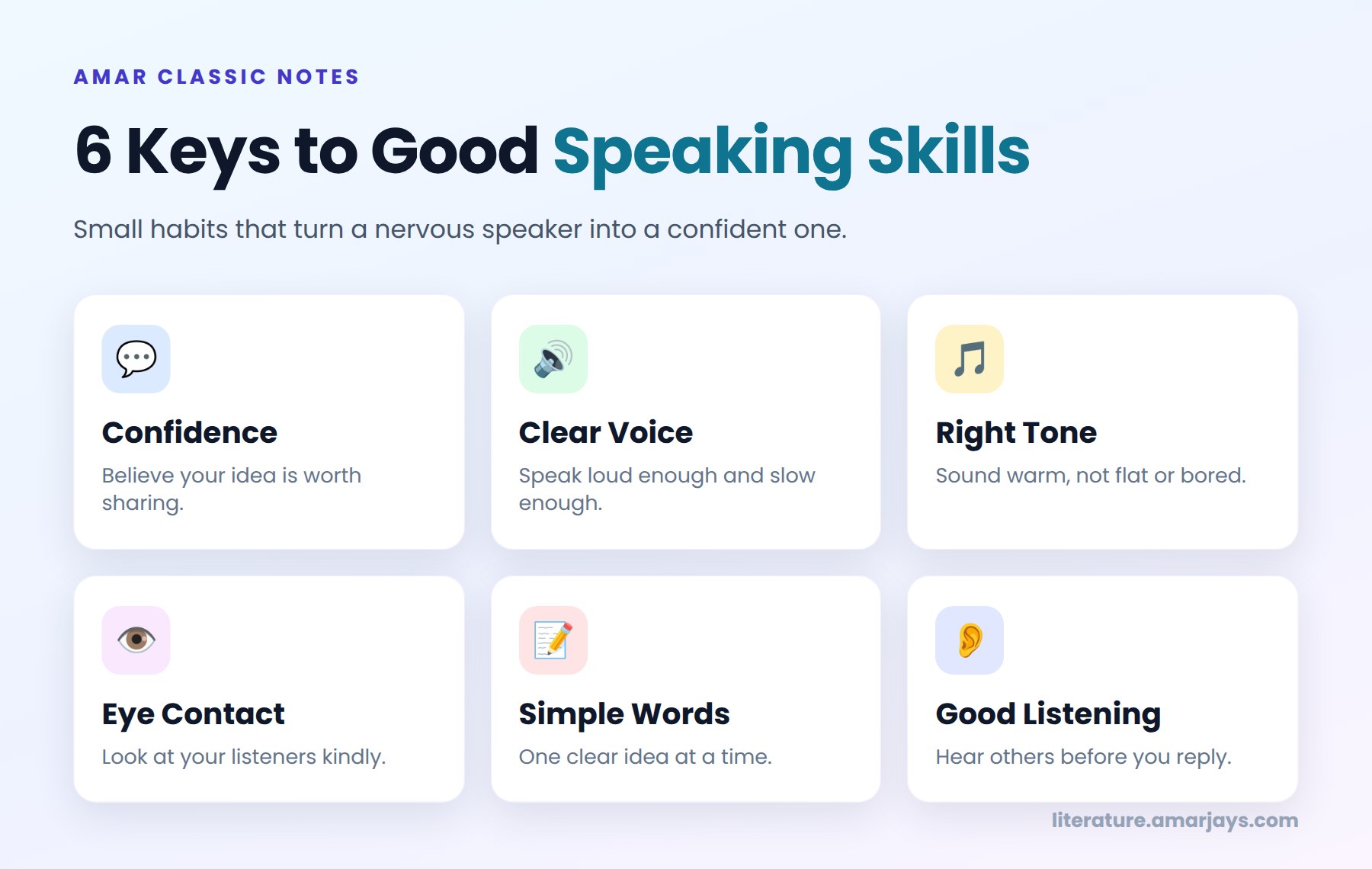
Good speaking is made of small parts. When you improve each part, your whole speaking gets better.
- Clear pronunciation means saying words so people understand them, even if your accent is not perfect.
- Correct language means using grammar that does not confuse the listener.
- Appropriate vocabulary means choosing the right words for the right people.
- Fluency means speaking in a smooth flow, without long, awkward pauses.
- Confidence means believing you have something worth saying.
- Voice modulation means changing your tone so you do not sound flat.
- Appropriate speed means not too fast and not too slow.
- Good tone means sounding warm and respectful, not rude or bored.
- Active listening means truly hearing others before you reply.
- Body language means using your face and hands to support your words.
- Eye contact means looking at your listeners so they feel included.
- Organization of ideas means saying things in a clear order.
Here is a quick example that ties these together. Imagine two people telling the same story about a cricket match. One stares at the floor, speaks in a flat voice, and jumps around with no order. The other looks up, smiles, changes their tone at the exciting part, and tells it step by step. Same story, but you would rather listen to the second person. That is the power of these elements.
Speaking Skills vs Communication Skills
Many students think speaking and communication are the same thing. They are related, but not equal.
Communication is the full process of sharing meaning. Speaking is just one part of it. Communication also includes listening, reading, writing, and body language. When you speak, you are doing one important type of communication, but not all of it.
| Point | Speaking Skills | Communication Skills |
|---|---|---|
| Meaning | Sharing ideas using spoken words | Sharing meaning through many ways |
| Includes | Voice, words, tone, confidence | Speaking, listening, reading, writing, body language |
| Direction | Mostly you talking to others | Two-way exchange between people |
| Example | Giving a speech in class | A full conversation, email, or discussion |
Think of it like this. Speaking is one strong pillar. Communication is the whole building. If you improve speaking, you improve a big part of your communication skills. But to be a full communicator, you must also listen and understand well.
Common Problems That Affect Speaking Skills
If you struggle to speak well, do not worry. Almost everyone starts here. Remember: each of these problems can be fixed.
- Fear of speaking is the most common. Nervousness before an audience is normal, and it fades with practice.
- Lack of confidence makes you doubt your own ideas, which often matter more than you think.
- Poor vocabulary makes you search for words. The good news is you only need a few useful words to start.
- Fear of making mistakes stops many learners. But mistakes are simply proof that you are trying.
- Speaking too fast happens when you are nervous. Slowing down makes you clearer.
- Speaking too softly means people cannot hear you. A little more volume changes everything.
- Lack of practice is the real reason most people stay weak. Skills grow only with use.
- Poor pronunciation can confuse listeners, but it improves quickly when you read aloud.
- Translating from the mother tongue slows you down. With practice, you start thinking directly in the new language.
- Not organizing thoughts first leads to messy talk. A few seconds of thinking fixes this.
Here is the encouraging part. Not one of these problems is permanent. They are habits, and habits can change. Every confident speaker you admire was once nervous too.
How to Improve Speaking Skills
Now for the most useful part. You do not need money or a special course. You need practice and patience.
- Speak every day. Even a few minutes daily beats one long session per week.
- Read aloud. Read a page from a book or newspaper out loud to improve flow.
- Learn useful words, not huge word lists. Ten words you use beat a hundred you forget.
- Think in English (or your target language). Name the things around you.
- Record your voice and listen back. You will quickly notice what to fix.
- Talk to yourself. Explain your day out loud when you are alone.
- Practice with friends on a topic for five minutes.
- Join group discussions and say at least one point every time.
- Give short presentations, even to your family or a mirror.
- Watch good speakers and notice their pace, pauses, and tone.
- Listen actively. Good listening gives you ideas to speak about.
- Do not fear mistakes. Fluency comes from doing, not from being perfect.
- Start with simple sentences. Short and clear beats long and confused.
A Simple 15-Minute Daily Speaking Routine
Here is an easy plan you can start today.
- Minutes 1–3: Read one paragraph aloud, slowly and clearly.
- Minutes 4–7: Talk about your day out loud, in simple sentences.
- Minutes 8–11: Pick one topic and speak about it without stopping.
- Minutes 12–14: Record the same topic and listen back.
- Minute 15: Note one small thing to improve tomorrow.
Do this for thirty days and you will feel the difference. Fifteen honest minutes a day can change how you speak. For more free practice, groups like Toastmasters International let people practise public speaking in a friendly setting.
From a Weak Speaker to a Confident Speaker
Let me tell you about Ravi.
Ravi was a first-year college student. He was good at studies but terrified of speaking. In class, he would hide behind the student in front of him. When teachers asked questions, he looked down and prayed he would not be picked.
One day, his class had to give a two-minute self-introduction. Ravi barely spoke for thirty seconds. His voice shook, and he forgot half of what he wanted to say. He walked back to his seat feeling terrible.
That night, Ravi decided he would not let this fear win. He made a small rule. Every morning, he would speak aloud for fifteen minutes. He read the newspaper out loud, described his breakfast, and recorded himself, even though he hated his own voice at first.
For the first week, nothing seemed to change. But Ravi kept going. In the second week, he raised his hand in class for the first time. His answer was short, but he said it. His heart pounded, but he survived. And the teacher nodded.
By the second month, Ravi was joining group discussions. He was not the best speaker in the room, but he was no longer silent. His friends even asked him to lead their project presentation.
At the end of the year, Ravi stood up at a college event and spoke to a hall full of students. His hands were still a little cold. But his words were clear, calm, and confident.
Ravi did not become a genius overnight. He simply practised a little every day. That is the whole secret. You do not need talent to speak well. You need practice and the courage to keep trying.
10 Golden Rules of Effective Speaking
Here is an easy framework to remember: the THINK – SPEAK – GROW path.
- Think first, then speak. A short pause to organize your thoughts makes you clear.
- Keep it simple. Use small words. Simple English is smart English.
- Slow down. When in doubt, speak a little slower than you feel like.
- Look up. Make eye contact. It connects you to your listeners.
- Speak with warmth. A friendly tone wins hearts faster than perfect grammar.
- Say one point at a time. One idea, then the next.
- Listen fully. Great speakers listen before they reply.
- Do not fear mistakes. Speak, stumble, and continue.
- Practice daily. Small daily effort beats rare big effort.
- Grow one step at a time. Improve one small thing each week.
Frequently Asked Questions
What are speaking skills?
Speaking skills are your ability to use spoken words to share ideas, feelings, and information clearly, so that others understand you easily and enjoy listening to you.
Why are speaking skills important?
They help you express ideas, build confidence, do well in interviews and presentations, work better with people, and lead others. Almost every part of life depends on clear speaking.
What are the four types of speaking skills?
The four common types are interactive speaking (conversations), extensive speaking (speeches), intensive speaking (reading aloud for practice), and responsive speaking (short replies and answers).
How can students improve speaking skills?
Speak a little every day, read aloud, join group discussions, record your voice, and practise with friends. Fifteen focused minutes a day makes a big difference over time.
What is the difference between speaking and communication?
Speaking is sharing ideas through spoken words. Communication is the bigger process that also includes listening, reading, writing, and body language. Speaking is one part of communication.
Why is confidence important in speaking?
Confidence makes your voice steady and clear. When you believe your idea is worth sharing, people are more likely to listen and trust you.
How can I improve my English speaking skills?
Learn a few useful words, think in English, read English aloud, watch good English speakers, and practise daily. Do not wait for perfect grammar; speak and improve as you go.
What are the qualities of a good speaker?
A good speaker is clear, confident, and warm. They speak at the right speed, listen well, organize their ideas, and use friendly body language and eye contact.
How can speaking skills help in a job interview?
In an interview, you must talk about yourself and your abilities. Clear, confident speaking helps you make a strong impression and often decides whether you get the job.
How can I overcome fear of speaking?
Start small. Speak in safe places first, like with family or friends. Practise daily, accept that mistakes are normal, and slowly take on bigger audiences. Fear fades with practice.
Conclusion
Let us end with the most important idea of all. Good speaking is not about big words or a perfect accent. It is about taking a simple idea from your mind and placing it clearly and kindly in someone else’s mind. That is the whole job.
You do not need to sound like a news anchor. You do not need to memorize a dictionary. You need clear thoughts, simple words, and the courage to speak them.
Every strong speaker you admire started somewhere. Many were shy. Many shook the first time they stood up. What changed was not luck. It was practice.
So start today. Speak for fifteen minutes. Read aloud. Say one point in class. Small steps, done daily, turn a nervous speaker into a confident one. Your ideas deserve to be heard, and now you have the tools to share them. For more easy study notes, explore the rest of Amar Classic Notes. Go and speak.