Types of Feedback in Communication: Meaning, Importance and Types of Feedback
Introduction
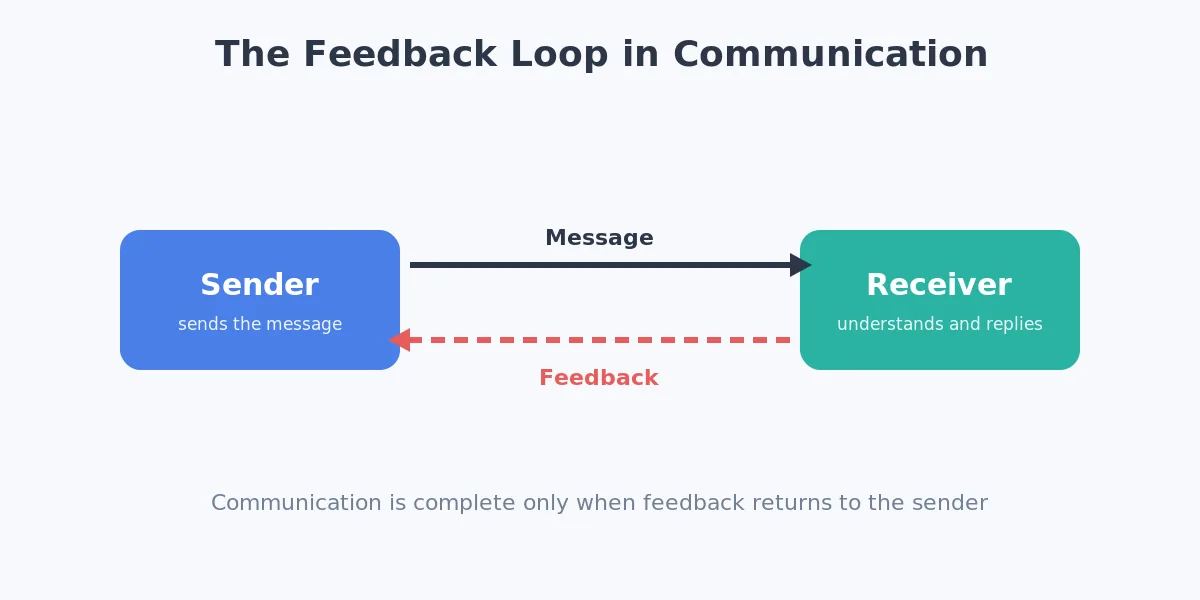
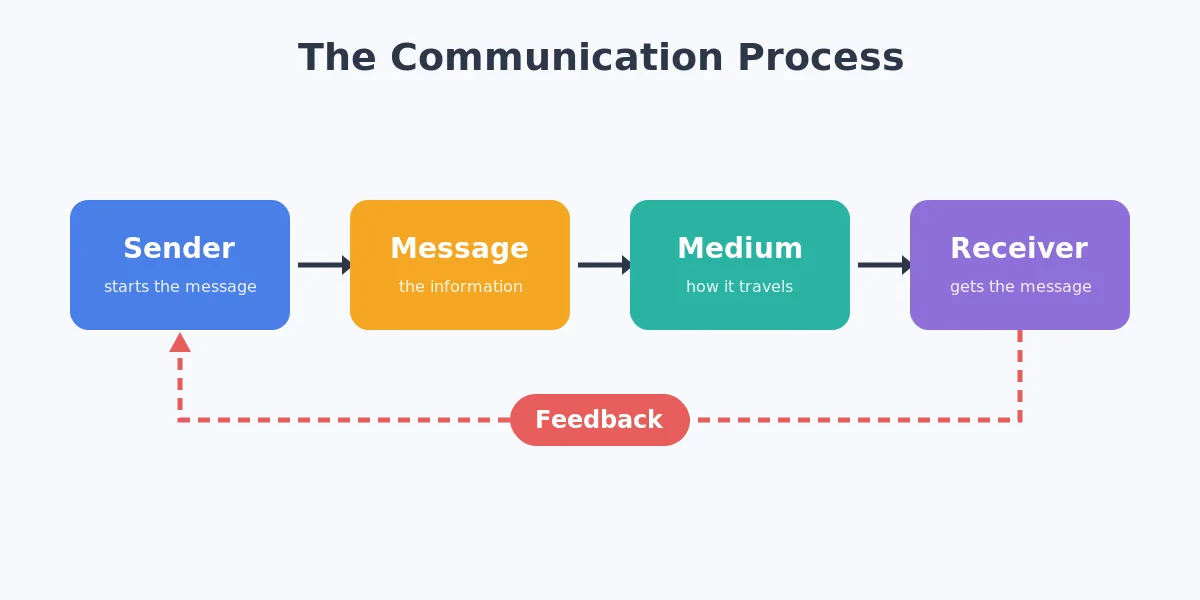
Communication is a two-way process. It does not end when a sender sends a message to a receiver. Communication becomes complete only when the receiver responds to the message. This response is known as feedback in communication.
In our daily life, we continuously give and receive feedback. When a teacher asks a question and students answer it, feedback takes place. When a customer gives a review about a product, it is feedback. When an employee responds to a manager’s instruction, it is feedback.
Feedback is an important part of communication because it helps the sender know whether the message has been understood correctly or not. Without feedback, communication remains incomplete.
In business organizations, schools, colleges, hospitals, banks, and every other institution, feedback plays a very important role. It helps people understand each other better and improves communication effectiveness.
Therefore, feedback is often called the final and most important stage of the communication process.
What is Feedback?
Feedback is the response given by the receiver to the sender after receiving and understanding the message.
In simple words, feedback means a reaction or reply to a message.
Feedback helps the sender know:
Whether the message has been received.
Whether the message has been understood.
Whether the receiver agrees or disagrees.
Whether any further explanation is required.
Thus, feedback completes the communication process.
Definition of Feedback in Communication
Feedback can be defined as:
“The response given by the receiver to the sender after receiving and understanding a message.”
Feedback may be given through words, actions, facial expressions, gestures, emails, letters, reports, or any other form of response.
Example of Feedback
Example 1
Teacher: “Have you understood today’s lesson?”
Students: “Yes, Madam.”
The students’ answer is feedback.
Example 2
Manager: “Please complete this report by tomorrow.”
Employee: “Sure, I will complete it.”
The employee’s response is feedback.
Example 3
A customer purchases a product online and writes a review.
The review is feedback for the company.
Importance of Feedback
Feedback is extremely important in communication. It helps both the sender and the receiver.
The following points explain the importance of feedback:
1. Completes the Communication Process
Communication is incomplete without feedback.
A sender may send a message, but unless a response is received, the sender cannot know whether the communication was successful.
Therefore, feedback completes the communication cycle.
Example
A teacher teaches a lesson. Students answer questions and participate in discussion. Their responses complete the communication process.
2. Confirms Understanding
Feedback helps the sender know whether the receiver has understood the message correctly.
If the receiver misunderstands the message, the sender can explain it again.
Example
A manager explains a new work procedure. Employees ask questions to clarify their doubts. This feedback helps avoid confusion.
3. Reduces Misunderstanding
Many problems occur because people misunderstand messages.
Feedback helps identify misunderstandings and correct them immediately.
As a result, communication becomes more accurate and effective.
4. Improves Future Communication
Feedback helps the sender improve communication skills.
By receiving feedback, a person can learn what works well and what needs improvement.
This leads to better communication in the future.
5. Encourages Participation
Feedback allows receivers to express their opinions and ideas.
People feel involved and valued when their responses are considered.
This encourages active participation.
6. Builds Better Relationships
Feedback creates interaction between people.
When people communicate openly and respond honestly, trust and understanding increase.
This helps build strong personal and professional relationships.
7. Helps in Decision-Making
Managers often rely on feedback before making decisions.
Feedback provides useful information and suggestions.
This helps organizations make better decisions.
8. Increases Motivation
Positive feedback motivates people to perform better.
When employees, students, or team members receive appreciation, they feel encouraged and confident.
Types of Feedback
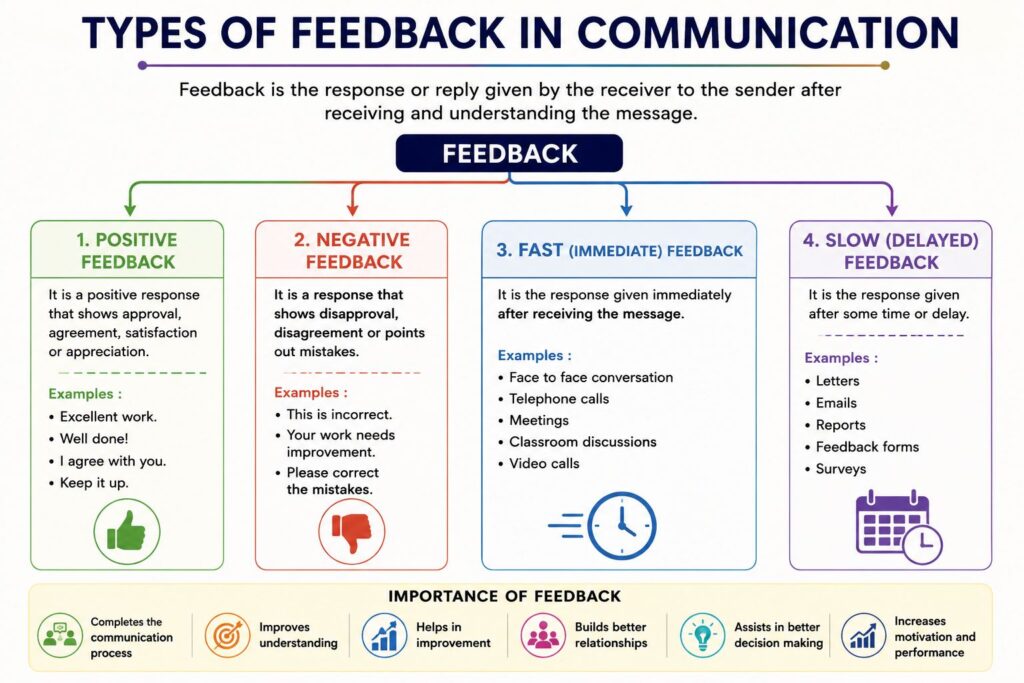
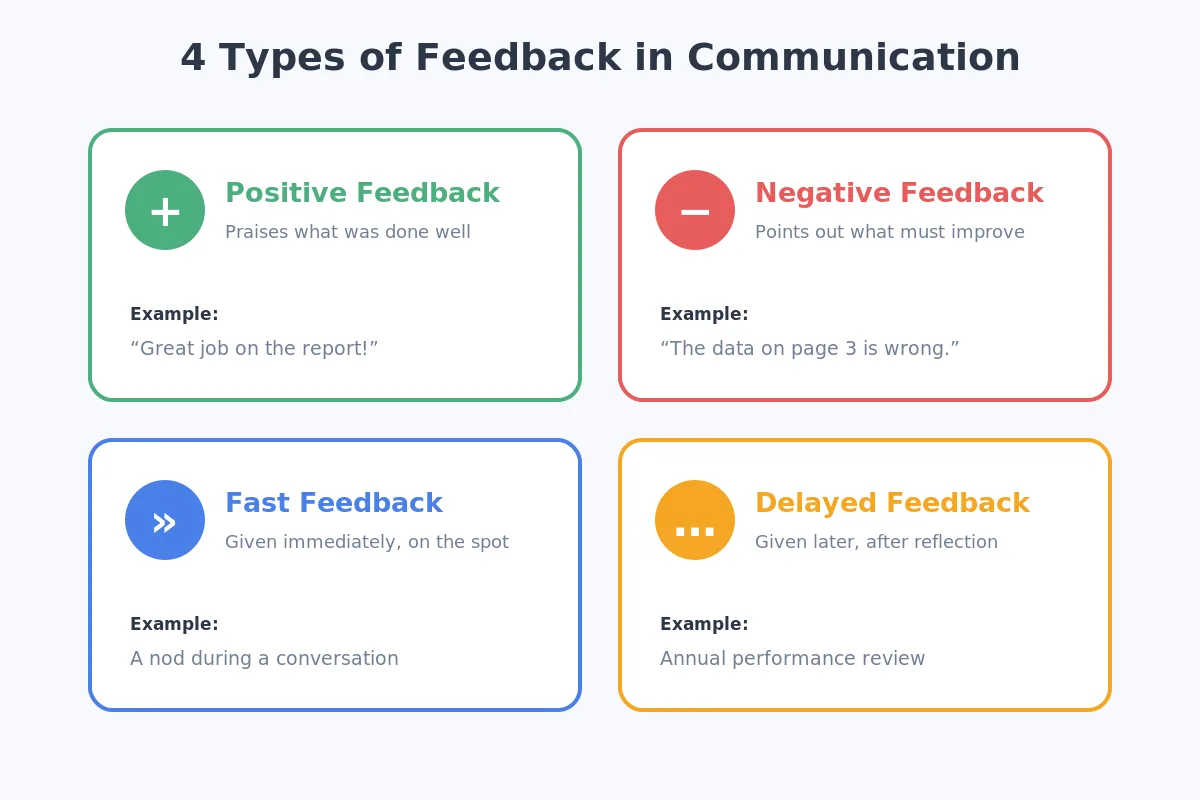
Feedback can be classified into different types based on the nature and timing of the response.
The main types of feedback are:
Positive Feedback
Negative Feedback
Fast or Immediate Feedback
Slow or Delayed Feedback
Let us study each type in detail.
1. Positive Feedback
Positive feedback shows a positive attitude towards the message, task, or activity.
It indicates approval, agreement, satisfaction, encouragement, or appreciation.
Positive feedback tells the sender that the message has been accepted and appreciated.
Meaning
Positive feedback is the response that supports, encourages, or agrees with the sender.
It usually contains appreciation and encouragement.
Examples of Positive Feedback
“Excellent work.”
“I completely agree with your idea.”
“Your presentation was very good.”
“You have done a great job.”
“This project has been completed successfully.”
Business Example
A manager says to an employee:
“Your report is excellent. Keep up the good work.”
This is positive feedback because it appreciates the employee’s performance.
Advantages of Positive Feedback
1. Increases Motivation
People feel encouraged when they receive positive feedback.
2. Builds Confidence
Positive responses increase self-confidence.
3. Improves Performance
People try to perform even better in the future.
4. Creates a Positive Environment
Positive feedback improves workplace relationships and teamwork.
5. Increases Job Satisfaction
Employees feel valued and appreciated.
2. Negative Feedback
Negative feedback expresses dissatisfaction, disagreement, correction, or criticism.
It informs the sender that something is wrong and needs improvement.
Negative feedback is not always bad. If given properly, it helps people improve their performance.
Meaning
Negative feedback indicates that the message, task, or performance is not satisfactory.
It points out mistakes or weaknesses.
Examples of Negative Feedback
“There are several mistakes in this report.”
“Your presentation needs improvement.”
“The project was not completed on time.”
“This answer is incorrect.”
“The quality of work is below expectations.”
Business Example
A manager tells an employee:
“The report contains many errors. Please correct them and submit it again.”
This is negative feedback.
Advantages of Negative Feedback
1. Identifies Mistakes
People become aware of their errors.
2. Encourages Improvement
It helps individuals improve their skills and performance.
3. Maintains Standards
Organizations can maintain quality and efficiency.
4. Promotes Learning
People learn from their mistakes.
Limitations of Negative Feedback
If negative feedback is given harshly, it may:
Hurt feelings
Reduce confidence
Create stress
Lower motivation
Therefore, negative feedback should always be polite and constructive.
3. Fast or Immediate Feedback
Fast feedback is also called immediate feedback.
It is the response given immediately after receiving the message.
This type of feedback is common in face-to-face communication.
Meaning
When the receiver responds instantly or very quickly, it is called immediate feedback.
There is little or no delay between the message and the response.
Examples of Fast Feedback
Classroom discussions
Face-to-face conversations
Interviews
Meetings
Telephone calls
Video conferences
Example
Teacher: “Is this concept clear?”
Student: “Yes, Sir.”
The student’s immediate reply is fast feedback.
Advantages of Fast Feedback
1. Quick Clarification
Doubts can be solved immediately.
2. Better Understanding
Both sender and receiver understand each other clearly.
3. Saves Time
Problems can be resolved quickly.
4. Improves Communication Effectiveness
The sender receives instant confirmation.
5. Useful in Emergency Situations
Immediate responses help during urgent situations.
Business Example
During a meeting, employees immediately respond to management questions.
This immediate interaction helps managers make quick decisions.
4. Slow or Delayed Feedback
Slow feedback is also known as delayed feedback.
In this type of feedback, the response is received after some time.
The delay may be a few hours, days, weeks, or even months.
Meaning
When the receiver takes time to respond, it is called delayed feedback.
The response does not come immediately.
Examples of Delayed Feedback
Letters
Reports
Surveys
Research studies
Annual performance reviews
Customer feedback forms
Example
A company sends a customer satisfaction survey.
Customers complete the survey after a week.
The responses received later are delayed feedback.
Advantages of Delayed Feedback
1. Allows Careful Thinking
People get enough time to analyze the message.
2. Better Quality Responses
Responses are often detailed and thoughtful.
3. Useful for Complex Issues
Complicated matters may require time for evaluation.
4. Helpful in Written Communication
Written responses can be properly prepared.
Limitations of Delayed Feedback
1. Slow Communication
The communication process becomes slower.
2. Delayed Decisions
Important decisions may take longer.
3. Possibility of Misunderstanding
Doubts may remain unresolved for some time.
4. Less Suitable for Urgent Situations
Immediate action may not be possible.
Difference Between Immediate and Delayed Feedback
| Immediate Feedback | Delayed Feedback |
|---|---|
| Response is instant | Response comes later |
| Common in oral communication | Common in written communication |
| Quick clarification possible | Clarification takes time |
| Suitable for urgent situations | Suitable for detailed analysis |
| Saves time | Takes more time |
Conclusion
Feedback is one of the most important elements of communication. It is the response given by the receiver to the sender after receiving and understanding a message. Feedback completes the communication process and helps determine whether communication has been successful.
Feedback improves understanding, reduces misunderstandings, strengthens relationships, and helps organizations function effectively. It also helps people learn, grow, and improve their performance.
There are four major types of feedback: Positive Feedback, Negative Feedback, Fast or Immediate Feedback, and Slow or Delayed Feedback. Each type serves a different purpose and plays an important role in communication.
Therefore, effective feedback is essential for successful communication in personal life, education, and business organizations. A communication process without feedback is incomplete, while proper feedback ensures understanding, cooperation, and continuous improvement.
If you liked this Article, then remember one very important thing, you cannot have efficiency over any subject, without the proper use of Grammar. If you would like to explore all the corners of Grammar in very very simple language, please click on this link:https://literature.amarjays.com/category/english-grammar/grammar/
FAQs about Feedback in Communication
What is feedback in communication?
Feedback in communication is the response a receiver gives after getting a message. It can be spoken words, a written reply, a nod, a smile, or even silence. It tells the sender whether the message was understood correctly, and it turns one-way information into a real two-way conversation.
Why is feedback in communication important?
Feedback in communication completes the communication cycle. It confirms understanding, corrects mistakes early, motivates people, and helps the sender improve future messages. Without it, the sender is left guessing whether the message worked at all.
What are the main types of feedback in communication?
The four main types of feedback in communication are positive, negative, fast (immediate), and delayed feedback. Each type has its own advantages and is useful in different situations at school, at home, and at work. Good communicators learn to use all four types wisely.
How can I give better feedback?
Be specific, be timely, and be kind. Praise what was done well, explain clearly what can be improved, and always focus on the work — never on the person. Feedback should help, not hurt. That is the golden rule of feedback in communication.
Conclusion: Why Feedback in Communication Matters
Feedback in communication is what turns a one-way message into a real conversation. Without it, a sender can never be sure the message was received and understood. Whether it is positive or negative, fast or delayed, feedback in communication helps us confirm understanding, correct mistakes, and build stronger relationships at school, at work, and at home. Master feedback in communication, and every other communication skill becomes easier.
Related reading: Continue learning with our guides on the 7 Cs of Communication, Methods of Communication, Objectives and Functions of Communication, Characteristics of Communication, and Encoding and Decoding in Communication. To see how feedback loops work in other fields too, read the Wikipedia article on feedback.