Table of Contents
ToggleEncoding and Decoding: The Hidden Steps Inside Communication
Encoding and decoding in communication are the two hidden steps that decide whether your message works or fails. You already know the basic communication process — Sender, Message, Medium, Receiver, Feedback. But there are two hidden steps inside this process that most students never notice. These two steps decide whether your message actually works or completely fails.
These two steps are called Encoding and Decoding.
Once you understand these, you will start seeing why some conversations go smoothly and why some create confusion, even when both people are speaking the same language.
What is Encoding?
Encoding happens inside the Sender’s mind. It is the process of turning a thought or idea into words, symbols, or signs that another person can understand.
Think about it this way. Right now, you might have a feeling inside you — maybe you’re hungry, or maybe you have a doubt about a topic. That feeling or idea is just inside your head. Nobody else can see it. To share it with someone, you must convert it into something outside your mind — spoken words, written words, a gesture, or an expression.
That conversion — from “idea in the mind” to “words that can be shared” — is called Encoding.
Example:
A student feels confused about a grammar topic. That confusion is just a feeling at first. When the student says, “Sir, I don’t understand the difference between ‘was’ and ‘were’,” that sentence is the encoded version of the confusion. The feeling became words.
Encoding is not always easy. Sometimes we know exactly what we feel, but we struggle to put it into the right words. That struggle happens because encoding is a skill — and like any skill, it can be improved with practice.
Why Encoding Sometimes Goes Wrong
Encoding fails when the Sender:
- Uses words the Receiver won’t understand (too difficult, too technical, or in a language they don’t know well)
- Doesn’t organize their thoughts before speaking, so the message comes out mixed up
- Chooses the wrong tone (saying something serious in a joking way, or the opposite)
- Leaves out important details, assuming the other person already knows them
A simple example of bad encoding:
Imagine a teacher says, “Submit it soon.” What does “soon” mean? Tomorrow? Next week? This is poor encoding — the idea in the teacher’s mind (maybe “within 2 days”) was not properly converted into clear words. The student now has to guess.
A simple example of good encoding:
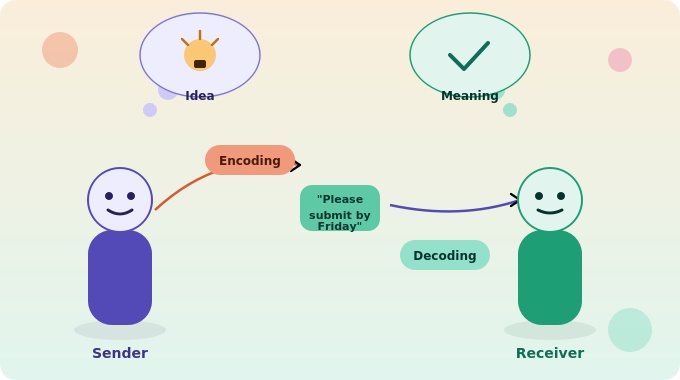
“Please submit the assignment by Friday, 5 PM.” Now the idea has been converted clearly. There is no guessing needed.
This is why good encoding is one of the most valuable communication skills you can develop — for exams, for interviews, and for your daily life.
What is Decoding?
Decoding is the opposite process. It happens inside the Receiver’s mind. It means taking the words, symbols, or signs that were received, and turning them back into meaning.
When someone speaks to you, your brain doesn’t just “hear sounds” — it works to understand what those sounds actually mean. That mental work is Decoding.
Example:
When the teacher says, “Please submit the assignment by Friday, 5 PM,” the student’s brain immediately processes this and understands: I have time until Friday evening. I should plan my remaining work accordingly. That understanding — the meaning built inside the student’s mind — is the decoded message.
Just like encoding, decoding can also go wrong.
Why Decoding Sometimes Goes Wrong
Decoding fails when the Receiver:
- Doesn’t know the meaning of certain words used by the Sender
- Is distracted or not paying full attention
- Has a different cultural or personal background, so the same words carry a different meaning to them
- Is emotionally upset or biased, so they “hear” something different from what was actually said
- Makes assumptions instead of asking for clarification
A simple example of decoding failure:
A teacher says, “This chapter is not very important.” A weak student might decode this as “I don’t need to study this chapter at all” — while the teacher actually meant “This chapter carries fewer marks, but you should still read it once.” Same words, but two very different meanings, because decoding went wrong.
This is exactly why two students sitting in the same classroom, hearing the same lecture, can walk out with two completely different understandings.
Encoding and Decoding in Communication — Why Both Must Work
Here’s the important part that many students miss: communication only succeeds when both encoding AND decoding work correctly.
If the Sender encodes the message badly, even a good listener will misunderstand it.
If the Receiver decodes badly, even a perfectly clear message will get misunderstood.
Think of it like a parcel being sent from one city to another.
- Encoding is like packing the parcel properly, with the correct address and correct contents.
- Decoding is like unpacking the parcel carefully and understanding what was sent.
If the sender packs the parcel badly (wrong items, unclear label), the parcel arrives useless — no matter how carefully the receiver unpacks it.
If the receiver unpacks carelessly (throws things away without checking, misreads the label), even a well-packed parcel gets wasted.
Both steps must be done correctly for the communication to succeed.
A Simple Picture to Remember Encoding and Decoding in Communication
   SENDER                                          RECEIVER
  (has an idea)                                  (understands the idea)
       │                                                  ▲
       ▼                                                  │
   ENCODING                                          DECODING
 (idea → words)                                  (words → meaning)
       │                                                  ▲
       └──────────────►  MESSAGE  ──── MEDIUM ───────────┘
                      (travels from Sender to Receiver)
Keep this picture in your mind. Every single conversation you have — with your family, your friends, your teachers, and one day, your interviewers and colleagues — passes through these exact two hidden steps.
Real-Life Examples to Understand Better
Example 1 — Job Interview
An interviewer asks, “Tell me about yourself.”
If a candidate hasn’t practiced encoding this answer properly, they might give a confused, disorganized response — even though they actually have good qualities to share. Poor encoding, even with good content, creates a bad impression.
On the other side, if the interviewer is distracted while listening (poor decoding), they might miss important points the candidate made — through no fault of the candidate at all.
Example 2 — WhatsApp Messages
Text messages are famous for encoding and decoding problems. If you type “Ok.” with a full stop, it can feel cold or angry to the reader, even if you didn’t mean it that way. The Sender encoded a neutral message, but without tone of voice or facial expression, the Receiver’s brain decodes it differently — often adding emotion that wasn’t originally there.
This is exactly why serious topics are better discussed in person or on a call, not just through text.
Example 3 — Classroom Teaching
A teacher who uses very difficult English while teaching poor or first-generation learners is technically “sending a message” — but if the encoding uses words far beyond the students’ level, decoding becomes almost impossible for them. The teacher may feel they explained everything, while the students understood almost nothing. This is one of the most common and most damaging communication failures in Indian classrooms.
How You Can Improve Your Own Encoding and Decoding
To improve encoding (as a Sender):
- Think before you speak — organize your idea first
- Use simple, clear words suited to your listener
- Avoid vague words like “soon,” “later,” “somewhat” — be specific
- Check your tone before delivering serious or sensitive messages
To improve decoding (as a Receiver):
- Listen fully before reacting — don’t decode half the message and assume the rest
- Ask questions if something is unclear, instead of guessing
- Be aware of your own mood — anger or stress can distort decoding
- Try to understand the Sender’s intention, not just their exact words
Why This Really Matters for You
Once you understand encoding and decoding, you stop blaming “communication” in a vague way, and you start identifying exactly where a conversation went wrong.
Was the message poorly encoded? Or was it decoded incorrectly on the other end? This one question can solve half the misunderstandings you face in daily life — with friends, family, teachers, and one day, your workplace.
Good communicators are not people who simply “talk well.” They are people who encode their ideas clearly, and who decode others’ words carefully and patiently. That combination — not vocabulary, not accent, not confidence alone — is what actually makes someone a strong communicator.
In Short
Encoding and Decoding are the two invisible engines running inside every conversation.
- Encoding: converting your idea into clear words (Sender’s job)
- Decoding: converting received words back into correct meaning (Receiver’s job)
When encoding and decoding in communication work well together, the message succeeds. When either one fails, misunderstanding happens — even between people who care about each other and mean well.
Understand encoding and decoding in communication, and you will start noticing breakdowns before they turn into bigger problems — in your studies, your interviews, and your everyday relationships.
Encoding and Decoding in Communication: Quick Revision
For your exam, remember that encoding and decoding in communication are the sender’s and receiver’s silent jobs — the sender converts ideas into words (encoding) and the receiver converts words back into meaning (decoding). Most breakdowns in encoding and decoding in communication happen because of unclear language, wrong assumptions, or missing context, so always pair this topic with a real-life example in your answer.
Related notes: Objectives and Functions of Communication | Characteristics of Communication | Feedback in Communication. For a broader academic overview, see this encoding/decoding model of communication on Wikipedia.