Introduction
Have you ever sent a message and got a reply that made no sense? Or explained something twice, and the other person still did not get it?
It happens to all of us. A student asks a teacher to repeat the lesson. A boss reads an email three times and still feels confused. A parent tells a child to clean the room, and the child cleans only the bed.
Here is the truth. The problem is usually not the listener. The problem is how the message was sent.
The good news? There is a simple fix. It is called the 7 Cs of Communication. These are seven small rules that make any message easy to understand. They work in emails, meetings, classrooms, interviews, and even WhatsApp chats.
In this guide, you will learn each C with examples from daily life, school, and work. By the end, you will know exactly how to speak and write so that people understand you the first time.
Let’s begin.
What is Communication?
Communication is the act of sharing information between people. One person sends a message. Another person receives it and understands it.
That last word matters most: understands.
If you speak and nobody understands, communication has not happened. You have only made noise. Real communication is complete only when the message received is the same as the message sent.
The Simple Communication Process
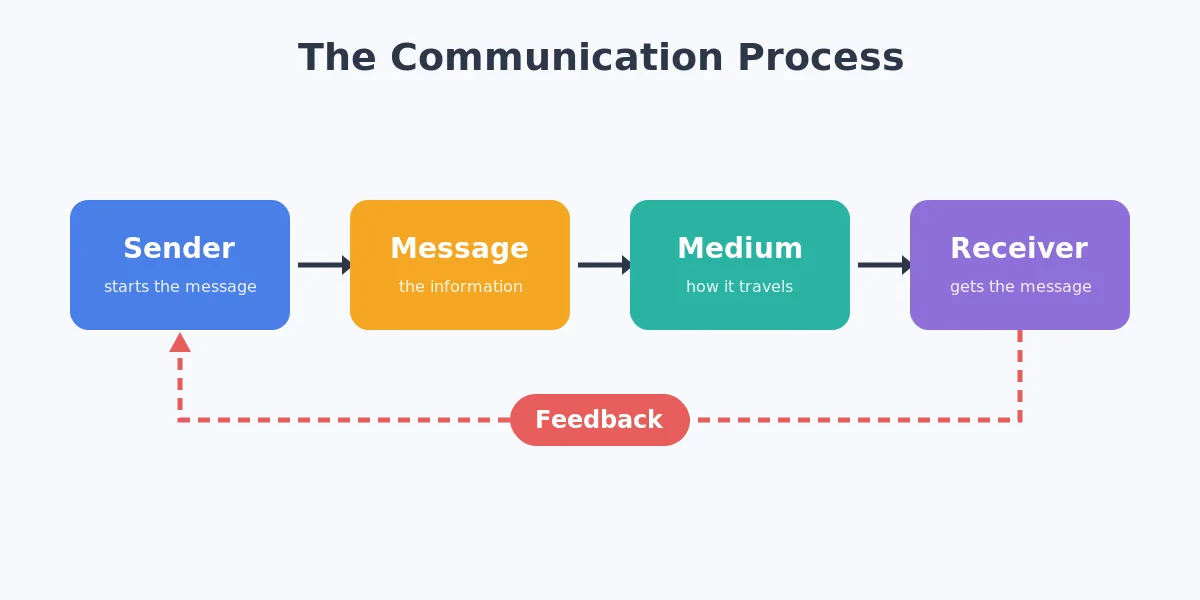
Every act of communication has five parts:
- Sender – the person who starts the message
- Message – the information being shared
- Medium – how it travels (speech, email, text, gesture)
- Receiver – the person who gets the message
- Feedback – the reply that shows the message was understood
Think of it like throwing a ball. You throw it (send). Your friend catches it (receives). Your friend throws it back (feedback). If the ball drops, the game breaks. If the message drops, communication breaks.
Types of Communication
Type | What It Means | Examples |
Verbal | Using spoken words | Meetings, phone calls, classroom lectures |
Written | Using written words | Emails, reports, text messages, notes |
Non-verbal | Using body and face | Smiles, eye contact, hand gestures, posture |
Visual | Using images | Charts, posters, presentations, emojis |
What are the 7 Cs of Communication?
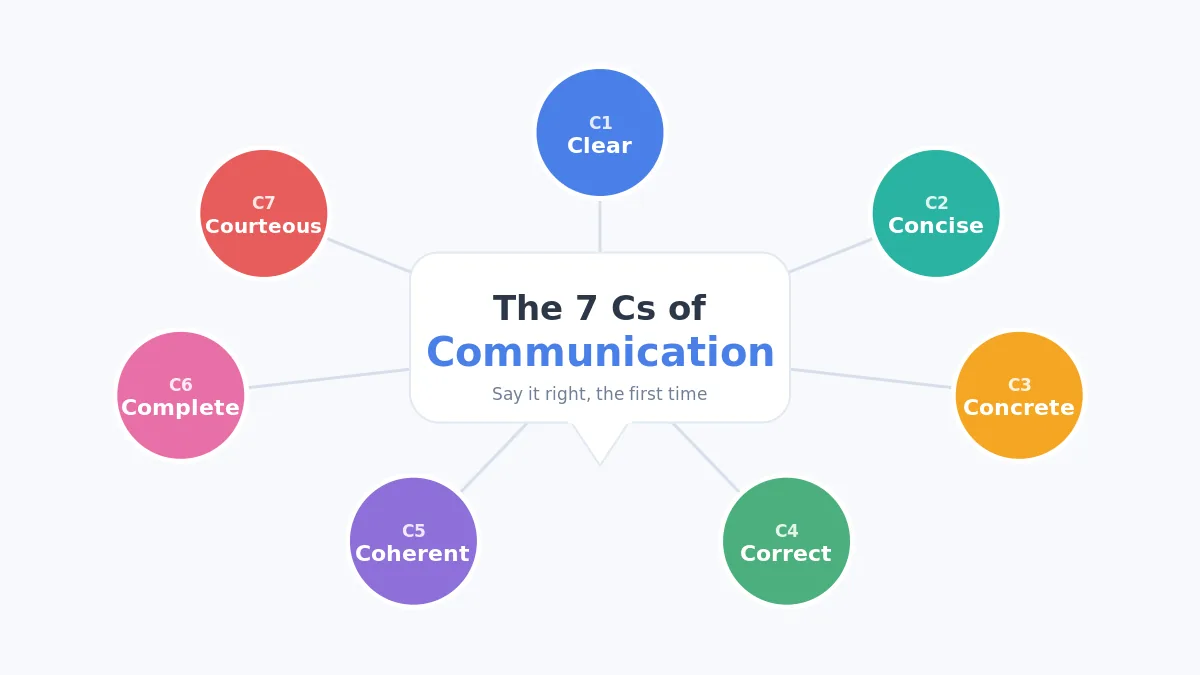
💡 Quick Answer Box: The 7 Cs of Communication are seven principles that make communication effective: Clear, Concise, Concrete, Correct, Coherent, Complete, and Courteous. Following these seven rules helps your message get understood the first time, whether you are speaking or writing.
These seven principles were popularized by Scott M. Cutlip and Allen H. Center in their 1952 book Effective Public Relations. The rules are more than seventy years old, yet they still work perfectly today — even for emails, video calls, and social media.
Here is a quick overview before we go deep into each one:
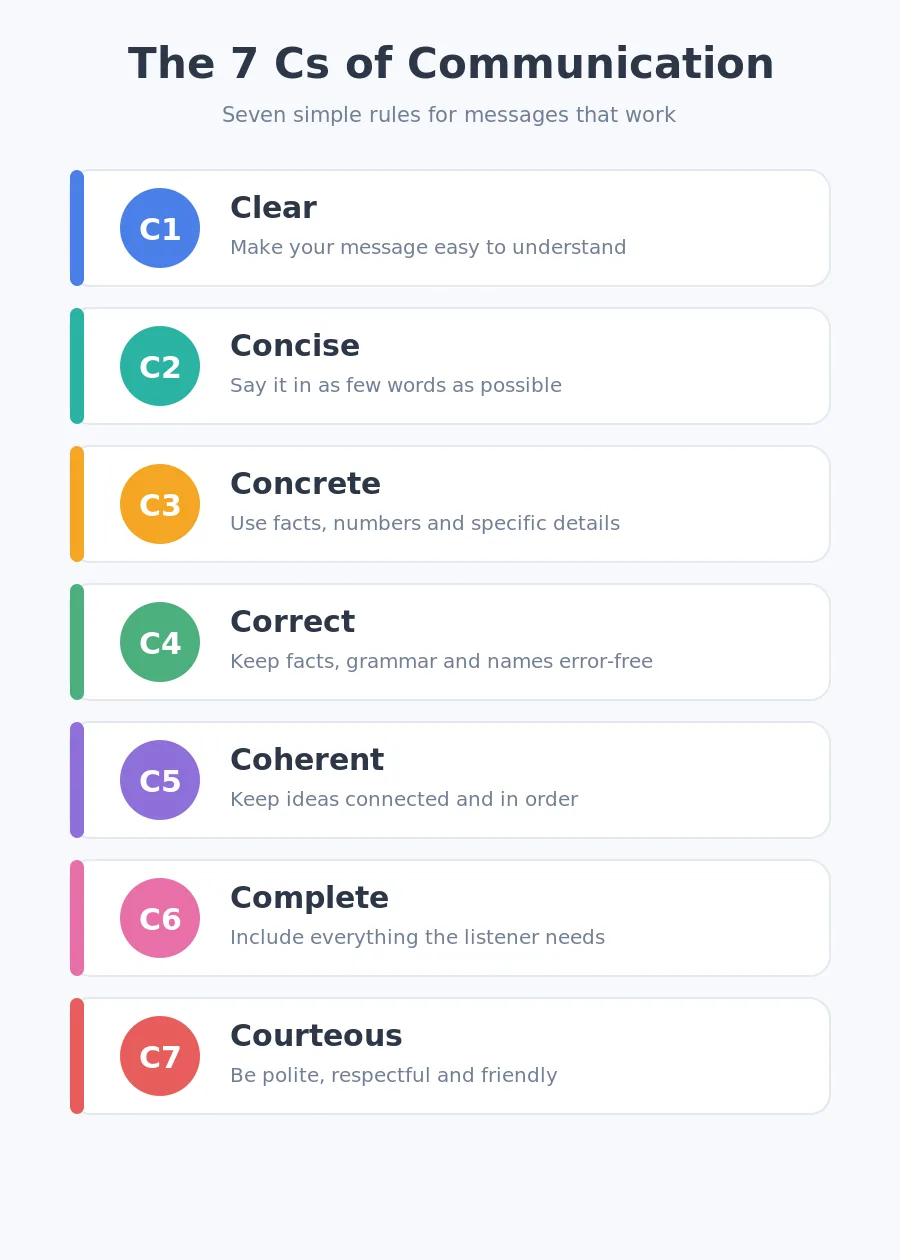
# | The C | One-Line Meaning |
1 | Clear | Make your message easy to understand |
2 | Concise | Say it in as few words as possible |
3 | Concrete | Use facts, numbers, and specific details |
4 | Correct | Keep facts, grammar, and names error-free |
5 | Coherent | Keep ideas connected and in order |
6 | Complete | Include everything the listener needs |
7 | Courteous | Be polite, respectful, and friendly |
Now, let’s understand each C one by one — with examples you will actually remember.
C1: Clear
Definition
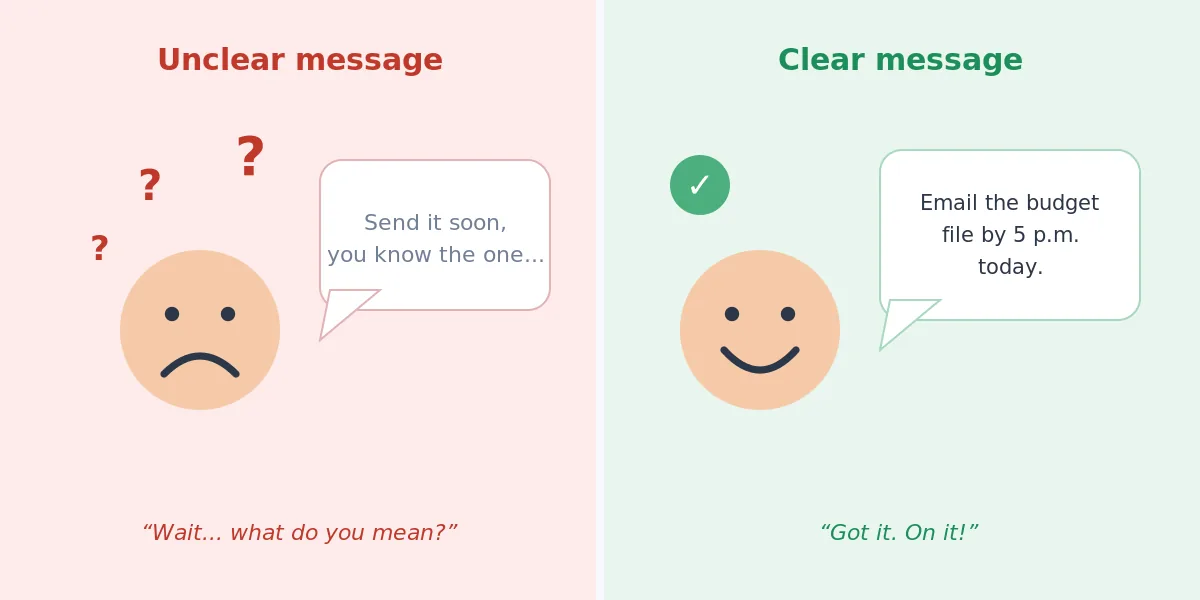
Clear communication means your message has one obvious meaning. The listener should never have to guess what you meant.
Why It Is Important
Confusion wastes time. When a message is unclear, people either ask again or, worse, do the wrong thing. Clarity saves time for both sides.
Easy Explanation
Before you speak or write, ask yourself one question: “What exactly do I want this person to know or do?” If you cannot answer in one sentence, your message is not ready yet.
Examples
- Daily-life example: Instead of telling your family “Let’s leave early tomorrow,” say “Let’s leave at 7 a.m. tomorrow.” Everyone now knows exactly what “early” means.
- Student example: Instead of asking a teacher “Sir, I didn’t understand the chapter,” say “Sir, I didn’t understand how photosynthesis works in Step 2.” The teacher can now help you instantly.
- Business example: Instead of emailing “Please look into the report,” write “Please check the sales numbers on page 4 of the March report and confirm by Friday.”
Wrong vs. Correct
❌ Wrong (Unclear) | ✅ Correct (Clear) |
“Send me that file soon.” | “Please email me the budget file by 5 p.m. today.” |
“The meeting is postponed.” | “The 3 p.m. meeting is moved to Thursday at 11 a.m.” |
Pro Tips
- ✓ Use one idea per sentence.
- ✓ Replace vague words like soon, some, and early with exact details.
- ✓ Read your message aloud. If you pause in confusion, rewrite it.
🔑 Key Points: Clear = one meaning only. Know your goal before you speak. Avoid vague words.
C2: Concise
Definition
Concise communication means giving your full message in the fewest words possible — without cutting anything important.
Why It Is Important
People are busy. Long messages get skimmed or ignored. Short messages get read and remembered. Studies on attention show readers decide within seconds whether to keep reading.
Easy Explanation
Being concise is like packing a school bag. You take only what you need for today’s classes, not every book you own. Extra words are extra weight.
Examples
- Daily-life example: Instead of “I was thinking that maybe we could possibly go out for dinner sometime tonight if you want,” just say “Want to go out for dinner tonight?”
- Student example: In an exam answer, write “Plants make food using sunlight” instead of “Plants are living things that have the amazing ability to create their own food by using the light that comes from the sun.”
- Business example: Replace “As per our earlier discussion held in the previous week regarding the matter of the project deadline” with “About last week’s deadline discussion.”
Wrong vs. Correct
❌ Wrong (Wordy) | ✅ Correct (Concise) |
“Due to the fact that it was raining…” | “Because it was raining…” |
“At this point in time, we are unable to…” | “We cannot currently…” |
Pro Tips
- ✓ Cut filler words: basically, actually, just, really, very.
- ✓ After writing, delete 10% of your words. The message usually improves.
- ✓ One paragraph = one idea.
🔑 Key Points: Short is strong. Cut fillers. Never repeat the same point twice.
C3: Concrete
Definition
Concrete communication means using specific facts, figures, and vivid details instead of vague, general statements.
Why It Is Important
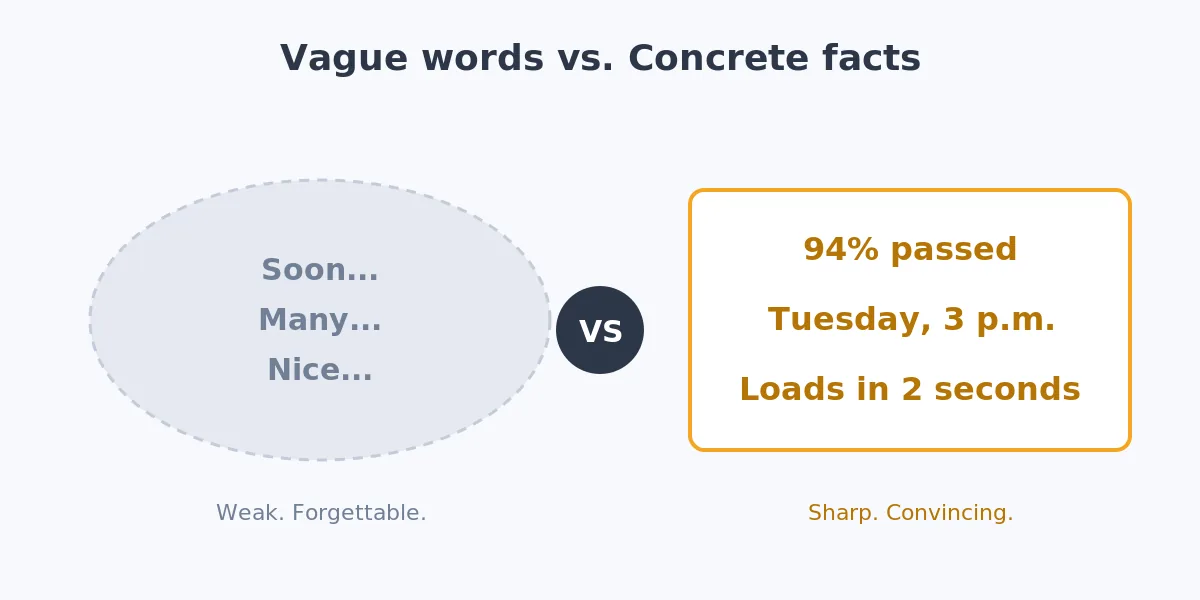
Specific messages build trust and are hard to misunderstand. Vague messages sound weak. “Sales grew a lot” convinces nobody. “Sales grew 32% in March” convinces everyone.
Easy Explanation
Imagine two friends describing a movie. One says, “It was nice.” The other says, “The hero fought three villains on a moving train.” Which friend makes you want to watch it? Details paint pictures. Pictures stick in memory.
Examples
- Daily-life example: Instead of “The doctor’s clinic is nearby,” say “The clinic is 500 meters ahead, next to the blue bakery.”
- Student example: In an essay, write “India won the 1983 Cricket World Cup” instead of “India won an important match long ago.”
- Business example: Instead of “Our product is fast,” say “Our app loads in under 2 seconds — 3x faster than the average competitor.”
Wrong vs. Correct
❌ Wrong (Vague) | ✅ Correct (Concrete) |
“Many students passed.” | “94 out of 100 students passed.” |
“We’ll finish soon.” | “We’ll finish by Tuesday, 20 January.” |
Pro Tips
- ✓ Use numbers whenever you can.
- ✓ Name people, places, and dates exactly.
- ✓ Replace adjectives like good, big, fast with measurable facts.
🔑 Key Points: Facts beat opinions. Numbers beat adjectives. Specific beats general.
C4: Correct
Definition
Correct communication means your message is free from errors — in facts, grammar, spelling, names, and numbers.
Why It Is Important
One small error can destroy trust. If your email says “meeting at 4” but you meant 2, people lose two hours. If you spell a client’s name wrong, they may feel disrespected. Accuracy protects your reputation.
Easy Explanation
Think of correctness as brushing your teeth before leaving home. It takes two minutes, nobody applauds you for it, but everyone notices when you skip it.
Examples
- Daily-life example: Before forwarding a message about a “school holiday tomorrow,” check the official school notice first. Forwarding wrong news spreads confusion.
- Student example: In a history exam, writing “1947” instead of “1974” for India’s independence changes everything. Check dates twice.
- Business example: An invoice with the wrong amount — ₹15,000 instead of ₹1,50,000 — can delay payment for weeks and embarrass the whole team.
Wrong vs. Correct
❌ Wrong | ✅ Correct |
“Dear Mr. Jhon, please except our offer.” | “Dear Mr. John, please accept our offer.” |
“The train leaves at 6” (a.m. or p.m.?) | “The train leaves at 6:00 p.m.” |
Pro Tips
- ✓ Proofread every message before sending — even short ones.
- ✓ Double-check names, dates, numbers, and attachments.
- ✓ Use spell-check, but do not trust it blindly. It cannot catch “except” vs. “accept.”
🔑 Key Points: Errors kill trust. Verify facts. Proofread everything.
C5: Coherent
Definition
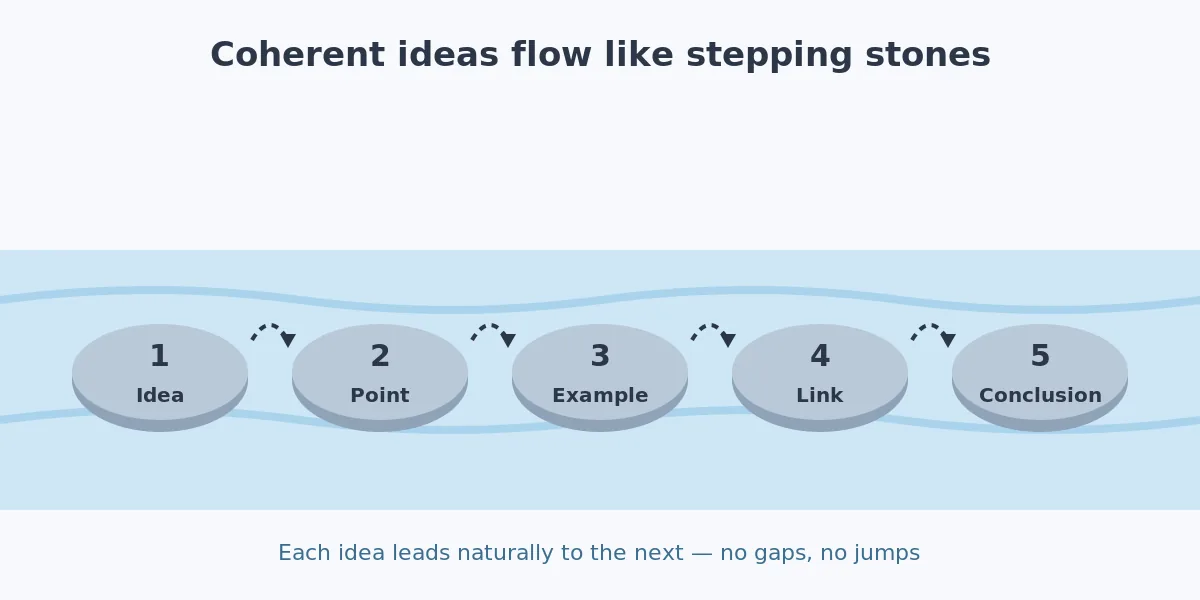
Coherent communication means your ideas are logically connected and flow in order. Each point leads naturally to the next.
Why It Is Important
A jumbled message forces the listener to rearrange your thoughts for you. Most people will not bother. When ideas flow in order, understanding feels effortless.
Easy Explanation
A coherent message is like a recipe. Step 1, then Step 2, then Step 3. Imagine a recipe that says “Serve hot. Chop onions. Preheat the oven.” Same information, useless order. Order is everything.
Examples
- Daily-life example: When giving directions, go in travel order: “Go straight, take the second left, and the shop is on your right” — not “The shop is on the right, after you go straight, but first there’s a left turn.”
- Student example: In an essay, follow one structure: introduction → main points → conclusion. Do not jump from the conclusion back to a new point.
- Business example: In a presentation, cover the problem first, then the solution, then the cost. Mixing them confuses the audience and weakens your case.
Wrong vs. Correct
❌ Wrong (Jumbled) | ✅ Correct (Coherent) |
“The event is Friday. Bring your ID. It’s cancelled if it rains. It starts at 5.” | “The event is Friday at 5 p.m. Bring your ID. If it rains, it will be cancelled.” |
Pro Tips
- ✓ Plan your points before you start. Even a 10-second mental outline helps.
- ✓ Use connecting words: first, next, then, finally, because, however.
- ✓ Stick to one topic per message. New topic? New message.
🔑 Key Points: Ideas must flow in order. Connect points logically. One topic at a time.
C6: Complete
Definition
Complete communication means your message contains all the information the receiver needs to understand and act — with no follow-up questions required.
Why It Is Important
Incomplete messages create ping-pong conversations. “Meeting tomorrow.” — “What time?” — “10.” — “Where?” — “Conference room.” Four messages for what one complete message could do.
Easy Explanation
Use the 5 Ws test: does your message answer Who, What, When, Where, and Why? If any answer is missing and the receiver needs it, your message is incomplete.
Examples
- Daily-life example: “Beta, buy vegetables on the way home” is incomplete. “Buy 1 kg tomatoes and 2 onions from the corner shop on your way home” is complete.
- Student example: A leave application should state the reason, the exact dates, and your class and roll number. “I need leave next week” tells the teacher almost nothing.
- Business example: A complete meeting invite includes the date, time, place or link, agenda, and who must attend. Anything less guarantees confusion emails.
Wrong vs. Correct
❌ Wrong (Incomplete) | ✅ Correct (Complete) |
“Party at my place!” | “Birthday party at my place, Saturday 7 p.m., 12 Green Street. Dinner included!” |
“Call the client.” | “Call Mr. Rao (98XXXXXX21) before noon about the delivery delay.” |
Pro Tips
- ✓ Run the 5 Ws check before sending anything important.
- ✓ Anticipate questions. If someone might ask “which one?” — answer it in advance.
- ✓ Include contact details, links, or attachments the receiver will need.
🔑 Key Points: Answer Who, What, When, Where, Why. Leave no obvious question unanswered.
C7: Courteous
Definition
Courteous communication means being polite, respectful, and considerate of the receiver’s feelings — in both your words and your tone.
Why It Is Important
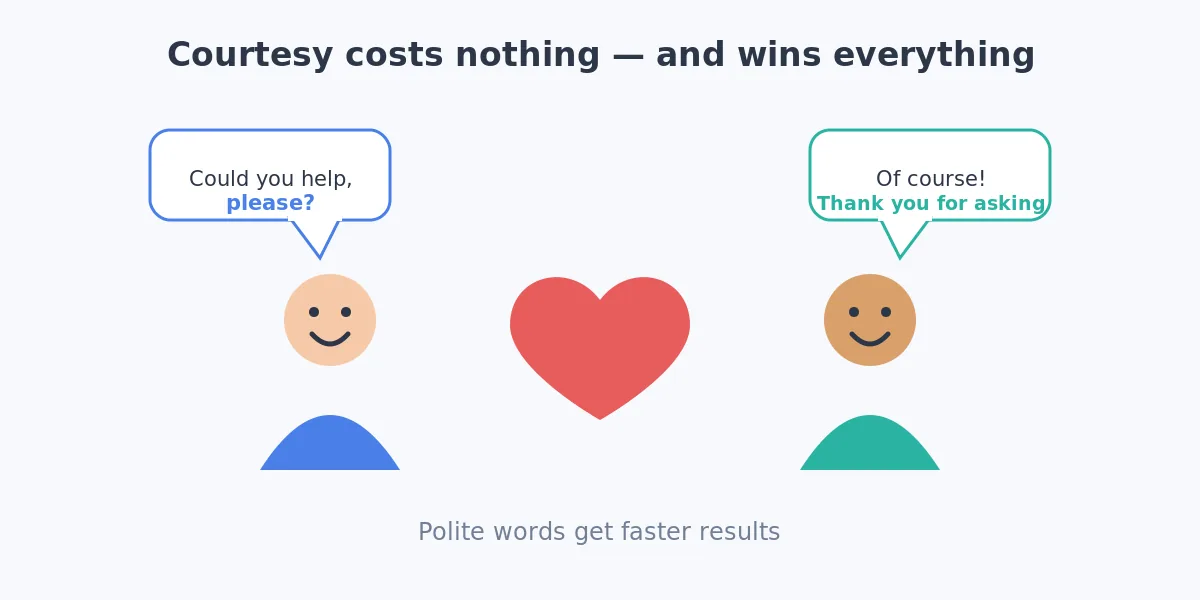
People may forget your exact words, but they remember how you made them feel. A polite message opens doors. A rude message closes them — sometimes forever. Courtesy costs nothing and buys goodwill.
Easy Explanation
Courtesy is not just saying “please” and “thank you.” It is thinking from the other person’s side. Would you feel respected receiving this message? If not, rewrite it.
Examples
- Daily-life example: “Pass the salt” vs. “Could you pass the salt, please?” Same request, completely different feeling at the dinner table.
- Student example: Asking a classmate “Give me your notes” often fails. “Hi Priya, could I borrow your notes for an hour? I missed yesterday’s class” almost always works.
- Business example: Instead of “You made an error in this report,” write “I noticed a small error in the report — could we fix it together before the deadline?”
Wrong vs. Correct
❌ Wrong (Rude) | ✅ Correct (Courteous) |
“This is wrong. Redo it.” | “Thanks for the effort. A couple of points need changes — happy to explain.” |
“Why haven’t you replied?” | “Just following up in case my earlier message got missed.” |
Pro Tips
- ✓ Start with a greeting; end with thanks.
- ✓ Focus on the problem, never the person.
- ✓ Never send a message written in anger. Wait ten minutes, then reread it.
🔑 Key Points: Respect the receiver’s feelings. Polite words get faster results. Tone matters as much as words.
Why the 7 Cs Matter
The 7 Cs are not just theory for textbooks. They quietly decide the results you get every day.
Think about it. A job application that is clear and complete gets shortlisted. A confusing one gets deleted. A courteous complaint gets a refund. A rude one gets ignored. A concrete business proposal wins clients. A vague one loses them.
Communication skill is a result multiplier. Two people can have the same knowledge, but the one who communicates better gets the marks, the job, the promotion, and the trust. That is why the 7 Cs appear in school syllabi, MBA courses, corporate training, and competitive exams alike.
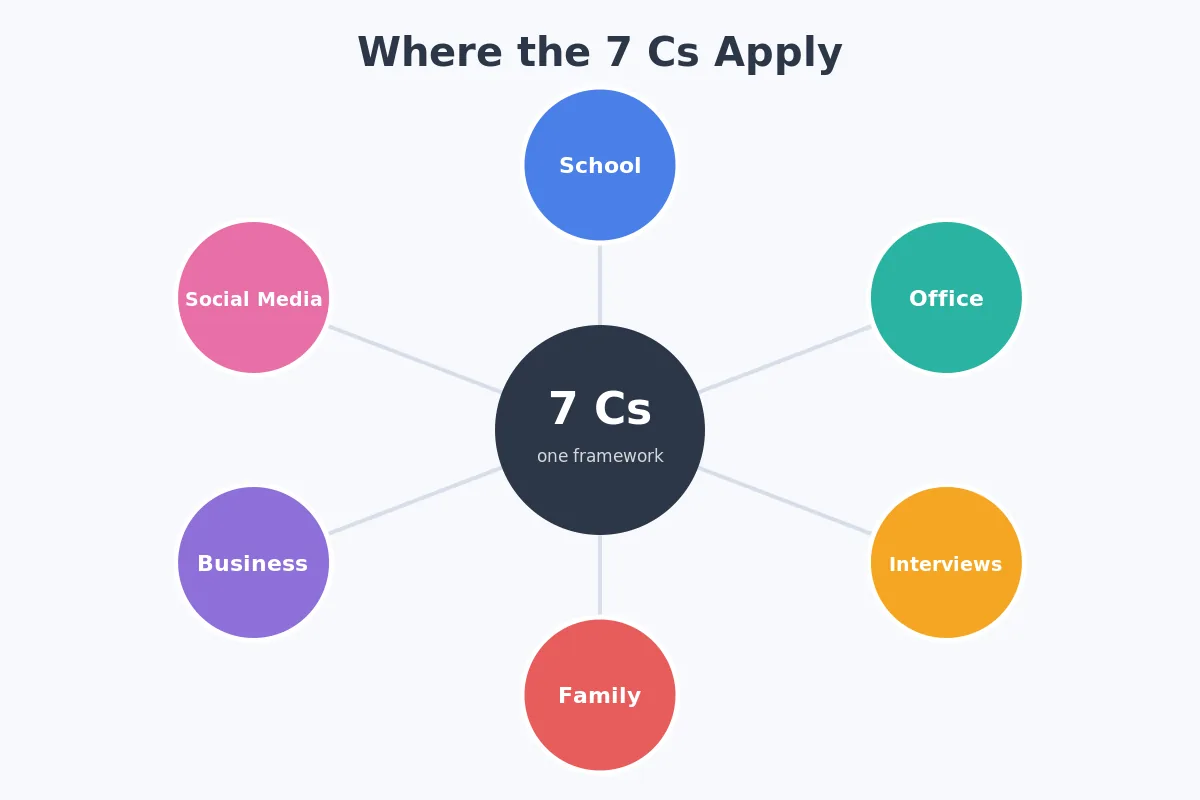
Where the 7 Cs Apply
Area | How the 7 Cs Help |
School & College | Better essays, clearer answers, confident presentations |
Job Interviews | Sharp, specific answers that impress interviewers |
Office & Workplace | Emails that get replies, meetings that end on time |
Family & Friends | Fewer misunderstandings, fewer arguments |
Business | Winning proposals, loyal customers, stronger teams |
Social Media | Posts that people understand, share, and trust |
Advantages of Using the 7 Cs
Here is what changes when you apply the 7 Cs regularly:
- You save time. Messages are understood the first time, so fewer clarification calls and follow-up emails.
- You avoid conflicts. Most fights — at home and at work — start from misunderstanding, not disagreement.
- You build trust. Correct and complete messages make people rely on your word.
- You look professional. Clean, polite, error-free communication signals competence before anyone sees your work.
- You persuade better. Concrete facts and coherent structure make your arguments hard to reject.
- You grow faster. Teachers, bosses, and clients naturally favor people who are easy to communicate with.
Real-Life Applications
In the Classroom
A teacher who says “Read pages 40 to 45 tonight; there will be a five-question quiz tomorrow at 9 a.m.” uses almost all seven Cs in one sentence. Students know exactly what to do. Compare that with “Prepare well for tomorrow” — and you can predict the panic.
In a Job Interview
Interviewer: “Tell me about yourself.”
- Weak answer: “I am hardworking and I like challenges and I am a team player and…”
- 7 Cs answer: “I’m a marketing graduate with two internships. At my last internship, I grew the company’s Instagram reach by 40% in three months. I’d love to bring that skill here.”
Clear, concise, concrete, complete. That is how interviews are won.
In Office Emails
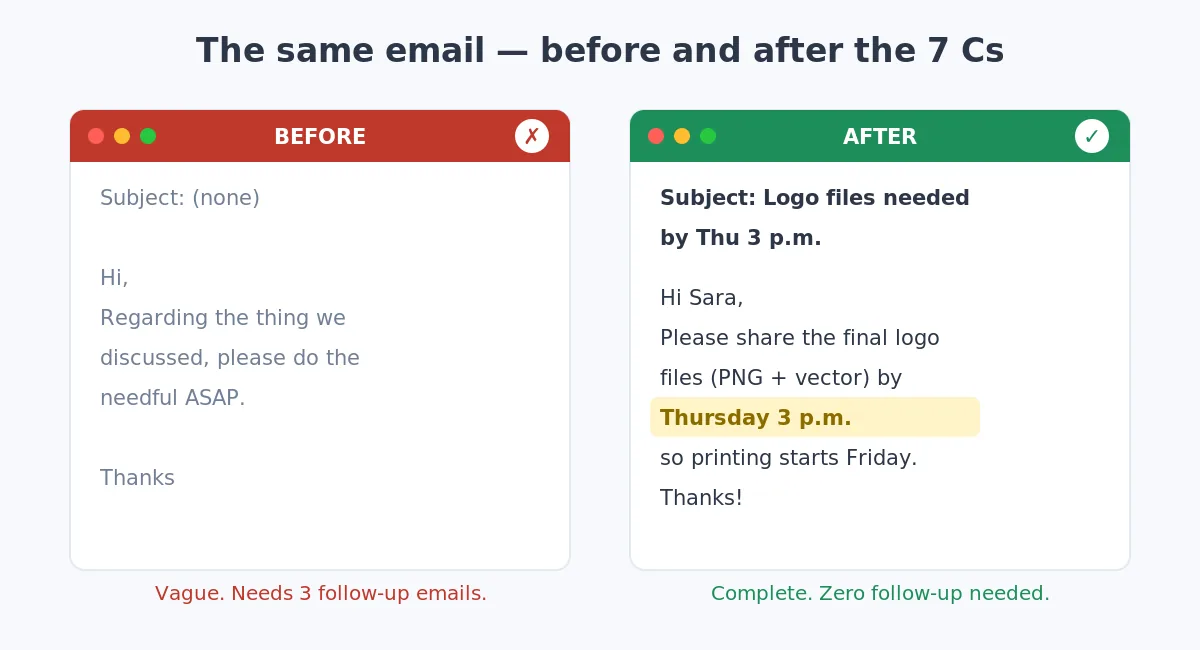
Before: “Hi, regarding the thing we discussed, please do the needful ASAP.”
After: “Hi Sara, as discussed, please share the final logo files (PNG + vector) by Thursday 3 p.m. so printing can start Friday. Thanks!”
The second email needs zero follow-up.
In Family Communication
“You never listen to me!” starts a fight. “I felt ignored when my suggestion was skipped yesterday — can we talk about it?” starts a conversation. Same feeling, different C’s — coherent, concrete, courteous.
In Digital and Social Media Communication
Texts and posts have no tone of voice, so words carry all the weight. “Fine.” reads as angry. “Fine, that works for me 🙂” reads as friendly. On social media, a concrete post — “5 tips that helped me score 90% in boards” — outperforms a vague one — “Some study thoughts” — every single time.
Common Communication Mistakes
⚠️ Important Note: Knowing the 7 Cs is easy. The real challenge is catching yourself breaking them. Here are the most common slips.
- Assuming people know the background. You know the context; they don’t. Always give a one-line setup.
- Writing long, heavy paragraphs. Walls of text scare readers. Break them up.
- Using vague time words. “Soon,” “later,” and “ASAP” mean different things to different people.
- Sending without proofreading. Ten seconds of checking prevents hours of damage control.
- Mixing multiple topics in one message. The receiver responds to one and forgets the rest.
- Replying in anger. Angry messages are almost always regretted and rarely deleted in time.
- Talking more, listening less. Communication is two-way. Great communicators are great listeners first.
- Ignoring body language. Saying “I’m listening” while staring at your phone sends the opposite message.
Tips to Improve Your Communication
Follow these habits and watch your communication improve within weeks:
- Think before you speak. Take three seconds to decide your main point.
- Use the 5 Ws checklist for every important message: Who, What, When, Where, Why.
- Read your message aloud before sending. Your ears catch what your eyes miss.
- Shrink it by 10%. After writing, cut one word in ten. It almost always gets better.
- Replace vague words with numbers. “A few days” → “3 days.” “Many people” → “over 200 people.”
- Listen actively. Nod, ask questions, and summarize what the other person said.
- Watch great communicators. Notice how good teachers, anchors, and leaders structure what they say.
- Practice daily. Rewrite one of your own old emails or texts using the 7 Cs. It is the fastest training there is.
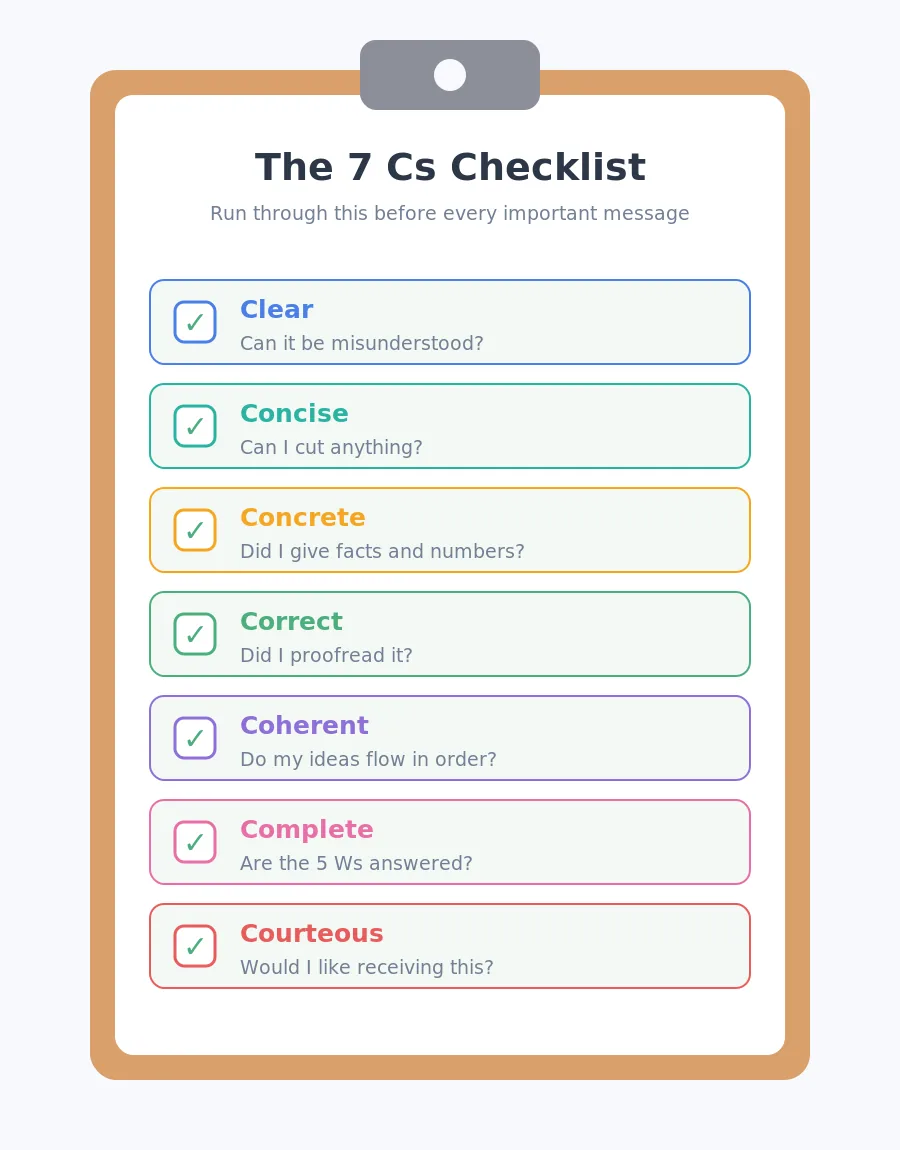
✅ Quick Tip: Print the 7 Cs and stick them near your desk. Before sending any important message, run down the list in ten seconds. This one habit alone can transform your writing.
Related reading: To build a full picture of communication, also read our guides on Methods of Communication, Objectives and Functions of Communication, Characteristics of Communication, Feedback in Communication, and Encoding and Decoding in Communication.
Frequently Asked Questions
1. What are the 7 Cs of communication?
The 7 Cs are Clear, Concise, Concrete, Correct, Coherent, Complete, and Courteous. They are seven simple rules that make any spoken or written message effective and easy to understand.
2. Who created the 7 Cs of communication?
The 7 Cs were popularized by Scott M. Cutlip and Allen H. Center in their 1952 book Effective Public Relations, one of the most influential books in the field.
3. Why are the 7 Cs of communication important?
They prevent misunderstanding, save time, build trust, and make you sound professional. Whether you are a student, employee, or business owner, clear communication directly improves your results.
4. What is the difference between clear and concise?
Clear means your message has only one possible meaning. Concise means you use the fewest words needed. A message can be clear but too long, or short but confusing. Great communication is both.
5. How can students use the 7 Cs?
Students can use them in exam answers, essays, presentations, leave applications, and even while asking doubts in class. Specific, well-ordered answers typically score better than long, vague ones.
6. Are the 7 Cs useful in job interviews?
Yes, extremely. Interviewers favor candidates who give clear, specific, well-structured answers. Concrete examples (“I improved sales by 20%”) are far more convincing than general claims (“I’m hardworking”).
7. Do the 7 Cs apply to text messages and social media?
Yes. In fact, they matter more there because digital messages have no tone of voice or facial expressions. A clear, complete, courteous text prevents most online misunderstandings.
8. What is the most important C of communication?
All seven work together, but clarity is often considered the foundation. If your message is unclear, the other six Cs cannot save it.
9. What happens when the 7 Cs are ignored?
Messages get misunderstood, tasks get done wrong, deadlines slip, relationships strain, and trust erodes. Most workplace and family conflicts begin with poor communication, not bad intentions.
10. How long does it take to improve communication skills?
With daily practice — using checklists, proofreading, and active listening — most people notice visible improvement within three to four weeks. Communication is a skill, and like any skill, it grows with practice.
11. Are there more than 7 Cs of communication?
Some modern authors add extra Cs like Creativity, Credibility, or Consideration. However, the classic seven remain the most widely taught and tested version in schools, universities, and exams.
12. Is the 7 Cs framework asked in competitive exams?
Yes. The 7 Cs frequently appear in business communication papers, management entrance exams, banking exams, and professional courses like BBA, MBA, and B.Com.
Summary
Here is the whole article in one table:
C | Rule | Quick Test |
Clear | One obvious meaning | Can it be misunderstood? |
Concise | Fewest words needed | Can I cut anything? |
Concrete | Facts and numbers | Did I give specifics? |
Correct | Zero errors | Did I proofread? |
Coherent | Logical order | Do ideas flow? |
Complete | All needed info | Are the 5 Ws answered? |
Courteous | Polite and respectful | Would I like receiving this? |
In short: know your point, say it briefly, back it with facts, check it for errors, arrange it in order, include everything needed, and wrap it in politeness.
Conclusion
Communication is the one skill you use every single day, in every part of life. Yet most of us were never really taught how to do it well.
The 7 Cs change that. They are simple enough for a Class 7 student and powerful enough for a CEO. You do not need a fancy vocabulary or a loud voice. You only need to be clear, concise, concrete, correct, coherent, complete, and courteous.
Start small. Apply just one C to your next message. Then add another. Within a month, people will start saying the words every communicator loves to hear: “That was really easy to understand.”
Final Takeaway
The quality of your communication decides the quality of your results. Master the 7 Cs, and you master the most valuable soft skill of your life.
Your turn now:
- 💬 Comment below: Which C do you struggle with the most?
- 🔖 Bookmark this page and use the summary table as your daily checklist.
- 📤 Share this article with one friend, student, or colleague who would benefit from it.
- 🚀 Practice today: Rewrite your last email or text using the 7 Cs. You’ll see the difference immediately.
Better communication starts with your very next message. Make it count.