
Top Grammar Rules for Competitive Exams
(A Complete Textbook-Style Guide for CET, SSC, Banking, MBA & Other Exams)
Introduction: Why Grammar is Your success key to High Scores
If you carefully observe the question papers of exams like CET, SSC, Banking, Railways, MBA entrance, and even UPSC, one thing becomes very clear — grammar is compulsory and it has no option.
👉 First, grammar questions are predictable.
This means theydo not ask entirely new things every year. They generally used to ask the same topics again and again like tenses, articles, subject-verb agreement, prepositions, etc. Only the example or sentence changes, but the rule remains the same. So if you practice previous year papers, you will start understanding the pattern.
👉 Second, grammar follows repeated patterns.
In most of the exams, you will see similar types of mistakes again and again. For example:
- “Each of the students…”
- “A number of…”
- Wrong use of prepositions
- Wrong tense
These are very common. Once you understand these patterns, you can quickly find the correct answer without confusion.
👉 Third, you don’t need hard study, you need smart study.
Many students think English is very difficult. But grammar is actually easy if you study in the right way. You don’t have to learn everything. You just need to focus on important rules and practice questions regularly.
Now understand one important thing.
Vocabulary (words) is very big and sometimes unpredictable. New words can come in exams, and it becomes difficult.
But grammar is different.
👉 Grammar is rule-based.
This means it works on fixed rules. Once you understand a rule, you can use it in many sentences.
For example:
If you understand subject-verb agreement, you can solve many questions easily.
Because of this, grammar becomes a scoring topic.
If your basics are clear and you practice regularly:
- You will solve questions faster
- You will make less mistakes
- Your confidence will increase
Many toppers use grammar as their strong area. While other students get confused, they easily score marks in grammar.
So don’t be afraid of grammar.
Think of it as a golden chance to score more marks easily.
This article is designed in a student-friendly, exam-oriented way, covering the Top 20 grammar rules with:
- Clear explanations
- Real exam-type examples
- Common mistakes
- Easy tricks
- Subject-Verb Agreement
👉 Why it is important:
This is one of the most important topics in grammar. Almost every competitive exam like CET, SSC, Banking, etc., asks 2–3 questions from this rule. If your concept is clear, you can score easy marks here.
Basic Rule:
The verb must agree with the subject in number and person.
👉 One important tip:
Always first find the real subject of the sentence. Sometimes long sentences confuse students, but if you find the subject correctly, the answer becomes easy.
Explanation:
- Singular subject → singular verb
- Plural subject → plural verb
Examples:
- The boy plays cricket.
- The boys play cricket.
Advanced Exam Patterns:
- Words between subject and verb
- The quality of the apples is good.
(Ignore “of the apples”)
- The quality of the apples is good.
- Collective nouns
- The team is winning. (as one unit)
- Special phrases
- A number of students are present.
- The number of students is increasing.
Common Mistake:
- Each of the players are ready ❌
- Each of the players is ready ✅
- Articles (A, An, The)
Articles are small words like a, an, and the that we use before nouns. They help us understand whether we are talking about something general or specific. We use “a” and “an” for general things, and “the” when we talk about something specific or already known. Learning articles is important because small mistakes in them can change the meaning of a sentence and are often asked in competitive exams.
Importance:
Frequently asked in fill-in-the-blanks and error detection.
Rules:
- A/An → general reference
- The → specific reference
Examples:
- I saw a cat.
- I saw the cat that was injured.
Special Cases:
- An honest man (sound-based rule)
- The sun, the moon (unique things)
Exam Trap:
- He is a university student. (correct, sound = “yu”)
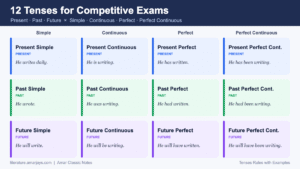
- Tense Consistency
Tense consistency means using the same tense in a sentence so that the meaning is clear and correct. We should not change the tense without a proper reason. If a sentence is talking about the past, all verbs should generally be in the past tense. This rule is important in exams because many questions are based on finding incorrect tense usage in a sentence.
Concept:
Maintain proper tense according to time and context.
Examples:
- She went home and slept.
- She went home and sleeps ❌
Important Rules:
- Universal truth → Present tense
- Water boils at 100°C
- Past events → Past tense
CET Pattern:
Identify incorrect tense usage in long sentences.
- Prepositions
Prepositions are small words like in, on, at, to, from, with, of that show the relationship between words in a sentence. They tell us about place, time, direction, or manner. Prepositions are very important in exams because they are often asked in error detection and fill-in-the-blanks, and even a small mistake can make the sentence incorrect.
Why tricky:
Mostly memory-based but repeated in exams.
Common Prepositions:
- Fond of
- Good at
- Interested in
Common Errors:
- Discuss about ❌
- Order for food ❌
Correct:
- Discuss
- Order food
Tip:
Make a list and revise daily.
- Active and Passive Voice
Active and Passive Voice shows how the action in a sentence is presented. In active voice, the subject does the action, while in passive voice, the subject receives the action. This topic is important in exams because questions are often asked on changing sentences from active to passive or finding the correct form.
Concept:
- Active: Subject performs action
- Passive: Subject receives action
Example:
- Active: She wrote a letter.
- Passive: A letter was written by her.
Exam Pattern:
Convert sentences or identify incorrect voice.
- Direct and Indirect Speech
Direct and Indirect Speech shows how we report what someone has said. In direct speech, we write the exact words of the speaker using quotation marks. In indirect speech, we report the same idea without using the exact words. This topic is important in exams because questions are often asked on changing sentences from direct to indirect form.
Rules:
- Remove quotes
- Change pronoun
- Change tense
Example:
- He said, “I am tired.”
- He said that he was tired.
Key Changes:
- Today → That day
- Now → Then
- Modals
Modals are helping verbs like can, could, may, might, must, should that show ideas like ability, permission, possibility, or obligation. They are important in grammar because they help us express meaning clearly. In exams, questions are often asked to choose the correct modal according to the situation.
Common Modals:
- Can, Could, May, Might, Must, Should
Usage:
- Ability → Can
- Permission → May
- Obligation → Must
Example:
- You must follow rules.
Exam Trap:
Confusion between can/may.
- Adjective vs Adverb
Adjectives and adverbs are used to give more information in a sentence. An adjective describes a noun (person, place, or thing), while an adverb describes a verb (action). This topic is important in exams because students often confuse the two, and questions are asked to find the correct form.
Rule:
- Adjective → describes noun
- Adverb → describes verb
Example:
- He is a fast runner.
- He runs fast.
Common Mistake:
- She sings beautiful ❌
- She sings beautifully ✅
- Degrees of Comparison
Degrees of comparison are used to compare people or things. There are three forms — positive, comparative, and superlative. The positive form shows a simple quality, the comparative form compares two things, and the superlative form compares more than two. This topic is important in exams because questions are often asked to choose the correct form of comparison.
Types:
- Positive
- Comparative
- Superlative
Rules:
- Use “than” with comparative
- Use “the” with superlative
Example:
- This is the best book.
- Conjunctions
Conjunctions are words like and, but, because, although that join words, phrases, or sentences. They help us connect ideas and make sentences clear and meaningful. This topic is important in exams because questions are often asked to find the correct conjunction or to identify errors in sentence structure.
Types:
- Coordinating: and, but
- Subordinating: although, because
Rule:
Avoid double conjunctions.
❌ Although he was tired but he worked.
✅ Although he was tired, he worked.
- Pronoun Agreement
Pronoun agreement means that a pronoun must match the noun it refers to in number and gender. If the noun is singular, the pronoun should also be singular, and if the noun is plural, the pronoun should be plural. This is important in exams because many questions test whether the correct pronoun is used in a sentence
Rule:
Pronoun must agree with noun.
Example:
- Every student must bring his/her book.
Modern Usage:
- Everyone should bring their book.
- Conditionals (If Clauses)
Conditionals are sentences that talk about a condition and its result. They usually start with “if”. These sentences explain what will happen, might happen, or could have happened in different situations. This topic is important in exams because questions are often asked to choose the correct verb form in such sentences.
Types:
- Real → If it rains, I will stay home.
- Unreal → If I were rich, I would travel.
Important Rule:
Use were for imaginary situations.
- Error Spotting
Error spotting means finding the mistake in a sentence. The error can be related to grammar rules like tense, subject-verb agreement, articles, prepositions, etc. This topic is very important in exams because it checks your overall grammar understanding, and questions are often asked to identify the incorrect part of a sentence.
Concept:
Questions combine multiple grammar rules.
Example:
- She don’t like tea ❌
- She doesn’t like tea ✅
Tip:
Practice previous papers.
- Parallelism
Parallelism means using the same grammatical form for similar ideas in a sentence. When we list things or connect ideas, the structure should be the same to make the sentence clear and correct. This topic is important in exams because questions are often asked to identify sentences where the structure is not properly balanced.
Rule:
Maintain same grammatical structure.
Example:
- She likes reading, writing, and dancing.
- Determiners
Determiners are words like some, any, much, many, few, little, this, that, my, your that come before nouns and give more information about them. They tell us about quantity, number, or ownership. This topic is important in exams because questions are often asked to choose the correct determiner in a sentence.
Examples:
- Some, Any, Much, Many
Rules:
- Many → countable
- Much → uncountable
- Gerund vs Infinitive
Gerund and infinitive are two forms of verbs used in sentences. A gerund is a verb with “-ing” (like reading, writing), while an infinitive is “to + verb” (like to read, to write). Both are used in different situations, and we cannot use them randomly. This topic is important in exams because questions are often asked to choose the correct form after certain verbs.
Rule:
- Gerund → verb + ing
- Infinitive → to + verb
Example:
- I enjoy reading.
- I want to read.
- Double Negatives
Double negatives mean using two negative words in the same sentence, which makes the meaning incorrect or confusing. In standard English, we should use only one negative word in a sentence. This topic is important in exams because such mistakes are commonly tested in error detection questions.
Rule:
Avoid two negatives.
Example:
- I don’t know anything.
- Punctuation
Punctuation means using symbols like comma (,), full stop (.), question mark (?), apostrophe (’) to make a sentence clear and easy to understand. These marks help show pauses, questions, or possession. This topic is important in exams because even a small punctuation mistake can change the meaning of a sentence.
Important:
- Apostrophe (’s)
- Comma
- Full stop
Example:
- It’s = It is
- Its = possessive
- Sentence Correction
Sentence correction means finding and correcting mistakes in a sentence to make it grammatically correct and meaningful. The error can be related to tense, articles, prepositions, or sentence structure. This topic is important in exams because it tests your overall understanding of grammar rules.
Tip:
Understand meaning, not just grammar.
Example:
- Senior to (not than)
- Idioms and Phrases
Idioms and phrases are groups of words that have a special meaning different from their actual words. We cannot understand their meaning word by word, so we have to learn them as a whole. This topic is important in exams because questions are often asked to choose the correct meaning of an idiom or phrase.
Examples:
- Break the ice
- Hit the nail on the head
Practice Strategy (Very Important)
Step-by-Step Plan:
- Learn 2 rules daily
- Solve 20 questions daily
- Revise weekly
Best Sources:
- Previous Year Papers (SSC, Banking, CET)
- Mock Tests
Final Conclusion
Grammar is not difficult — it is systematic.
If you:
✔ Understand rules
✔ Practice regularly
✔ Revise smartly
Then you can easily:
👉 Score high
👉 Improve rank
👉 Build confidence
Bonus Tip for You (Very Important)
In competitive exams:
👉 Accuracy matters more than speed in grammar
So:
✔ Attempt fewer but correct answers
✔ Avoid guesswork

Pingback: English Grammar Rules for Competitive Exams: 50 Best Tips
What a writing ! The note is written in very simple language.