Let me tell you a little story. 😊
One Monday morning, an employee named Rohan heard a whisper near the water cooler: “I think the company is giving a bonus this month!” By lunch, the whole office was buzzing. By evening, half the staff believed the bonus was double.
Nobody sent an email. No manager made an announcement. Yet the news travelled across the entire office in hours.
How did that happen? 🤔
That invisible, super-fast, unofficial network is called grapevine communication — and you’re about to become an expert on it.
Have you ever wondered why office news spreads faster than official notices? Or why a small rumour can grow into a big story overnight? In this simple, friendly guide, you’ll learn:
- What grapevine communication really means (in plain words)
- Why it’s called “grapevine”
- The four types with easy diagrams
- Real advantages, disadvantages, and examples
- How smart managers control it
- A comparison table, 20+ FAQs, and quick revision notes
By the end, you’ll understand this topic better than most textbooks explain it. Let’s begin. 👇
What Is Communication? (Quick Recap)
Before we jump in, let’s remember one simple idea.
Communication means sharing information between people so that it is understood.
One person sends a message. Another receives it and understands it. Simple.
Now, communication travels through two main roads:
- Formal communication – official messages that follow the proper chain (like a notice from the boss).
- Informal communication – unofficial messages that flow freely between people (like friendly chit-chat).
Grapevine communication is a type of informal communication. Keep this in mind — it’s the foundation of everything below.
What Is Grapevine Communication?
Now the main topic.
Definition
Grapevine communication is the informal, unofficial flow of information within an organization that spreads through casual talk, rumours and personal relationships — not through official channels.
Meaning (in easy words)
Imagine news jumping from person to person like a spark — friend to friend, desk to desk, group to group. There’s no fixed path and no official stamp. That’s grapevine.
It’s the “unofficial news channel” of every office, school and group. It works during tea breaks, in corridors, on WhatsApp groups, and over lunch.
Did You Know? Studies suggest a large share of grapevine information is actually correct — often 70–90% accurate! The problem is the small wrong part, which can spread fear or confusion. 💡
Why Is It Called “Grapevine”?
Great question! 🍇
The name comes from the American Civil War (1860s). Telegraph wires were strung loosely from tree to tree and looked like tangled grapevine plants. The messages passing through them were often unclear and mixed-up — just like informal office news.
So people started calling confusing, twisting, person-to-person messages “the grapevine.” The name stuck, and we still use it today.
Exam Point “The term grapevine comes from Civil-War-era telegraph wires that looked like twisting grapevine plants.” Write this and impress your examiner! 🎯
Features (Characteristics) of Grapevine Communication
Let’s understand what makes grapevine special.
- Informal: No official rules or forms.
- Fast: Spreads quicker than official notices. ⚡
- No fixed direction: Moves up, down and sideways freely.
- Spontaneous: Happens naturally, without planning.
- Based on relationships: Flows through friendships and trust.
- Hard to trace: You can’t easily find who started it.
- Present everywhere: Every organization has it — you can’t fully remove it.
- Can carry rumours: Sometimes true, sometimes twisted.
Remember You cannot stop the grapevine. But a smart manager can guide it. We’ll see how later. 👍
Why Does Grapevine Communication Happen? (Causes)
The grapevine grows for very human reasons:
- Curiosity: People love to know what’s going on.
- Lack of information: When the boss stays silent, people fill the gap with guesses.
- Insecurity: Worry about jobs, salary or change makes people talk.
- Friendship: Friends naturally share news with each other.
- Excitement: Big news (bonus, transfer, new boss) spreads fast.
- Boredom: Idle time leads to chit-chat.
Quick Tip The best cure for harmful rumours is clear, honest, timely information from the top. When people know the truth, the grapevine has less to invent. ✅
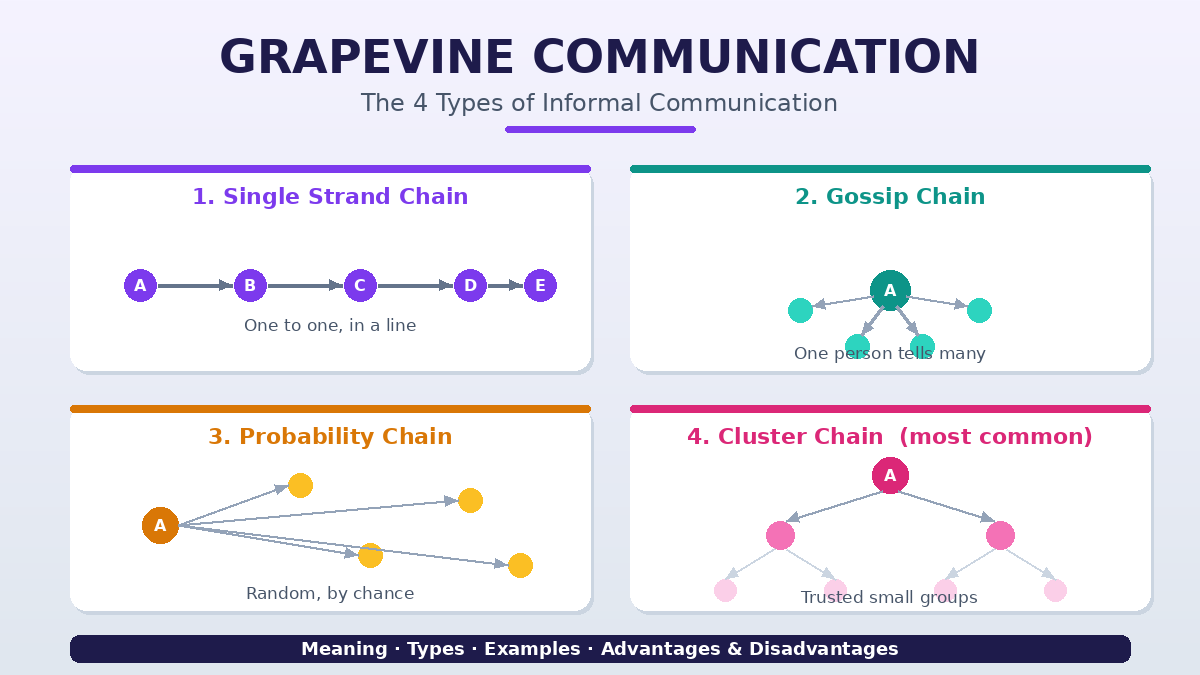
Types of Grapevine Communication (with Diagrams)
This is the most important part for exams and real life. There are four main types, first described by researcher Keith Davis. Let’s make each one super simple.
1. Single Strand Chain
In a single strand chain, information passes from one person to the next, one by one — like a line.
A tells B, B tells C, C tells D. Straight line.
A → B → C → D → E- Reliability: Low. The message changes at each step (like “Chinese Whispers”).
- Example: One employee tells one friend about a manager’s transfer, who tells one more, and so on.
2. Gossip Chain
In a gossip chain, one person tells the news to many people — like the centre of a wheel.
One “news-lover” spreads it to everyone they meet.
        B
        ↑
   C ← A → D
        ↓
E- Use: Common for interesting but non-urgent news.
- Example: One talkative person tells the whole team, “Did you hear the office picnic is next week?”
3. Probability Chain
In a probability chain, a person tells the news randomly to a few people — by chance, not by choice.
The message spreads in a random, unplanned way.
A → C
A → F
A → D → G- Use: For interesting but not very important news.
- Example: You randomly mention to a couple of colleagues, “I heard the canteen menu is changing.”
4. Cluster Chain
In a cluster chain, a person tells a few trusted people, and each of them tells a few more trusted people.
This is the most common type in real offices. News moves through small trusted groups.
        A
       / \
      B   C
     / \   \
D E F- Use: The main way most office news actually travels.
- Example: A team lead tells two close teammates about a policy change; each tells two of their friends.
Important Note The cluster chain is the most common and most powerful type in real workplaces. If a question asks “which type is most common?”, the answer is cluster chain. 🎯
Comparison Table: The Four Types of Grapevine
| Type | How It Spreads | Reliability | Common? | Simple Example |
|---|---|---|---|---|
| Single Strand | One to one, in a line | Low (message distorts) | Rare | A tells B, B tells C |
| Gossip Chain | One to many | Medium | Sometimes | One person tells the whole team |
| Probability Chain | Randomly to a few | Low | Occasional | You mention news to random colleagues |
| Cluster Chain | Trusted small groups | High | Most common | Friends tell friends they trust |
Interview Question “Which is the most common type of grapevine communication?” Quick answer: The cluster chain — where trusted people pass news to other trusted people. ✅
Grapevine Flow Diagram (Formal vs Informal)
Here’s a simple picture of how grapevine sits beside the official system.
   FORMAL CHANNEL (official)        GRAPEVINE (informal)
        CEO                              Rohan 🍇
         ↓                              /   |   \
      Manager                        Priya  Sam  Anu
         ↓                            /       \
      Employee                     Ravi       Neha
   (slow, official)              (fast, friendly, unofficial)
The formal channel is like a straight highway. The grapevine is like little footpaths everyone actually uses. Both exist together in every organization.
Importance of Grapevine Communication
Many people think grapevine is only “bad gossip.” Not true! When handled well, it is genuinely useful.
- Fast feedback: Managers learn how employees really feel.
- Fills information gaps: People stay informed even before official notices.
- Builds friendships: Casual talk creates team bonding.
- Reduces stress: Sharing worries makes people feel lighter.
- Warning system: Leaders spot problems early through informal buzz.
- Boosts belonging: People feel “in the loop” and valued.
Did You Know? Smart managers actually listen to the grapevine to sense employee mood — like a doctor checking a pulse. 🩺
Advantages of Grapevine Communication
Let’s list the clear benefits.
- Very fast — spreads news in minutes.
- Flexible — no forms, no rules, no delay.
- Emotional support — friends share feelings freely.
- Honest feedback — reveals true opinions of staff.
- Team bonding — builds friendships and trust.
- Fills gaps — keeps people informed between official updates.
- Early warnings — managers sense trouble before it grows.
Disadvantages of Grapevine Communication
Now the honest downsides.
- Spreads rumours — half-truths can travel fast.
- Distortion — the message changes at each step.
- Creates fear — false news causes panic (e.g., “layoffs coming!”).
- Hard to control — you can’t easily stop it.
- No proof — nobody is responsible for wrong news.
- Wastes time — too much chit-chat lowers work.
- Can hurt reputations — gossip may damage people unfairly.
Common Mistake Don’t believe grapevine news blindly. Always verify important information from an official source before acting on it. ⚠️
Real-Life Examples of Grapevine Communication
Let’s see it working across everyday places.
- Office: “I heard the boss is leaving!” spreads before any official memo.
- School: Students whisper that “the exam might be postponed.”
- College: News of a surprise holiday spreads through friend groups in minutes.
- Hospital: Staff quietly share that “a new head doctor is joining.”
- Bank: Employees talk about a possible branch transfer before the order arrives.
- Factory: Workers discuss a rumoured shift change during tea break.
- IT Company: Developers chat about an upcoming appraisal on the team WhatsApp group.
- Family: Relatives share wedding news across the family before the card is printed.
- Neighbourhood: News of a new shop opening spreads door to door.
- Cricket Team: Players whisper about a possible change in the captain.
See? You’ve witnessed grapevine communication a hundred times — now you know its name! 😄
How Managers Can Control (Manage) the Grapevine
You can’t switch the grapevine off. But you can keep it healthy. Here’s how good leaders do it:
- Share information early — don’t leave gaps for rumours to fill.
- Be honest and open — trust reduces wild guessing.
- Communicate often — regular updates keep facts flowing.
- Listen to the buzz — treat the grapevine as feedback, not enemy.
- Correct rumours quickly — reply to false news fast and calmly.
- Involve informal leaders — the “popular” people can spread correct news too.
- Build trust — employees who trust bosses gossip less.
- Explain changes clearly — fear grows in silence, not in clarity.
Quick Tip The golden rule: Fill the silence with truth before the grapevine fills it with rumour. 🥇
Common Mistakes Students Make
Watch out for these traps — fixing them boosts your marks.
- Thinking grapevine is only bad. (It has real benefits too.)
- Believing grapevine is a formal channel. (It’s informal.)
- Forgetting the four types (single strand, gossip, probability, cluster).
- Saying the single strand chain is most common. (It’s the cluster chain.)
- Thinking grapevine only moves downward. (It moves in all directions.)
- Believing grapevine news is always false. (It’s often mostly true.)
- Confusing grapevine with formal communication.
- Forgetting why it’s called “grapevine” (Civil War telegraph wires).
- Writing that managers should ban it. (They should manage it.)
- Ignoring that grapevine gives useful feedback.
20 Tips to Handle Grapevine Communication Wisely
- Verify important news before believing it.
- Don’t spread news you can’t confirm.
- Ask official sources when unsure.
- Stay calm during rumours.
- Don’t panic over “big scary” news.
- Avoid spreading harmful gossip about people.
- Share only positive, helpful informal news.
- Managers: give updates early and often.
- Managers: reply to false rumours fast.
- Build trust so people gossip less.
- Listen to the grapevine for real feedback.
- Keep private matters private.
- Don’t judge people based on gossip.
- Use the grapevine to spread good news too.
- Encourage open, honest team talk.
- Respect confidentiality at work.
- Correct yourself if you spread wrong info.
- Keep chit-chat balanced with work.
- Treat everyone’s reputation with care.
- Remember: silence feeds rumours — clarity kills them.
Quick Summary (Key Takeaways)
- Grapevine communication = the informal, unofficial spread of news through casual talk and relationships.
- It is a type of informal communication — fast, spontaneous and hard to trace.
- The name comes from Civil-War telegraph wires that looked like grapevines.
- Four types: single strand, gossip, probability, and cluster (the most common).
- Advantages: fast, flexible, builds bonds, gives honest feedback.
- Disadvantages: spreads rumours, causes fear, hard to control.
- Managers should manage the grapevine with honest, timely information — not try to ban it.
Frequently Asked Questions (FAQ)
1. What is grapevine communication? It is the informal, unofficial flow of information in an organization that spreads through casual talk, rumours and personal relationships instead of official channels.
2. Why is it called grapevine communication? The name comes from the American Civil War, when telegraph wires strung loosely between trees looked like tangled grapevines, and the messages were often unclear.
3. Is grapevine communication formal or informal? It is informal. It does not follow the official chain of command.
4. What are the four types of grapevine communication? Single strand chain, gossip chain, probability chain, and cluster chain.
5. Which type of grapevine communication is most common? The cluster chain, where trusted people pass news to other trusted people.
6. What is a single strand chain? Information passes from one person to the next in a straight line — A tells B, B tells C, and so on.
7. What is a gossip chain? One person spreads the news to many people, like the centre of a wheel.
8. What is a probability chain? A person shares the news randomly with a few people, by chance rather than choice.
9. What is a cluster chain? A person tells a few trusted people, and each of them tells a few more trusted people. It is the most common type.
10. Who gave the four types of grapevine communication? Researcher Keith Davis first described these four grapevine patterns.
11. Is grapevine communication good or bad? Both. It is fast and builds bonds (good), but it can spread rumours and fear (bad). Managed well, it is helpful.
12. What are the advantages of grapevine communication? It is fast, flexible, builds friendships, fills information gaps, and gives honest feedback.
13. What are the disadvantages of grapevine communication? It can spread rumours, distort messages, create fear, and is hard to control.
14. How accurate is grapevine information? Often surprisingly accurate — studies suggest 70–90% — but the small wrong part can cause big problems.
15. Can grapevine communication be stopped? No. It exists in every organization. It can only be managed, not removed.
16. How can managers control the grapevine? By sharing honest information early and often, listening to the buzz, and correcting false rumours quickly.
17. What is the difference between formal and informal communication? Formal follows official channels and rules; informal (like grapevine) flows freely through relationships.
18. Does grapevine communication move in one direction? No. It moves in all directions — up, down and sideways.
19. Give one real-life example of grapevine communication. Employees hearing “the boss is leaving” through casual talk before any official announcement.
20. Why does grapevine communication happen? Because of curiosity, lack of official information, insecurity, friendship and excitement.
21. Is grapevine communication useful for managers? Yes. It acts like a “pulse check” — managers can sense employee mood and spot problems early.
22. What is the biggest risk of the grapevine? Spreading false rumours that create fear or panic among employees.
23. How can students remember the four types easily? Think S-G-P-C: Single strand, Gossip, Probability, Cluster. 🎯
24. Is WhatsApp a grapevine channel? Yes. Office WhatsApp groups are a very common modern grapevine channel.
25. What is the best way to reduce harmful rumours? Give clear, honest, timely information from the top — truth leaves less room for rumours.
Conclusion: Turn the Grapevine into Your Friend
Let’s go back to Rohan and that “double bonus” rumour. 😄
By now, you understand exactly what happened. An information gap + curiosity + friendly talk = a fast-moving grapevine. And you also know the cure: honest, timely information.
Here’s the beautiful truth: the grapevine is not your enemy. It’s a natural, human part of every workplace, school and family. When you learn to read it, verify it, and guide it, it becomes a powerful tool for feedback, bonding and early warnings.
So the next time you hear a whisper near the water cooler, smile. You now know its name, its types, and its tricks. 💪
Use the grapevine wisely — and never let a rumour do the work that a little honesty could fix.
You’ve got this. Now go communicate like a pro! 🌟
📣 Found this helpful?
- 💬 Comment below with a grapevine example you’ve seen.
- 🔁 Share this with a classmate before the exam.
- 🔖 Bookmark it for quick revision.
- 🔔 Subscribe for more simple communication guides.