
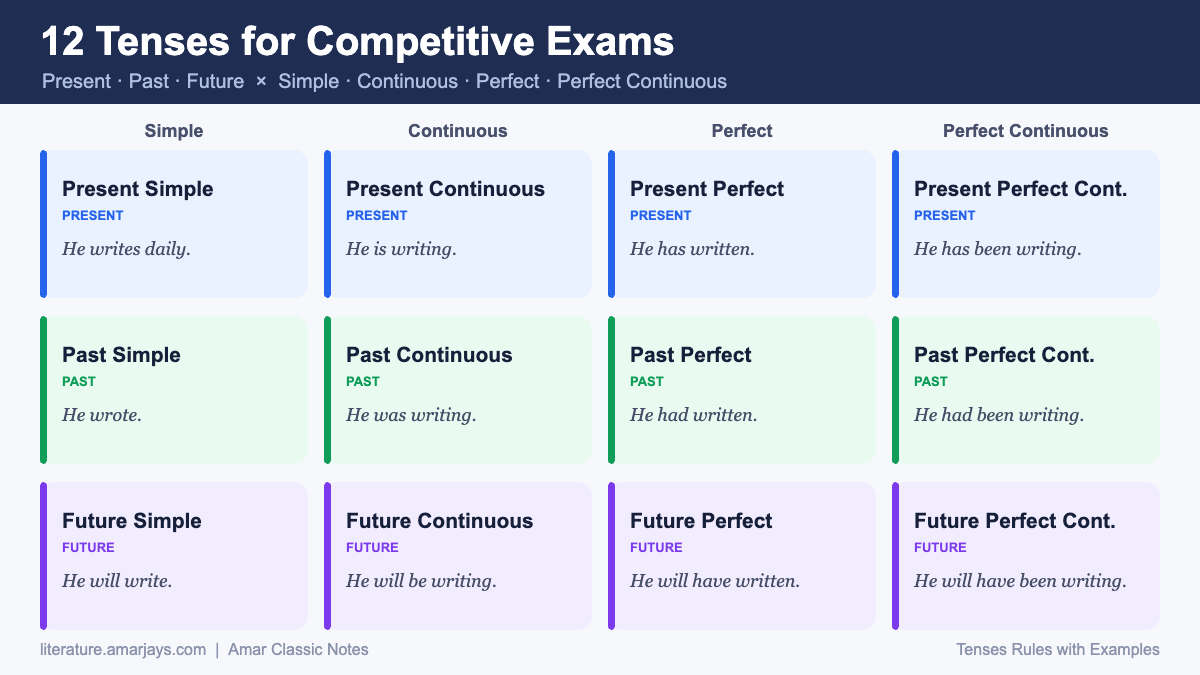
Tenses for competitive exams are the backbone of the English section in SSC, Banking, Railway and other government tests. Almost every year you face questions on tense rules, fill-in-the-blanks and spotting errors. This guide explains all 12 tenses with simple rules, clear examples and quick exam tricks, so you can revise the whole topic fast and score more marks.
Prepared by Dr. Amar Sontakke, Associate Professor of English
Reading time: about 12 minutes
Quick answer: English has three tenses — Present, Past and Future — and each has four forms: Simple, Continuous, Perfect and Perfect Continuous. That gives 12 tense forms in total. For competitive exams like SSC, Banking and Railways, you must be able to spot the correct tense from time-signal words (such as yesterday, since, already, by next year) and correct common tense errors in spotting-the-error questions.
The 12 Tenses at a Glance
Use this table as your revision anchor. The verb used is “write.”
| Tense | Structure | Example |
|---|---|---|
| Present Simple | subject + V1 (+s/es) | She writes notes daily. |
| Present Continuous | is/am/are + V-ing | She is writing notes now. |
| Present Perfect | has/have + V3 | She has written the notes. |
| Present Perfect Continuous | has/have been + V-ing | She has been writing since morning. |
| Past Simple | V2 | She wrote notes yesterday. |
| Past Continuous | was/were + V-ing | She was writing when I called. |
| Past Perfect | had + V3 | She had written before he came. |
| Past Perfect Continuous | had been + V-ing | She had been writing for an hour. |
| Future Simple | will + V1 | She will write notes tomorrow. |
| Future Continuous | will be + V-ing | She will be writing at 5 p.m. |
| Future Perfect | will have + V3 | She will have written by Monday. |
| Future Perfect Continuous | will have been + V-ing | She will have been writing for years. |
(V1 = base form, V2 = past, V3 = past participle.)
Time-Signal Words (the exam shortcut)
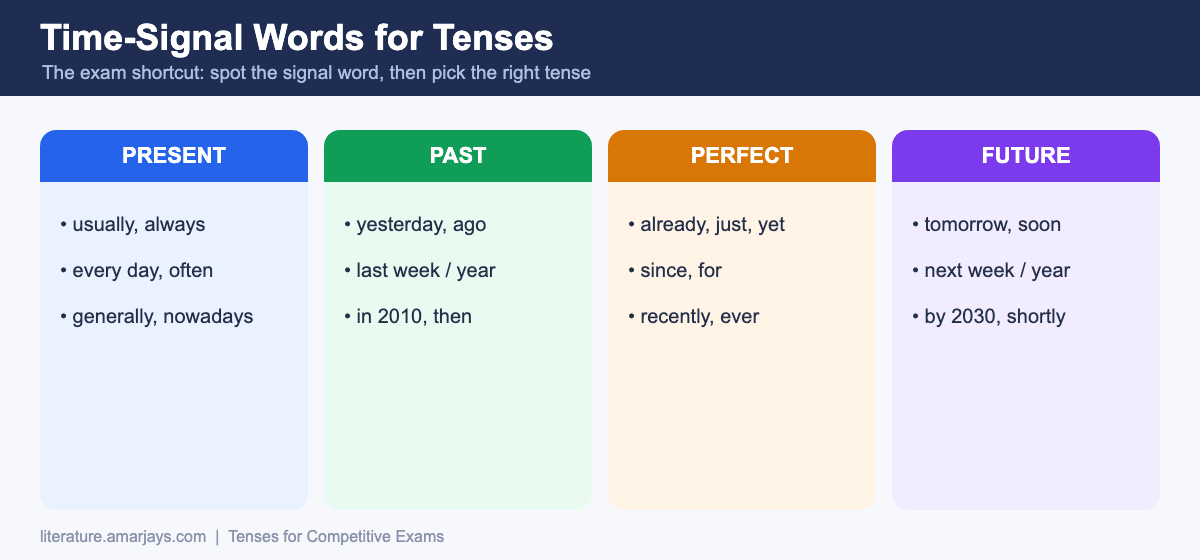
Most tense questions can be solved by spotting the signal word:
- Present Simple: always, usually, every day, generally.
- Present Continuous: now, at present, at the moment, currently.
- Present Perfect: just, already, yet, ever, never, so far, recently.
- Present Perfect Continuous: since, for (with an ongoing action).
- Past Simple: yesterday, ago, last week, in 1999.
- Past Perfect: before, after, by the time, already (in the past).
- Future Simple: tomorrow, next week, soon.
- Future Perfect: by + future time (by 2027, by next month).
Tip: Since points to a starting point (since 2010); for points to a duration (for ten years).
The Rules Examiners Test Most
Rule 1 – Universal truths take the Present Simple. The sun rises in the east. (Never “rose” in reported speech for a universal truth.)
Rule 2 – Two past actions: the earlier action takes Past Perfect, the later one Past Simple. The train had left before we reached the station.
Rule 3 – After “since,” use the Present Perfect / Perfect Continuous, not the Present. ✗ I am living here since 2015. ✓ I have been living here since 2015.
Rule 4 – Time and conditional clauses use the Present, not the Future. ✗ I will call you when I will reach. ✓ I will call you when I reach.
Rule 5 – Stative verbs (know, believe, love, own, seem) are not normally used in continuous forms. ✗ I am knowing the answer. ✓ I know the answer.
Rule 6 – “Yesterday, ago, last…” force the Past Simple, never the Present Perfect. ✗ I have met him yesterday. ✓ I met him yesterday.
Common Errors to Correct (Spotting-the-Error practice)
- ✗ He did not came. → ✓ He did not come. (After did, use V1.)
- ✗ She has went home. → ✓ She has gone home.
- ✗ They are playing cricket every Sunday. → ✓ They play cricket every Sunday.
- ✗ When I reached, the film already started. → ✓ …the film had already started.
Common Tense Mistakes in Competitive Exams
Examiners love to test the same slip-ups again and again. Watch out for these common mistakes when you attempt tenses for competitive exams:
- Wrong verb form after “has/have/had”. Always use the third form: He has gone (not went).
- Using two past markers together. Avoid “did not went”; the correct form is did not go.
- Mixing present and past in one sentence. Keep the tense consistent unless the meaning clearly changes.
- Ignoring time-signal words. A word like since or already usually forces the perfect tense.
- Subject–verb disagreement. Singular subjects take is/was/has; plural subjects take are/were/have.
Quick Tricks to Choose the Right Tense
These fast tricks help you decide the correct tense in seconds during the exam:
- Read the sentence and find the time reference first.
- Match the time-signal word to its tense using the chart above.
- Check the helping verb and make sure the main verb takes the right form.
- Re-read the full sentence once to confirm it sounds correct.
With regular practice, these tricks make tenses for competitive exams one of the fastest and most reliable scoring areas in the English paper.
How to Revise Tenses for Competitive Exams
Smart revision matters as much as knowing the rules. Use this simple plan to master tenses for competitive exams in less time:
- Learn the structure first. Fix the helping verb and the main-verb form for each tense before moving on to examples.
- Use time-signal words. Words like already, since, yesterday and by next year tell you which tense to choose in the exam.
- Practise error-spotting. Most tense questions in competitive exams test wrong verb forms, so solve spotting-the-error sets daily.
- Revise with the chart. Keep the 12-tense table above handy and recall one example for each tense.
For a wider revision plan, see our guide on how to study grammar for competitive exams and the list of important English grammar rules for competitive exams. For a general overview you can also read about grammatical tense on Wikipedia. Mastering tenses for competitive exams early gives you an easy, reliable source of marks.
Keep practising these tenses for competitive exams with real question papers until every rule feels automatic.
Summary
English tenses fall into a neat 3 × 4 grid of twelve forms. In exams you rarely need grammar theory — you need to (1) read the signal word, (2) apply the sequence-of-tense rules above, and (3) watch for the classic traps with since/for, universal truths, and will in time clauses.
Key Points: Tenses for Competitive Exams
- 12 tense forms = 3 tenses × 4 aspects.
- Master the structures (auxiliary + verb form) for each.
- Learn the signal words — they solve most objective questions instantly.
- Memorise the 6 high-frequency rules above; SSC and Banking test them repeatedly.
- Practise error-spotting, the format in which tenses are most commonly examined.
Five Likely Questions on Tenses for Competitive Exams
1. Fill in the blank: “He ______ (work) in this bank since 2018.”
has been working. “Since” with an ongoing action needs the Present Perfect Continuous.
2. Spot the error: “I will inform you as soon as I will get the news.”
Error is in I will get. Time clauses use the Present Simple: as soon as I get the news.
3. Choose the correct tense: “By next December, she ______ (complete) ten years of service.”
will have completed. “By + future time” signals the Future Perfect.
4. Which is correct: “I am knowing him for years” or “I have known him for years”?
I have known him for years. Know is a stative verb and is not used in the continuous form.
5. Fill in the blank: “The guests ______ (leave) before I reached home.”
had left. The earlier of two past actions takes the Past Perfect.
Related notes:
Parts of Speech with Examples · English for Competitive Examinations – Study Guide
Preparing for SSC or Banking? Get the complete grammar set in our English Grammar for Competitive Exams section — and see Dr. Sontakke’s Kindle book English for Competitive Examinations for full practice.
Final tip: treat tenses for competitive exams as a scoring topic, not something to fear. Once you know the rule and one example for each of the 12 tenses, most questions become easy marks. Revise this page before every test and practise a few error-spotting sentences daily, and your accuracy with tenses for competitive exams will keep improving.