You Negotiate More Than You Think
It is Sunday evening. You want to watch a film. Your younger sister wants the same TV for her cartoons. Nobody wants to give up. After five minutes of “It’s my turn,” one of you says, “Okay — you take it now, I get it after dinner.” Deal done.
You just negotiated. You didn’t call it that. There was no big table, no suits, no lawyers. But two people wanted different things, and you found a way both could live with.
This happens all day, every day. A student asks a teacher for two more days to submit an assignment. A customer at a shop asks, “Sir, can you make it a little less?” A friend says, “You choose the movie, I’ll choose the place to eat.” An employee sits nervously in a cabin and says the hardest sentence of the month: “I was hoping we could talk about my salary.”
Here is the honest truth that most people miss: you are already a negotiator. You have been one since you were a child begging for ten more minutes of play. The question is not whether you negotiate. The question is how well.
And that is good news. Because a skill you already use every day is a skill you can get much, much better at. That is what this guide to negotiation skills is for.
What Is Negotiation, Really?
Let’s keep it simple.
Negotiation is a conversation between two or more people who want different things, held to reach an agreement that everyone can accept.
Read that again slowly. Three parts matter.
First, different things. If we both want the same thing in the same way, there is nothing to negotiate. Negotiation only starts when there is a gap between what you want and what the other person wants.
Second, a conversation. Not a fight. Not a lecture. A back-and-forth, where both sides speak and both sides listen.
Third, an agreement everyone can accept. Not “I win, you cry.” A result both people can walk away with.
So here is a line worth remembering:
Negotiation is not about getting everything you want. It is about finding a way forward when two people want different things — a way both can say yes to.
Negotiation Is Not the Same as Arguing
This confuses a lot of people, so let’s clear it up.
In an argument, the goal is to prove you are right and the other person is wrong. You push. They push back. Voices rise. Even if you “win,” the other person feels defeated — and often quietly plans to get back at you later.
In a negotiation, the goal is to reach a workable deal. You are not trying to defeat a person. You are trying to solve a shared problem: “We disagree — now how do we move ahead?”
Think of it like this. In an argument, you sit across from the other person, like enemies. In a good negotiation, you both turn and sit on the same side, looking together at the problem in front of you.
Is negotiation the same as bargaining? Not quite. Bargaining is one small part of negotiation — usually the money part, the haggling over price. Negotiation is bigger. It includes preparation, listening, understanding why the other side wants something, offering options, and building trust. Bargaining is asking “How much?” Negotiation is asking “How can this work for both of us?”
And no — negotiation is not about defeating the other person. A negotiation where the other side feels cheated is a failure, even if you got a good number. Because you will meet that person again. That manager, that supplier, that classmate, that neighbour. People remember how you made them feel.
Is Negotiation Only About Money?
Ask most people what negotiation means and they say “price.” But money is only one thing we negotiate.
We negotiate time (“Can we push the meeting to 4?”). We negotiate work (“You do the slides, I’ll do the speaking”). We negotiate space, rules, freedom, respect, and attention. A couple deciding where to spend Diwali is negotiating. A team deciding who leads a project is negotiating. A child promising to finish homework in exchange for phone time is negotiating.
Once you see this, the world changes a little. You realise negotiation is not a business skill. It is a life skill.
Where Negotiation Hides in Everyday Life
Let’s make this real. Look at how often it happens:
- Students and teachers: asking for a deadline extension, or requesting a re-check of marks.
- Parents and children: screen time, pocket money, curfew, career choices.
- Friends: who pays, where to go, whose plan wins this weekend.
- Employees and managers: salary, leave, workload, responsibilities.
- Customers and sellers: price, delivery, warranty, a small discount.
- Business partners: who invests how much, who handles what.
- Landlords and tenants: rent, repairs, deposit, notice period.
- Family members: dividing chores, planning functions, sharing money for parents.
- Team members: deadlines, credit, who does the boring part.
Count how many of these touched your last week. Most people are surprised. You are not “learning” negotiation from zero. You are polishing something you already do.
Why Negotiation Skills Matter (In Places You Didn’t Expect)
Everyone says negotiation is “important.” Few explain why. Let’s be specific, because each area gives you something different.
In education, it helps you get fair marks, better project roles, and support from teachers. A student who can calmly explain their case gets heard. A student who sulks does not.
In your career, your first salary sets the base for years. A person who negotiates their starting pay well often earns more for a long time, because future raises are calculated on top of that first number.
In job interviews, negotiation is a quiet test. How you discuss salary tells the employer how you will handle clients and conflicts later.
In business, almost every rupee of profit passes through a negotiation — with suppliers, customers, staff, or partners. A small improvement in each deal adds up hugely over a year.
In leadership, you cannot order people to care. You negotiate agreement, buy-in and cooperation. Good leaders are, quietly, excellent negotiators.
In teamwork, every group has limited time and clashing ideas. Negotiation is how a team turns “my idea vs your idea” into “our plan.”
In conflict, it lowers the temperature. Two angry people rarely fix anything. A negotiator finds the small overlap and builds on it.
In customer relations, an unhappy customer who feels heard often stays. One who feels dismissed leaves and tells ten friends.
In personal relationships, it protects the bond. You can win a fight with your partner and still lose the evening. Negotiation lets you solve the issue and keep the peace.
In entrepreneurship, you negotiate before you have money, brand or power — for your first client, your first hire, your first loan. It is often the founder’s most-used skill.
In daily decisions, it saves time, money and stress in small ways that quietly add up.
Notice the pattern. Negotiation is not one skill in one room. It is a thread running through your whole life.
The 16 Skills That Make a Good Negotiator
People imagine a great negotiator as a fast, smooth talker. Usually it is the opposite — a calm, patient listener. Here are the skills that actually matter. For each, I’ll give you the meaning, why it counts, a quick example, and one tip.
1. Active Listening
Meaning: fully hearing what the other person says, including what they don’t say.
Why: people reveal what they really need when they feel heard.
Example: a customer says “It’s too costly.” A poor listener defends the price. A good listener hears the real message: “Convince me it’s worth it.”
Tip: before replying, repeat their point in your own words: “So your worry is X — is that right?”
2. Clear Communication
Meaning: saying what you mean in simple, calm words.
Why: confusion kills deals; clarity builds trust. Strong speaking skills help here too.
Example: “I need Rs 5,000 more” beats a long, foggy speech about how you “feel undervalued.”
Tip: one clear ask is stronger than five vague hints.
3. Asking Good Questions
Meaning: using questions to understand, not to trap.
Why: the person who asks better questions controls the conversation.
Example: “What matters most to you in this deal?” opens doors. “So you refuse?” slams them.
Tip: ask “why” and “what if” more than “yes or no.”
4. Preparation
Meaning: knowing the facts, your goal, and your limits before you begin.
Why: most negotiations are won or lost before anyone speaks.
Example: checking market salary before an interview so you don’t quote too low.
Tip: write three things on paper — your goal, your limit, and one thing you can give away.
5. Emotional Control
Meaning: staying calm when you feel angry, nervous or insulted.
Why: the moment you lose your temper, you start making mistakes.
Example: a supplier lowballs you; instead of snapping, you pause and say, “Let me think about that.”
Tip: when emotion rises, slow your breathing and say less.
6. Empathy
Meaning: understanding the other person’s situation and feelings.
Why: you can’t solve a problem you don’t understand.
Example: realising your landlord is worried about late rent, not just greedy.
Tip: ask yourself, “If I were in their chair, what would I want?”
7. Patience
Meaning: being willing to wait rather than rush to close.
Why: the person in a hurry usually gives away more.
Example: not accepting the first offer just to end the awkwardness.
Tip: silence is allowed. Let it sit.
8. Confidence
Meaning: believing your ask is reasonable.
Why: if you don’t value your request, why should they?
Example: stating your salary number without apologising for it.
Tip: confidence is calm, not loud. Say it plainly, then stop talking.
9. Problem-Solving
Meaning: finding creative ways to close the gap.
Why: many deals stall not because agreement is impossible, but because nobody looked for a third option.
Example: can’t agree on price? Add free delivery, or split payment.
Tip: keep asking, “Is there another way to do this?”
10. Persuasion
Meaning: helping the other side want to say yes.
Why: pushing creates resistance; persuading creates agreement.
Example: showing a client how your service saves them money, not just what it costs.
Tip: talk about their benefit, not your need.
11. Critical Thinking
Meaning: judging what is true, fair and realistic.
Why: it stops you from being fooled by pressure or fake urgency.
Example: spotting that “This offer ends today!” is often just a tactic.
Tip: separate facts from feelings before deciding.
12. Flexibility
Meaning: being firm on your goal but open on the path.
Why: rigid people break deals; flexible people find them.
Example: you want a raise; if cash is tight, you accept a raise in three months plus a title change now.
Tip: know what you must have vs what you’d merely like.
13. Decision-Making
Meaning: choosing clearly when the moment comes.
Why: endless “let me think” can lose a good deal.
Example: recognising a fair offer and saying yes without second-guessing forever.
Tip: decide your “yes” and “no” lines before you enter the room.
14. Relationship Building
Meaning: treating the other person as someone you’ll meet again.
Why: today’s deal is one of many; trust compounds.
Example: being fair to a junior supplier who later becomes your biggest one.
Tip: never win in a way that makes the other person hate you.
15. The Ability to Say “No”
Meaning: refusing calmly, without guilt or anger.
Why: a person who can’t say no accepts bad deals.
Example: “I can’t agree to that, but here’s what I can do.”
Tip: “no” to a term is not “no” to the person. Say it kindly, mean it firmly.
16. The Ability to Walk Away
Meaning: being ready to leave if the deal is truly bad.
Why: this is your greatest source of power.
Example: a candidate who has another job offer negotiates far more calmly.
Tip: never enter a negotiation you feel you cannot leave.
Table 1 — Quick reference
| Negotiation Skill | Simple Meaning | Example |
|---|---|---|
| Active listening | Truly hearing them | Catching that “too costly” means “convince me” |
| Preparation | Knowing your facts first | Checking market salary before an interview |
| Emotional control | Staying calm under pressure | Not snapping at a low offer |
| Empathy | Seeing their side | Sensing the landlord fears late rent |
| Confidence | Valuing your ask | Stating your number without apology |
| Flexibility | Firm goal, open path | Accepting a raise in stages |
| Walk away | Ready to leave | A candidate with a backup offer |
BATNA — Your Secret Source of Confidence
Now one of the most useful ideas in the whole subject. It has an odd name, but the idea is simple.
BATNA stands for Best Alternative To a Negotiated Agreement. In plain words: your best plan if this deal falls apart.
It is the answer to one quiet question you should always ask yourself: “If I don’t reach an agreement here, what is the best thing I can do instead?”
That answer is your BATNA. And it changes everything.
Here is why. Imagine you’re selling your old scooter. If you have no other buyer, you feel desperate. You accept a low price because you’re scared no one else will come. But if another buyer has already offered you a fair price, you feel calm. You can say “no thanks” without fear. That second buyer is your BATNA.
BATNA is not just “having another choice.” It is your best available option, honestly assessed. The stronger your BATNA, the more power you carry into the room — even if you never mention it out loud. It is like knowing you have a safety net below you. You walk the rope more calmly.
How to find your BATNA:
1. Ask: “If this doesn’t work, what will I actually do?”
2. List your real alternatives.
3. Pick the best one.
4. Improve it if you can — a stronger backup gives you a stronger position.
A student example: You want a research internship at Company A. Your BATNA is a confirmed internship offer at Company B. Because B is safe in your pocket, you can negotiate with A calmly, and even decline A if the terms are poor.
A salary example: You’re discussing pay for a new job. Your current job pays Rs 40,000. That existing salary is part of your BATNA — if the new offer is worse, you simply stay. Knowing this stops you from accepting a bad number out of fear.
A buying example: You want a laptop from one shop. The same model is available online for a fixed price. That online price is your BATNA. You’ll only pay the shop less than or equal to that — otherwise you just buy online.
The lesson: before any real negotiation, find your BATNA. Confidence isn’t a personality trait here. It’s a preparation habit.
ZOPA — Where a Deal Can Actually Happen
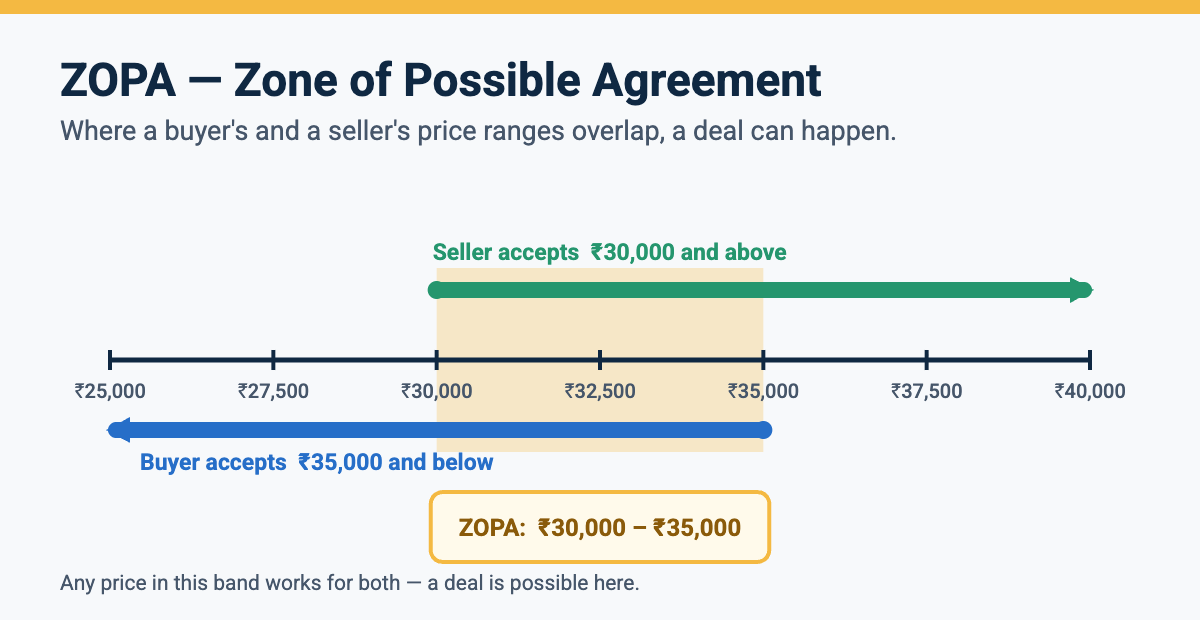
If BATNA is your backup, ZOPA is the shared space where a deal can be struck.
ZOPA means Zone Of Possible Agreement. It is the range where both sides can say yes — the overlap between what you’ll accept and what they’ll accept.
Let’s use simple numbers.
Suppose Rahul is selling his used bike. Quietly, in his own mind, he will not sell below Rs 30,000. That’s his floor. He’d love more, but 30,000 is his lowest yes.
Meena wants to buy it. Quietly, in her own mind, she will not pay more than Rs 35,000. That’s her ceiling.
Now look at the gap:
– Rahul accepts anything 30,000 and above.
– Meena accepts anything 35,000 and below.
– The overlap is Rs 30,000 to Rs 35,000.
That overlap is the ZOPA. Any final price in that band works for both. If they settle at 32,000 or 34,000, both go home satisfied. A deal exists here — they just have to find it.
What is a positive ZOPA? When the ranges overlap, like above. A deal is possible.
What if there is no ZOPA? Suppose Rahul’s floor is 40,000 and Meena’s ceiling is 35,000. Rahul won’t go below 40; Meena won’t go above 35. There is no overlap. No honest price makes both happy. This is a negative ZOPA — no deal is possible unless someone changes their limit or adds value another way (say, Rahul throws in a new helmet and accessories to justify the higher price).
How do BATNA and ZOPA connect? Your BATNA sets your limit. Rahul’s floor of 30,000 probably comes from his BATNA — maybe another buyer already offered him around that. Meena’s ceiling comes from her BATNA — the online price of a similar bike. So each person’s BATNA quietly draws the edges of the ZOPA. Better BATNA, better limit, better position.
You won’t usually say “ZOPA” out loud. But if you know both limits, you know whether a deal is even possible — and you stop wasting energy chasing agreements that can’t exist.
The Main Types of Negotiation
Negotiations come in a few basic flavours. Don’t overthink the names — the ideas are simple.
Distributive negotiation (the “fixed pie”)
Meaning: one thing is being split, so more for me means less for you. Usually just price.
Example: haggling over the price of a second-hand fridge. Every rupee you save is a rupee the seller loses.
Useful when: it’s a one-time deal, mostly about a single number, with no future relationship.
Weakness: it can turn tense, and it ignores creative solutions.
Integrative negotiation (the “grow the pie”)
Meaning: both sides bring different needs and create value together, so both can gain.
Example: a client wants a lower price; you want a longer contract. You trade — a small discount for a two-year commitment. Both win.
Useful when: there’s an ongoing relationship and more than one issue on the table.
Weakness: it takes more time, trust and openness.
Win-lose (competitive) negotiation
Meaning: one side aims to win at the other’s expense. Same spirit as distributive.
Example: a pushy salesperson squeezing every rupee from a one-time tourist.
Useful when: almost never for relationships; only for pure one-off deals.
Weakness: it burns trust and creates future enemies.
Win-win (collaborative) negotiation
Meaning: both sides work to find a result each is genuinely happy with.
Example: two departments sharing a limited budget by each funding the part they care about most.
Useful when: you’ll deal with these people again — which is most of life.
Weakness: it needs cooperation from both sides; it fails if one side plays dirty.
Multi-party negotiation
Meaning: three or more sides, each with their own interests.
Example: four flatmates deciding rules, rent-sharing and cleaning duties.
Useful when: group decisions must be made.
Weakness: it’s complex — alliances form, and it’s easy for the loudest voice to dominate.
Table 2 — Types at a glance
| Negotiation Type | Main Idea | Example |
|---|---|---|
| Distributive | Split a fixed pie | Haggling over a used fridge |
| Integrative | Grow the pie together | Discount for a longer contract |
| Win-lose | One gains, one loses | Squeezing a one-time buyer |
| Win-win | Both genuinely satisfied | Sharing a budget by priority |
| Multi-party | Many sides, many interests | Flatmates setting house rules |
Win-Win Is Not “Everybody Gets Everything”
“Win-win” is the most misused phrase in this subject. People think it means both sides get everything they asked for. That is impossible. If both got everything, there was never a real disagreement.
Real win-win means something better: each side gets what matters most to them, even if neither gets all of it. You give up what you care about less, so the other person can keep what they care about more — and they do the same for you.
The trick is to look at interests, not just positions (more on that next), and to search for creative options instead of fighting over one shared thing.
Here’s an original example. Two students, Priya and Arjun, both book the same empty classroom for Thursday evening. Priya needs it for debate practice. Arjun needs it to shoot a short video for a college competition.
The lazy solution: argue over who “deserves” it, flip a coin, one student loses and stays upset.
The win-win solution: they talk about why each needs the room. Priya’s debate practice needs quiet and only lasts one hour. Arjun’s video shoot needs good light and takes two hours. So they split it — Priya takes 5 to 6 pm for her quiet practice; Arjun takes 6 to 8 pm when the evening light is actually better for filming. Both get what they came for. Nobody lost.
That is value creation. They didn’t divide a fixed thing. They found that their real needs didn’t even fully clash — they just looked like they did.
Position vs Interest — The Idea That Changes Everything
If you remember only one concept from this entire guide, make it this one.
A position is what a person says they want.
An interest is why they want it.
People fight over positions. Smart negotiators dig for interests. Because two clashing positions often hide two needs that don’t clash at all.
Some examples:
- Position: “I want Friday off.”
Interest: “My cousin’s wedding is on Friday and I must travel.”
Once the manager knows the why, they might offer Friday off in exchange for covering a Sunday shift. The position was rigid; the interest opened a door. - Position: “I won’t pay more than Rs 20,000.”
Interest: “I’m on a tight budget this month.”
Maybe the seller offers to split payment over two months. The buyer’s real problem was timing, not the total. - Position: “We must launch the project by Monday.”
Interest: “My boss is reviewing progress on Tuesday.”
Perhaps a short demo on Monday, with full launch by Friday, solves it. The deadline was never the real need.
The old parable says it best: two people fight over one orange and cut it in half. But one only wanted the juice, the other only wanted the peel for baking. Had they asked “why,” each could have had all of what they needed. Positions made them split. Interests would have let them both win.
So train yourself to ask, gently and often: “Can you help me understand why that matters to you?” The answer is usually where the real solution lives.
A 12-Step Negotiation Process You Can Follow
You don’t need to memorise this. Just know the shape of a good negotiation.
Step 1 — Prepare. Gather facts. Know the situation, the numbers, the people.
Step 2 — Know what you want. Fix your goal, your ideal outcome, and your walk-away limit.
Step 3 — Understand the other side. Guess their interests, pressures and limits before you meet.
Step 4 — Start the conversation. Open warmly. Set a friendly, problem-solving tone.
Step 5 — Listen carefully. Let them talk first. You learn more by listening than speaking.
Step 6 — Ask questions. Dig for interests. “What’s most important to you here?”
Step 7 — Present your case. State your view with clear, objective reasons, not emotions.
Step 8 — Explore options. Put several possibilities on the table before choosing one.
Step 9 — Make and respond to offers. Exchange proposals. Don’t accept the first one automatically.
Step 10 — Handle objections. Stay calm. Treat “no” as a question, not a wall.
Step 11 — Reach agreement. When a fair deal appears, recognise it and close.
Step 12 — Confirm the final terms. Repeat what was agreed, clearly, so there’s no confusion later.
Skipping steps is where most people stumble — especially the first three (preparation) and the last one (confirmation).
Strategies That Quietly Work
Strategies are your overall game plan. Here are the ones that reliably help, each with a quick situation.
- Prepare before you begin. A landlord discussion goes better when you already know the rents of nearby flats.
- Know your minimum acceptable outcome. Fix, on paper, the lowest salary you’ll accept — so pressure can’t move you below it.
- Understand the other person’s interests. Your manager may care more about deadlines than money; offer reliability, not just requests.
- Ask more questions. “What would make this easy for you to approve?” often hands you the answer.
- Listen before responding. Let the seller finish; the reason for their price often reveals room to move.
- Avoid emotional reactions. A rude remark is bait; don’t bite. Stay level.
- Focus on the problem, not the person. “How do we solve the budget gap?” beats “You’re being unfair.”
- Use objective reasons. Quote market rates, written policy or real data — facts are harder to argue with.
- Look for trade-offs. Give something cheap to you but valuable to them.
- Don’t make unnecessary concessions. Every time you give, ask for something back.
- Don’t accept the first offer automatically. First offers usually leave room; a polite pause invites a better one.
- Know when to pause. “Let me think about this and get back to you” is a full sentence.
- Know when to walk away. If it’s below your limit, leaving is winning.
- Confirm the final agreement. Repeat the terms aloud; write them down where it matters.
Common Tactics — And How to Respond
Tactics are specific moves people make inside a negotiation. Knowing them protects you — because a tactic loses its power the moment you recognise it. Use these to solve problems, never to trick people.
Anchoring — What it is: the first number sets the mental reference point. Example: a seller quotes Rs 50,000 for something worth 35,000, so 40,000 later “feels” cheap. Respond: don’t get pulled toward their anchor; state your own reasoned number.
The first-offer effect — What it is: whoever names a figure first often shapes the whole deal. Example: naming your salary expectation first can set the tone. Respond: when you’re well prepared, offering first can help; when you’re unsure, ask them to share their range first.
Silence — What it is: saying nothing after an offer, letting the discomfort work. Example: after you quote a price, the other side just… waits, hoping you’ll lower it. Respond: be comfortable with silence. Don’t fill it by cutting your own price.
Asking questions — What it is: using questions to gather information and slow things down. Example: “How did you arrive at that figure?” Respond: answer honestly, and ask your own in return.
Strategic pauses — What it is: taking a break to cool emotions or think. Example: “Let’s take five minutes.” Respond: welcome it; use the time to check your limits, not to panic.
Bundling issues — What it is: combining several points so trade-offs become possible. Example: “Let’s discuss price, delivery and warranty together.” Respond: good tactic — use it yourself to find creative swaps.
Conditional offers — What it is: “If… then…” offers that protect you. Example: “If you order 100 units, then I can lower the rate.” Respond: use conditions to give safely; never give unconditionally.
Trade-offs — What it is: exchanging something you value less for something they value more. Example: faster payment in exchange for a small discount. Respond: always look for the swap before you simply concede.
Limited concessions — What it is: giving small, slow, and only in return. Example: dropping the price by 500, not 5,000, and only if they commit. Respond: mirror it — small steps, both ways.
Time pressure — What it is: creating urgency to force a fast yes. Example: “This price is only for today!” Respond: pause. Real deals rarely vanish in an hour. Ask, “And if I decide tomorrow?”
Extreme opening demands — What it is: starting far higher (or lower) than reasonable. Example: asking for double, hoping to land at fair. Respond: don’t be shocked; calmly bring the talk back to facts and fair value.
A warning worth stating plainly: tactics must stay honest. Anchoring with a reasoned high price is fine. Lying about a fake other buyer is not. The moment a tactic becomes a lie, it stops being negotiation and becomes manipulation — and it will cost you far more than it earns.
Table 4 — Tactics and your response
| Negotiation Tactic | What It Means | How to Respond |
|---|---|---|
| Anchoring | First number sets the reference | Ignore it; state your own reasoned figure |
| Silence | Using a pause as pressure | Stay calm; don’t fill it with concessions |
| Time pressure | “Only for today!” urgency | Pause; test if the deadline is real |
| Conditional offer | “If X, then Y” | Give only in exchange, never freely |
| Extreme opening | Starting far from fair | Don’t react; return to facts and value |
How to Handle Difficult Negotiators
Not everyone plays fair. Here’s how to stay steady with tough people — plus lines you can actually use.
The angry person. Don’t match their heat. Let them vent, then lower your voice. Say: “I can see this matters a lot to you. Let’s slow down and sort it out together.”
The aggressive person. Don’t shrink and don’t attack. Stand calm and firm. Say: “I want to reach a deal too, but I need us to talk respectfully to get there.”
The silent person. Silence may be a tactic or just their style. Don’t panic-fill the gap with concessions. Say: “I’ve shared my thinking — I’d really like to hear yours.”
The unreasonable person. Bring it back to facts. Say: “Help me understand how you reached that — because based on the market rate, here’s what I’m seeing.”
The extremely demanding person. Meet demands with conditions. Say: “I can consider that, but if I move on price, I’ll need you to move on the timeline.”
The person who keeps changing demands. Pin things down as you go. Say: “Let’s lock what we’ve already agreed before we open a new point.”
The pressuring person. Slow the pace. Say: “This is important, so I’d like a little time to think it through properly.”
The one who refuses to listen. Ask before you tell. Say: “Can I make sure I’ve understood you first — then I’ll share my side?”
The one rushing you to decide. Protect your right to think. Say: “I don’t want to rush a decision I’ll regret. Let me confirm by tomorrow morning.”
The thread through all of these: stay calm, stay respectful, stay firm. You control your own tone even when you can’t control theirs. That control is your power.
25 Sentences You Can Actually Say
Keep these handy. They sound human, not robotic, and they work.
To understand the other side:
1. “Could you help me understand what matters most to you here?”
2. “Before I respond, let me make sure I’ve understood your concern.”
3. “What would an ideal outcome look like for you?”
4. “How did you arrive at that figure?”
5. “Is there a particular part of this you’re most worried about?”
To open room and options:
6. “What if we looked at this from a different angle?”
7. “Could we explore a couple of options before deciding?”
8. “If we agree on X, would you be open to considering Y?”
9. “Is there any flexibility on this point?”
10. “Would it help if we split this into smaller steps?”
To hold your ground kindly:
11. “I understand your point — here’s my concern with it.”
12. “I’m not comfortable agreeing to that condition.”
13. “That’s a bit beyond what I can accept, but here’s what I can do.”
14. “I’d like to say yes, but that number doesn’t work for me.”
15. “I hear you, and I still need us to find a fairer middle.”
To buy time:
16. “Let me think about that before I respond.”
17. “That’s worth considering — can I get back to you tomorrow?”
18. “I’d like to check a couple of things before I confirm.”
To move toward a deal:
19. “Can we find a solution that works for both of us?”
20. “What would make this easy for you to say yes to?”
21. “If I do this for you, could you do that for me?”
22. “It sounds like we’re close — what’s the last thing standing in the way?”
To close and confirm:
23. “So, to confirm, we’ve agreed on the following…”
24. “Let’s write down who does what, so we’re both clear.”
25. “Thank you — I think this works well for both sides.”
Six Real-Life Mini Case Studies
Let’s watch these ideas play out. Each shows a poor approach and a better one.
Case 1 — The group project.
Situation: Four students; one always dodges work.
Problem: Ravi wants to “just handle the intro” and skip the hard analysis.
Poor approach: the others complain about him behind his back and do his share silently, growing bitter.
Better negotiation: the leader asks Ravi directly and calmly, “Which part do you actually feel confident doing?” Turns out he fears the data analysis but is great at design. They give him the slides and formatting; someone else takes the data.
Lesson: the problem wasn’t laziness — it was a mismatch. Ask about interests before you judge.
Case 2 — The salary talk.
Situation: Neha has done strong work all year and wants a raise.
Problem: the company says “budgets are tight.”
Poor approach: she says “everyone else earns more” and threatens to quit in anger.
Better negotiation: she brings a short list of her results, asks for a specific number backed by market data, and offers flexibility: “If a full raise isn’t possible now, could we agree a review in three months, plus a title change today?”
Lesson: facts plus flexibility beats emotion plus threats.
Case 3 — The shop purchase.
Situation: Amit wants a washing machine; the sticker says Rs 28,000.
Problem: he wants it cheaper but doesn’t want to seem rude.
Poor approach: he bluntly says “Too costly, make it 20,000” — an unrealistic anchor that annoys the seller.
Better negotiation: he says, “I’m ready to buy today. The same model is Rs 26,500 online. If you can match that and include free installation, I’ll take it right now.”
Lesson: a reasonable ask, backed by a real alternative (his BATNA), and a clear “yes” ready — that’s persuasive.
Case 4 — The leave request.
Situation: An employee needs three days off during a busy week.
Problem: the manager worries about the workload.
Poor approach: the employee just applies and hopes, leaving no plan.
Better negotiation: “I need Thursday to Saturday for a family commitment. I’ve spoken to Sameer, who’ll cover my calls, and I’ll finish the report before I leave. Does that work?”
Lesson: solve the other person’s problem before they raise it, and yes becomes easy.
Case 5 — The business partners.
Situation: Two friends start a small café; both want to “run operations.”
Problem: overlapping roles cause daily clashes.
Poor approach: they keep arguing about who’s “in charge.”
Better negotiation: they list every task, then each picks what they’re better at. One takes kitchen and suppliers; the other takes accounts and marketing. Big decisions are made together.
Lesson: divide by strength and interest, not by ego.
Case 6 — The bike sale.
Situation: A seller wants Rs 34,000; a buyer offers 30,000.
Problem: a Rs 4,000 gap and both are digging in.
Poor approach: both refuse to budge, and the deal collapses over a small gap.
Better negotiation: they bundle. The seller says, “I’ll come to 32,000 if you pay in full today and take it as-is.” The buyer agrees, saving the seller time and hassle.
Lesson: when a single number blocks you, add another factor (timing, extras, payment) and the ZOPA opens up.
15 Mistakes That Sink Good People
Even smart, kind people lose deals in the same predictable ways. Watch for these.
- Not preparing. Walking in blind — the fastest way to lose.
- Talking too much. Every extra sentence gives away information.
- Not listening. You miss the very clue that would help you.
- Getting emotional. Anger and panic switch off clear thinking.
- Revealing your minimum too early. Say your floor and the deal ends there.
- Conceding too quickly. Fast, free giving trains the other side to keep pushing.
- Treating it as a fight. You win the battle and lose the relationship.
- Focusing only on price. You ignore delivery, terms, timing and trust.
- Ignoring the relationship. A bruised partner remembers, and repays.
- Caving to pressure. “Only today!” makes you decide badly.
- Not asking questions. You negotiate against a person you don’t understand.
- Having no BATNA. With no backup, you negotiate from fear.
- Not confirming the final deal. Vague endings become tomorrow’s fights.
- Trying to “win” at any cost. A crushed opponent becomes a future problem.
- Ignoring the other person’s needs. You can’t solve a problem you never bothered to understand.
Table 3 — Mistake, why it hurts, and the fix
| Common Mistake | Why It’s a Problem | Better Approach |
|---|---|---|
| Not preparing | You negotiate blind | Fix your goal, limit and facts first |
| Talking too much | You leak information | Ask, then listen |
| Getting emotional | Clear thinking shuts down | Pause; slow your breathing |
| Revealing your minimum early | The deal ends at your floor | Guard your limit; anchor higher |
| No BATNA | You bargain from fear | Line up your best backup first |
| Not confirming | Confusion later | Repeat and record the final terms |
Negotiating Fairly — The Ethics Part
Here’s a truth people learn the hard way: you can win a negotiation and still lose. If you win by lying, tricking or bullying, you damage something worth far more than this one deal — your trust and your name.
Ethical negotiation rests on a few simple habits. Be honest — don’t invent fake offers or hide serious defects. Be fair — aim for a deal you’d accept if you sat in the other chair. Show respect — attack the problem, never the person. Practise transparency — share the real reasons behind your asks. Avoid false information, threats, and manipulation — pressure that relies on fear will curdle into resentment. Respect confidentiality — don’t leak what was shared in trust. And above all, keep your promises — a deal is only as good as the word behind it.
Why does this pay off? Because life is not a series of strangers. It’s the same suppliers, colleagues, clients and neighbours, again and again. Cheat someone today and you’ll pay for it in every future dealing with them — and with everyone they tell. The most successful negotiators are not the most cunning. They’re the ones people want to deal with again.
Negotiation Skills for College Students
If you’re a student — B.Com, B.A., B.Sc., engineering, diploma, any stream — negotiation isn’t a “later” skill. You need it now, and college is the perfect practice ground.
- Group projects: dividing work fairly so no one carries the whole load or slacks off.
- Presentations: deciding who speaks on what, and for how long.
- Internships: discussing your role, learning goals, or a small stipend.
- Placements: handling your first salary conversation with poise.
- College activities: getting budget, permission, or a venue from the department.
- Leadership roles: as a class representative or club head, you’ll constantly balance clashing demands.
- Team conflicts: cooling down two friends who both want the same responsibility.
- Event planning: agreeing dates, duties and money with committees and sponsors.
- Sharing responsibilities: with roommates, labmates and teammates.
A simple habit to build now: whenever you’re about to say “That’s not fair,” pause and ask instead, “Can we find a way that works for both of us?” That one swap — from complaint to problem-solving — will serve you for the rest of your life.
How to Negotiate Salary in a Job Interview
Salary talk makes almost everyone nervous. Here’s how to handle it well.
Research first. Before the interview, find the typical salary for this role, this experience level, and this city. Check job sites, ask seniors, look at industry ranges. Numbers give you calm confidence.
When they ask, “What salary do you expect?” Don’t blurt a single figure too early. Give a researched range and tie it to value: “Based on my skills and the market for this role, I’m looking at somewhere between X and Y — though I’m open to discussing the full package.” If you can, gently invite their range first: “I’d also love to understand the band you have in mind for this position.”
If the offer is low, don’t react with disappointment or anger. Pause, then respond: “Thank you for the offer. It’s a little below what I was expecting for this role. Is there any flexibility on the number?” Silence after this often works in your favour.
Remember salary isn’t the only thing you can negotiate. If the base pay is fixed, look at joining bonus, performance bonus, work-from-home days, learning budget, a faster review cycle, or an earlier promotion discussion. A “no” on salary can become a “yes” somewhere else.
Stay professional throughout. You’re not just discussing money — you’re showing them how you’ll behave with clients and under pressure. Calm, clear and respectful wins.
A Full Employee–Manager Salary Dialogue
Here’s how a real, healthy salary conversation can sound.
Employee: “Thank you for making time. I wanted to talk about my compensation. Over the past year I’ve led the customer-support revamp, and our response time dropped by nearly half. I’d like us to discuss bringing my salary in line with that contribution.”
Manager: “I appreciate the work, I really do. But honestly, budgets are tight this quarter.”
Employee: “I understand budgets are a real constraint — thank you for being straight with me. Can I ask, is the limit about this quarter specifically, or the annual pay band for my role?”
Manager: “Mostly this quarter. The band itself has some room.”
Employee: “That’s helpful to know. Given that, would it make sense to agree on a revised number now that takes effect from next quarter, when the budget opens up? I’d rather find a path that works within your constraints than push against them.”
Manager: “That could work. What figure did you have in mind?”
Employee: “Based on the market for this role and my results this year, I was hoping for a 15% increase. If that’s too much in one step, I’m open to 10% now and a review in six months.”
Manager: “15% is more than I can approve. But 10% from next quarter, with an honest review in six months — I think I can make that happen.”
Employee: “That sounds fair. To confirm: a 10% raise starting next quarter, and a documented performance review in six months to discuss the rest. Shall we put that in writing?”
Manager: “Yes, let’s do that. I’ll send it across this week.”
Techniques used, quickly:
– She prepared with specific results (the halved response time).
– She stayed calm when told “budgets are tight” instead of arguing.
– She asked a question to find the real constraint (this quarter vs the band).
– She showed empathy and flexibility by working within his limit, not against it.
– She made a conditional, staged offer (10% now, review later).
– She confirmed the final terms clearly and asked to put them in writing.
That’s negotiation done well — firm on her worth, kind to the relationship, and clear at the close.
Your Negotiation Checklist
Keep this simple checklist for any negotiation that matters.
Before
– ☐ Know your goal
– ☐ Research the situation
– ☐ Identify your BATNA
– ☐ Decide your walk-away point
– ☐ Think about the other person’s interests
– ☐ Prepare your questions
During
– ☐ Listen carefully
– ☐ Stay calm
– ☐ Ask questions
– ☐ Avoid unnecessary concessions
– ☐ Look for creative options
– ☐ Summarise points as you go
After
– ☐ Confirm the agreement
– ☐ Clarify who does what
– ☐ Confirm deadlines
– ☐ Keep your promise
The Real Lesson
Come back to that Sunday evening argument over the TV. The person who “wins” by shouting loudest doesn’t really win. They get the remote for one night and a sulking sibling for a week.
The real negotiator does something quieter and far more powerful. They stay calm when others heat up. They ask “why” when others only push “what.” They look for the option nobody else noticed. They know their value, and they know their limit. And when a fair deal appears, they take it — and leave the other person able to look them in the eye tomorrow.
Negotiation is not about having the loudest voice or the last word. It’s about understanding people, knowing your own worth, keeping your head when it’s hard, and finding a way forward that both sides can live with.
You already do this every day. Now you know how to do it well. Start small — a shop, a deadline, a shared task this week. Practice it like any skill. And slowly, you’ll notice something: the rooms that used to make you nervous start to feel like places where, calmly and fairly, you get things done.
Frequently Asked Questions (FAQs)
1. What are negotiation skills?
Negotiation skills are the abilities that help you reach an agreement when two or more people want different things. They include listening, clear communication, preparation, emotional control, empathy, problem-solving and knowing when to say no or walk away.
2. Why are negotiation skills important?
Because you use them everywhere — in studies, jobs, salary talks, business, teamwork and personal life. Good negotiation gets you fairer outcomes while keeping relationships intact, which pays off again and again.
3. What are the 5 most important negotiation skills?
If you had to pick five: active listening, preparation, emotional control, asking good questions, and the ability to walk away. Together they cover understanding the other side, staying calm, and holding a strong position.
4. What are the 7 steps of negotiation?
A simple seven-step version is: prepare, know what you want, understand the other side, listen and ask questions, present your case, explore options and exchange offers, then reach and confirm the agreement.
5. What is BATNA in negotiation?
BATNA means your Best Alternative To a Negotiated Agreement — your best plan if this deal fails. A strong BATNA gives you confidence, because you can walk away instead of accepting a bad deal.
6. What is ZOPA in negotiation?
ZOPA means the Zone Of Possible Agreement — the overlap between what you’ll accept and what the other side will accept. If a seller will take 30,000+ and a buyer will pay up to 35,000, the ZOPA is 30,000–35,000. If the ranges don’t overlap, no deal is possible.
7. What is win-win negotiation?
Win-win means both sides get what matters most to them, even if neither gets everything. It’s reached by focusing on interests (why people want things) and finding creative options, rather than fighting over one fixed point.
8. What is the difference between negotiation and bargaining?
Bargaining is usually just haggling over price. Negotiation is broader — it includes preparation, listening, understanding interests, exchanging options and building trust. Bargaining asks “How much?”; negotiation asks “How can this work for both of us?”
9. How can students improve negotiation skills?
Practise in real situations — dividing group-project work, requesting deadline extensions, planning events, or discussing internship roles. Focus on staying calm, asking why the other person wants something, and offering options instead of complaints.
10. How can I negotiate salary?
Research the market rate first, give a reasoned range instead of one early number, stay calm if the offer is low, and remember salary isn’t the only thing you can negotiate — bonus, flexibility, learning budget and review timing all count. Always confirm the final terms clearly.
11. How do I deal with an aggressive negotiator?
Don’t match their heat and don’t shrink. Stay calm and firm, bring the talk back to facts, and use lines like, “I want to reach a deal too, but I need us to talk respectfully to get there.” Your steady tone is your power.
12. What are common negotiation mistakes?
The big ones: not preparing, talking too much, not listening, getting emotional, revealing your minimum too early, conceding too fast, treating it as a fight, having no BATNA, and not confirming the final deal.
13. Is negotiation the same as arguing?
No. In an argument you try to prove you’re right and defeat the other person. In a negotiation you try to solve a shared problem and reach a deal both sides can accept — sitting on the same side of the problem, not across from each other.
14. What’s the difference between a position and an interest?
A position is what a person says they want (“I want Friday off”). An interest is why they want it (“I have a family wedding”). Understanding interests often reveals solutions that clashing positions hide.
Further Reading & References
For readers who want to go deeper, these are widely respected sources on negotiation theory and practice:
- Roger Fisher, William Ury and Bruce Patton — Getting to Yes: Negotiating Agreement Without Giving In. The classic text that popularised principled negotiation, BATNA, and focusing on interests rather than positions.
- Harvard Program on Negotiation (PON), Harvard Law School — articles and teaching materials on BATNA, ZOPA, distributive vs integrative negotiation, and win-win strategy.
- William Ury — Getting Past No: Negotiating in Difficult Situations. Practical guidance for handling hard, aggressive or stuck negotiations.
- Harvard Business School / Harvard Business Review — accessible articles on salary negotiation, tactics, and negotiation preparation.
- Chris Voss — Never Split the Difference. A practitioner’s view on listening, empathy and calibrated questions in high-stakes talks.
These sources were used to verify concepts such as BATNA, ZOPA, and the position–interest distinction. The examples, scenarios, dialogues and explanations in this article are original.