Communication: Meaning, Process and Elements of Communication
Introduction
Definition : Communication is the transformation of information from one person to another person.
Communication revolves around the Information, which is the central idea or concept. Before to understand the concept of Business Communication, it is essential to understand the basic concept of Communication.
Communication is an important part of our daily life. Human beings cannot live or work without communication. From morning till night, we communicate with different people around us. We talk to our family members at home, interact with friends in college, discuss matters with teachers, speak to customers, and connect with people in society. All these activities involve communication.
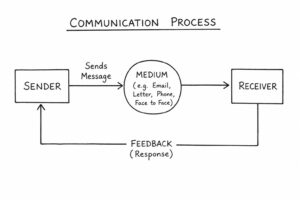
The communication flows via five major elements; Sender, Receiver, Message, Medium and Feedback. One can easily understand the concept with following image.
Communication is not limited to speaking only. It also includes listening, reading, writing, observing, and understanding. Whenever we exchange information, ideas, feelings, opinions, or messages with another person, communication takes place. Therefore, communication is a continuous process that helps people stay connected with one another.
In today’s fast-moving world, communication has become more important than ever before. It helps people understand each other and build strong personal and professional relationships. Good communication reduces misunderstandings and creates cooperation among people.
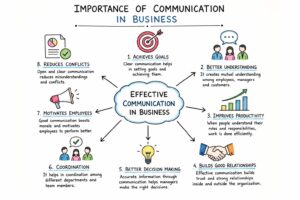
In the business world, communication plays a very important role. Every business organization depends on communication for its daily activities. Managers communicate with employees, employees communicate with customers, and different departments communicate with each other. Instructions, orders, reports, notices, emails, meetings, and presentations are all examples of business communication.
Without proper communication, an organization cannot function effectively. Employees may not understand their duties, customers may not receive correct information, and important decisions may be delayed. As a result, the organization may face confusion, conflicts, and losses. Therefore, effective communication is necessary for the smooth functioning of every business.
Communication helps people share ideas, thoughts, feelings, suggestions, instructions, and information. It creates understanding between individuals and groups. When communication is clear and effective, people can work together more efficiently and achieve common goals.
Communication can take many forms. It may be a face-to-face conversation, a telephone call, a video meeting, an email, a letter, a text message, or a presentation. Today, modern technology has made communication faster and easier than ever before. People can communicate instantly with others living in different cities, states, or even countries.
In modern organizations, communication is considered one of the most powerful management tools. Managers use communication to plan activities, give instructions, solve problems, motivate employees, and make important decisions. Employees use communication to share ideas, ask questions, report progress, and coordinate their work. Through effective communication, organizations can improve teamwork, productivity, efficiency, and employee satisfaction.
Communication also plays an important role in education. Teachers communicate knowledge to students, while students communicate their doubts, ideas, and opinions. Effective communication makes learning easier and more meaningful.
Thus, communication is the foundation of all human relationships and organizational activities. It connects people, promotes understanding, and helps achieve personal as well as professional goals. For students, developing good communication skills is essential because these skills help in studies, examinations, interviews, group discussions, presentations, and future careers. In today’s competitive world, a person with strong communication skills has a greater chance of achieving success in both personal and professional life.
Meaning and Definition of Communication
The word “communication” is derived from the Latin word communis, which means “common.” Communication aims to create a common understanding between the sender and the receiver.
Communication can be defined as the process of transmitting information, ideas, thoughts, opinions, or feelings from one person to another with the purpose of creating understanding.
According to the concept explained in the syllabus, communication is the transformation of information from one person to another. It is a systematic process and not a random activity. Communication involves the exchange of messages between individuals through various channels.
Example
A teacher explains a lesson in the classroom. The teacher sends information to students through spoken words. Students listen, understand, and ask questions. This entire activity represents communication.
Similarly, when a manager sends instructions to employees through email and receives their response, communication takes place.
Importance of Communication
Communication is important for individuals as well as organizations. It serves several purposes:
1. Exchange of Information
Communication enables people to share information, ideas, and knowledge with others.
2. Better Understanding
It helps create mutual understanding between individuals and groups.
3. Coordination
Organizations consist of various departments. Communication helps coordinate their activities and achieve common goals.
4. Decision-Making
Managers require accurate information before making decisions. Effective communication provides the necessary information.
5. Motivation
Employees can be motivated through proper communication, appreciation, guidance, and feedback.
6. Building Relationships
Communication strengthens personal and professional relationships by promoting trust and cooperation.
7. Conflict Resolution
Many misunderstandings and conflicts can be resolved through open and honest communication.
Process of Communication
Communication is not merely speaking or writing. It is a continuous process involving several stages. The process begins with the sender and ends with feedback from the receiver.
The basic communication process consists of five important elements:
Sender
Message
Medium
Receiver
Feedback
These elements work together to ensure effective communication.
Elements of Communication
1. Sender
The sender is the person who starts communication. The sender creates the idea, thought, or information and sends to communicate it to receiver.
The sender is responsible for:
Creating or Imagine the message
Selecting the proper medium
Communicating clearly
Ensuring that the message is understandable
The effectiveness of communication largely depends on the sender’s ability to express ideas properly.
Example
A manager instructing employees about a new project is the sender.
2. Message
The message is the information, idea, thought, instruction, opinion, or feeling that is communicated.
It is the core or central idea of the communication process because communication cannot take place without a message.
A message may be:
Verbal
Written
Visual
Non-verbal
For effective communication, the message should be:
Clear
Concise
Accurate
Relevant
Complete
Example
An email containing project instructions is the message being communicated.
3. Medium
The medium is the channel through which the message is transmitted from the sender to the receiver.
Different communication situations require different media.
Examples of communication media include:
Face-to-face conversation
Telephone
Email
Letters
Reports
Video conferences
Social media
Presentations
The selection of the medium depends upon:
Nature of the message
Urgency
Cost
Distance
Number of receivers
Choosing an inappropriate medium may lead to misunderstanding.
Example
A company may use email for routine communication and video conferencing for important meetings.
4. Receiver
The receiver is the person who receives the message.
The receiver’s role is not limited to receiving information. The receiver must understand, interpret, and evaluate the message correctly.
Effective communication occurs only when the receiver understands the message in the same way as intended by the sender.
Factors affecting the receiver’s understanding include:
Education level
Language skills
Experience
Attitude
Attention
Example
Employees reading instructions from management are receivers.
5. Feedback
Feedback is the response given by the receiver to the sender.
It indicates whether the message has been understood correctly.
Feedback completes the communication cycle and makes communication a two-way process.
Feedback may be:
Verbal
Written
Positive
Negative
Immediate
Delayed
Without feedback, the sender cannot determine whether communication has been successful.
Example
When students ask questions after a lecture, they provide feedback to the teacher.
Characteristics of Effective Communication
Effective communication possesses the following characteristics:
Clarity
The message should be simple and easy to understand.
Accuracy
Information communicated should be correct and reliable.
Completeness
The message should contain all necessary information.
Conciseness
Communication should avoid unnecessary details.
Timeliness
Information should reach the receiver at the appropriate time.
Understanding
The receiver should interpret the message correctly.
Feedback
The sender should receive feedback to confirm understanding.
Communication in Business Organizations
Communication is often described as the lifeblood of an organization. Every organizational activity depends upon communication.
In business organizations, communication is used for:
Giving instructions
Delegating work
Conducting meetings
Solving problems
Motivating employees
Negotiating with customers
Handling complaints
Making decisions
Coordinating departments
Without communication, confusion and inefficiency may arise, affecting organizational performance.
Example of Communication Process in a College
Consider the following situation:
A college principal wants to inform students about an upcoming examination.
The principal prepares the information.
The principal becomes the sender.
The examination notice becomes the message.
The college website and notice board act as the medium.
Students become the receivers.
Students asking questions or confirming details provide feedback.
This example demonstrates how all elements work together in the communication process.
Barriers to Communication
Sometimes communication may not achieve its purpose due to barriers.
Common barriers include:
Language differences
Noise and distractions
Poor listening
Lack of attention
Wrong interpretation
Technical problems
Cultural differences
Organizations must identify and remove these barriers to ensure effective communication.
Conclusion
Communication is a systematic process through which information, ideas, opinions, and feelings are exchanged between individuals. It is essential for personal growth, social interaction, and organizational success. The communication process consists of five important elements: Sender, Message, Medium, Receiver, and Feedback. Each element plays a significant role in ensuring successful communication.
If you liked this Article, then remember one very important thing, you cannot have efficiency over any subject, without the proper use of Grammar. If you would like to explore all the corners of Grammar in very very simple language, please click on this link:https://literature.amarjays.com/category/english-grammar/grammar/