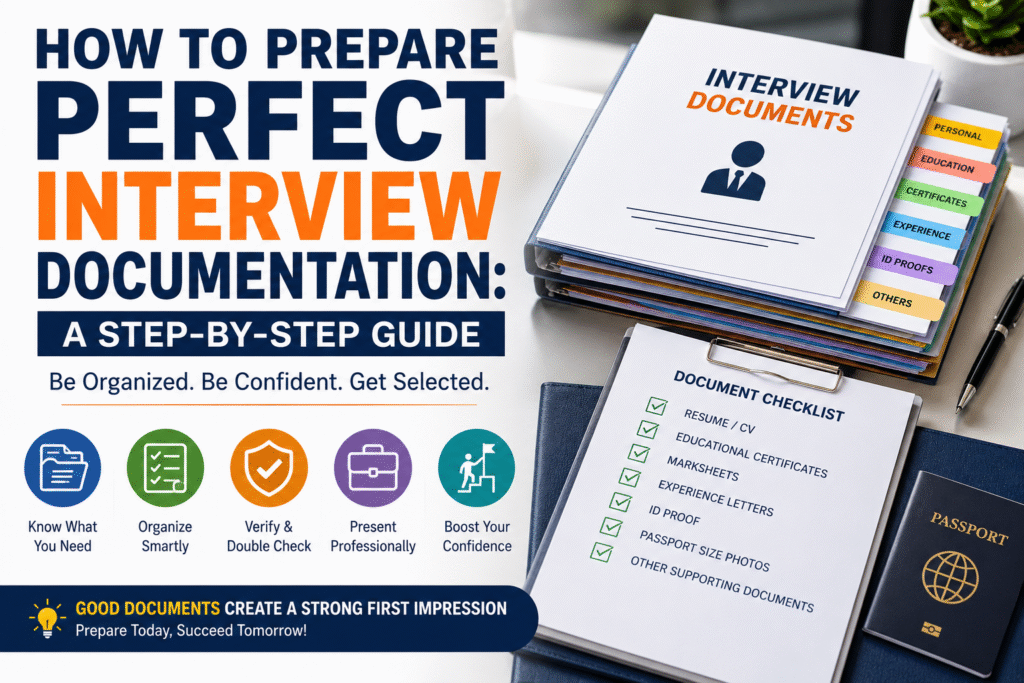
How to Prepare Perfect Interview Documentation:
Documentation of Interview
Introduction
Everyone knows the importance of Interview. An interview is one of the most important methods of communication used in government, business, education, media, research, and recruitment in all types of organizations. There are many important requirements of arrangement of an Interview. When a company wants to hire employees, a college wants to select students, or a journalist wants information from an important person, interviews are conducted. In short, for many reasons the interview can be taken. But conducting an interview alone is not sufficient. It is equally important to maintain proper records of the interview. Likewise the Oral performance, the detailed documentation ia also much needed. This process is called Documentation of Interview.
Interview documentation means writing down, recording, organizing, and preserving all important information related to an interview. It helps organizations remember details correctly and make proper decisions. In today’s modern world, documentation has become an essential part of professional communication because it provides transparency, accuracy, and accountability.
For example, when a company interviews ten candidates for one job post, the interviewer cannot remember every answer of every candidate. Proper documentation helps the company compare all candidates fairly and select the best person. Similarly, in research interviews, documentation helps researchers analyze responses carefully. In media interviews, documentation helps journalists prepare accurate reports and articles.
Thus, interview documentation is useful in every field where communication and information are important.
Meaning of Documentation of Interview
Documentation of interview refers to the process of systematically recording all important details of an interview in written, audio, video, or digital form. It includes information such as:
- Name and details of the interviewee
- Questions asked during the interview
- Answers given by the interviewee
- Observations made by the interviewer
- Evaluation and final decision
- Date, time, and place of interview
The main purpose of documentation is to maintain an accurate and permanent record of the interview for future use.
Interview documentation can be simple or detailed depending on the purpose of the interview. In small organizations, interview notes may be written on paper. In large companies, advanced software and digital systems are used for maintaining interview records.
Importance of Documentation of Interview
Documentation of interview is very important in professional communication. It helps organizations and individuals in many ways.
- Helps in Accurate Record Keeping
Human memory is limited. An interviewer may forget important points discussed during the interview. Proper documentation helps preserve all information accurately.
For example, if five candidates give similar answers, written records help the interviewer remember who answered better.
- Supports Fair Selection
Documentation helps organizations compare candidates fairly. It reduces confusion and personal bias during recruitment.
When proper evaluation forms and records are maintained, the selection process becomes more transparent and professional.
- Useful for Future Reference
Organizations may need interview records later for promotions, transfers, performance analysis, or legal purposes.
For example, if a selected employee later faces performance issues, the company can review past interview records to understand the employee’s qualifications and communication skills.
- Improves Communication
Documentation improves communication between departments such as HR, management, and selection committees.
All members can review the same information and make better decisions together.
- Acts as Legal Evidence
In some situations, interview documentation becomes legal proof. If any dispute arises regarding recruitment or selection, interview records can provide evidence.
Proper documentation protects both the organization and the candidates.
- Helps in Research and Analysis
Researchers often conduct interviews for collecting information. Documentation helps them study responses carefully and prepare reports or conclusions.
Without proper documentation, research data may become incomplete or inaccurate.
- Maintains Professionalism
Organizations that maintain proper interview records appear more professional and organized.
Good documentation reflects discipline, responsibility, and systematic working style.
Objectives of Interview Documentation
The main objectives of interview documentation are:
- To maintain accurate records
- To support decision-making
- To ensure fairness and transparency
- To preserve information for future use
- To improve organizational communication
- To provide legal and professional support
- To analyze interview performance properly
Types of Interview Documentation
Interview documentation can be done in different forms depending on the purpose and requirement.
- Written Notes
This is the most common form of interview documentation.
During the interview, the interviewer writes important points such as:
- Candidate’s answers
- Communication skills
- Confidence level
- Body language
- Technical knowledge
Written notes are simple and economical.
Advantages
- Easy to prepare
- Quick recording
- Useful for small interviews
Disadvantages
- Some details may be missed
- Depends on interviewer’s writing speed
- Evaluation Forms
Many organizations use structured evaluation forms.
These forms contain:
- Rating scales
- Marks or grades
- Skill evaluation sections
- Comments section
This method helps compare candidates systematically.
Example of Evaluation Areas
- Communication skills
- Subject knowledge
- Personality
- Confidence
- Problem-solving ability
- Audio Recording
In this method, the interview is recorded using audio devices.
This method is commonly used in:
- Research interviews
- Journalism
- Investigations
Advantages
- Complete conversation is recorded
- No information is missed
Disadvantages
- Requires permission
- Storage management is necessary
- Video Recording
Video recording captures both voice and body language.
It is useful in:
- Online interviews
- Media interviews
- Training sessions
Advantages
- Captures expressions and gestures
- Helpful for detailed analysis
Disadvantages
- Requires technical equipment
- Privacy concerns may arise
- Digital Documentation
Modern organizations use computer software and online systems for documentation.
Examples include:
- HR management software
- Applicant Tracking Systems (ATS)
- Cloud storage platforms
Advantages
- Easy storage and retrieval
- Better security
- Quick sharing
Disadvantages
- Requires technical knowledge
- Risk of cyber security issues
Process of Interview Documentation
Effective interview documentation follows a systematic process.
Step 1: Preparation Before Interview
Before the interview begins, proper preparation is necessary.
Preparation Includes:
- Preparing interview questions
- Keeping note sheets ready
- Arranging recording devices
- Preparing evaluation forms
- Setting documentation guidelines
Good preparation improves the quality of documentation.
Step 2: Recording Basic Information
At the beginning of the interview, basic details are recorded such as:
- Name of candidate
- Educational qualifications
- Work experience
- Contact details
- Date and time of interview
This information helps in identification and record management.
Step 3: Recording Questions and Answers
The interviewer records important questions and candidate responses.
The documentation should focus on:
- Relevant points
- Clear responses
- Technical knowledge
- Communication ability
The language should remain professional and objective.
Step 4: Recording Observations
Apart from answers, the interviewer also records observations such as:
- Confidence
- Body language
- Attitude
- Eye contact
- Leadership qualities
These observations help evaluate personality and communication skills.
Step 5: Evaluation and Remarks
After the interview, the interviewer writes:
- Strengths
- Weaknesses
- Overall performance
- Final recommendation
These remarks help management make final decisions.
Step 6: Organizing the Documents
All interview documents should be arranged properly.
Documents may be organized:
- Candidate-wise
- Department-wise
- Date-wise
- Position-wise
Proper organization saves time and improves efficiency.
Step 7: Safe Storage
Interview records contain confidential information. Therefore, secure storage is very important.
Organizations may use:
- Locked cabinets
- Password-protected systems
- Cloud storage security
Confidentiality must always be maintained.
Principles of Good Interview Documentation
Good documentation should follow certain important principles.
- Accuracy
Information should be correct and complete.
False or incomplete records may create confusion and problems later.
- Clarity
Documentation should be written in simple and clear language.
Complex or confusing writing reduces usefulness.
- Objectivity
Personal opinions and bias should be avoided.
Documentation should focus only on facts and observations.
- Confidentiality
Interview information should remain private.
Sensitive information must not be shared unnecessarily.
- Consistency
Organizations should use standard formats and procedures for all interviews.
Consistency improves fairness and professionalism.
Role of Technology in Interview Documentation
Technology has changed interview documentation significantly.
Today, organizations use modern tools and software for faster and more accurate documentation.
- Online Interview Platforms
Applications such as:
- Zoom
- Google Meet
- Microsoft Teams
allow recording and storing interviews easily.
- Applicant Tracking Systems (ATS)
ATS software helps companies:
- Store resumes
- Track candidates
- Record evaluations
- Manage recruitment processes
- Artificial Intelligence (AI)
AI tools can:
- Analyze interview responses
- Detect communication patterns
- Generate reports
- Improve evaluation accuracy
- Cloud Storage
Cloud systems allow safe and easy storage of interview records.
Benefits include:
- Easy access
- Better backup
- Data security
Advantages of Interview Documentation
Interview documentation provides many benefits.
- Better Decision-Making
Managers can review records carefully before selecting candidates.
- Saves Time
Well-organized records reduce confusion and repetition.
- Increases Transparency
Proper documentation makes the process more open and fair.
- Helps in Training
Organizations can use recorded interviews for training HR employees and interviewers.
- Improves Accountability
Interviewers become more responsible when proper records are maintained.
Challenges in Interview Documentation
Despite many advantages, some difficulties may occur.
- Incomplete Documentation
Interviewers may miss important information during note-taking.
- Personal Bias
Sometimes interviewers include personal opinions instead of objective facts.
- Technical Problems
Audio or video recording devices may fail.
- Confidentiality Risks
Unauthorized access to records may create privacy problems.
- Storage Problems
Large organizations generate huge amounts of interview data that require proper storage systems.
Solutions to Improve Interview Documentation
Organizations can improve documentation by following certain practices.
- Use Standard Formats
Standard forms improve consistency and fairness.
- Train Interviewers
Proper training helps interviewers record information effectively.
- Use Digital Tools
Technology improves speed, storage, and accuracy.
- Maintain Confidentiality
Access to records should be limited only to authorized persons.
- Review Records Regularly
Regular checking helps identify mistakes and improve quality.
Interview Documentation in Different Fields
- Business and Recruitment
Companies document interviews for:
- Employee selection
- Promotions
- Transfers
HR departments maintain detailed records for future reference.
- Education
Schools and colleges document interviews during:
- Student admissions
- Faculty recruitment
- Research activities
- Journalism
Journalists document interviews for:
- News reports
- Articles
- Television programs
Accurate documentation ensures trustworthy reporting.
- Research
Researchers conduct interviews to collect information and opinions.
Documentation helps:
- Data analysis
- Report writing
- Research conclusions
- Medical Field
Doctors and healthcare professionals document patient interviews and case histories.
Proper documentation supports treatment and diagnosis.
Ethical Considerations in Interview Documentation
Ethics are very important while documenting interviews.
- Respect Privacy
Personal information should remain confidential.
- Take Permission
Before audio or video recording, proper consent should be taken.
- Avoid Misrepresentation
Interview responses should not be changed or manipulated.
- Maintain Honesty
All records should be truthful and accurate.
Example of Simple Interview Documentation Format
Particulars | Details |
Candidate Name | Rahul Sharma |
Position Applied | Marketing Executive |
Date | 12 May 2026 |
Qualification | MBA |
Experience | 2 Years |
Communication Skills | Good |
Technical Knowledge | Excellent |
Confidence Level | Very Good |
Final Remark | Recommended |
This type of format helps organizations maintain records properly.
Best Practices for Effective Interview Documentation
To maintain high-quality documentation, organizations should:
- Use simple language
- Record information immediately
- Maintain confidentiality
- Avoid personal bias
- Use technology wisely
- Keep documents organized
- Store records securely
- Follow standard procedures
These practices improve professionalism and efficiency.
Conclusion
Documentation of interview is an essential part of professional communication and organizational management. It helps maintain accurate records, supports fair decision-making, improves communication, and ensures transparency. Whether in business, education, journalism, research, or healthcare, proper documentation plays a very important role.
In modern times, technology has made interview documentation easier, faster, and more secure. However, organizations must still focus on accuracy, confidentiality, objectivity, and ethical practices.
A well-documented interview not only helps in selecting the right candidate or collecting correct information but also reflects the professionalism and responsibility of an organization. Therefore, every organization should develop proper systems and methods for effective interview documentation.
Frequently Asked Questions (FAQs)
- What is documentation of interview?
Documentation of interview means recording and preserving important details of an interview in written, audio, video, or digital form.
- Why is interview documentation important?
It helps maintain accurate records, supports fair selection, improves communication, and provides legal evidence when necessary.
- What are the common types of interview documentation?
Common types include written notes, evaluation forms, audio recordings, video recordings, and digital documentation.
- What are the principles of good interview documentation?
Accuracy, clarity, objectivity, confidentiality, and consistency are the main principles.
- How does technology help in interview documentation?
Technology helps through online interview platforms, cloud storage, AI analysis, and digital record management systems.
- What problems can occur in interview documentation?
Problems may include incomplete records, personal bias, technical failures, confidentiality issues, and storage difficulties.
- How can organizations improve interview documentation?
Organizations can improve documentation by using standard formats, training interviewers, using digital tools, and maintaining confidentiality.