
Imagine it’s your first day at a new job. 😊
Your manager sends you a task. You finish it and reply to her. Later, you ask a teammate sitting next to you for a quick tip. Then someone from a different department pings you for a small favour.
In just one morning, you used three different directions of communication without even knowing it.
That’s what this guide is all about.
Have you ever wondered why some offices run smoothly while others feel messy and confusing? Or why a message sometimes reaches the wrong person? The secret often lies in the channels of communication — the paths a message travels from one person to another.
In this simple, friendly guide, you’ll learn:
- What communication channels actually mean (in plain words)
- The three main directions: vertical, horizontal and diagonal
- Upward and downward communication explained with real examples
- Easy comparison tables, flow diagrams, case studies, tips, and 20+ FAQs
By the end, you’ll understand this topic better than most textbooks explain it. Let’s begin. 👇
What Is Communication?
Let’s start from the very basics.
Communication simply means sharing information between two or more people.
One person sends a message. Another person receives it and understands it. That’s it.
Example You tell your friend, “The exam is on Monday.” Your friend hears it and understands it. Communication just happened. ✅
But here’s the important part. Communication is not complete until the message is understood. If your friend misheard you and thought the exam was on Sunday, then communication failed.
So true communication = message sent + message understood + feedback given.
Keep this simple idea in mind, because channels are just the roads on which this message travels.
What Are Channels (Mediums) of Communication?
Now the main topic.
Definition
Channels of communication are the paths or directions through which a message flows from the sender to the receiver inside an organization or group.
Meaning (in easy words)
Think of a message like water. Water needs a pipe to flow from one tank to another. In the same way, a message needs a channel to travel from one person to another.
The channel decides who talks to whom and in which direction the message moves — up, down, sideways, or across.
Why Are Communication Channels Important?
Because the right channel makes communication fast, clear and stress-free. The wrong channel creates confusion, delays and mistakes.
Here’s why they matter:
- They keep information flowing to the right people.
- They save time and avoid confusion.
- They build trust between bosses, teams and departments.
- They reduce errors and repeated work.
- They make teamwork smooth and friendly.
Did You Know? A single message passing through the wrong channel can delay an entire project by days. In big companies, choosing the right channel is a real business skill! 💡
Simple Example
In a school, the Principal sends a notice to teachers (one direction). Teachers discuss it with each other (another direction). A teacher then talks to the office clerk in a different department (a third direction).
Same school, three different channels. Cool, right?
Types of Communication Channels
Communication can flow in three main directions. This is the heart of our topic.
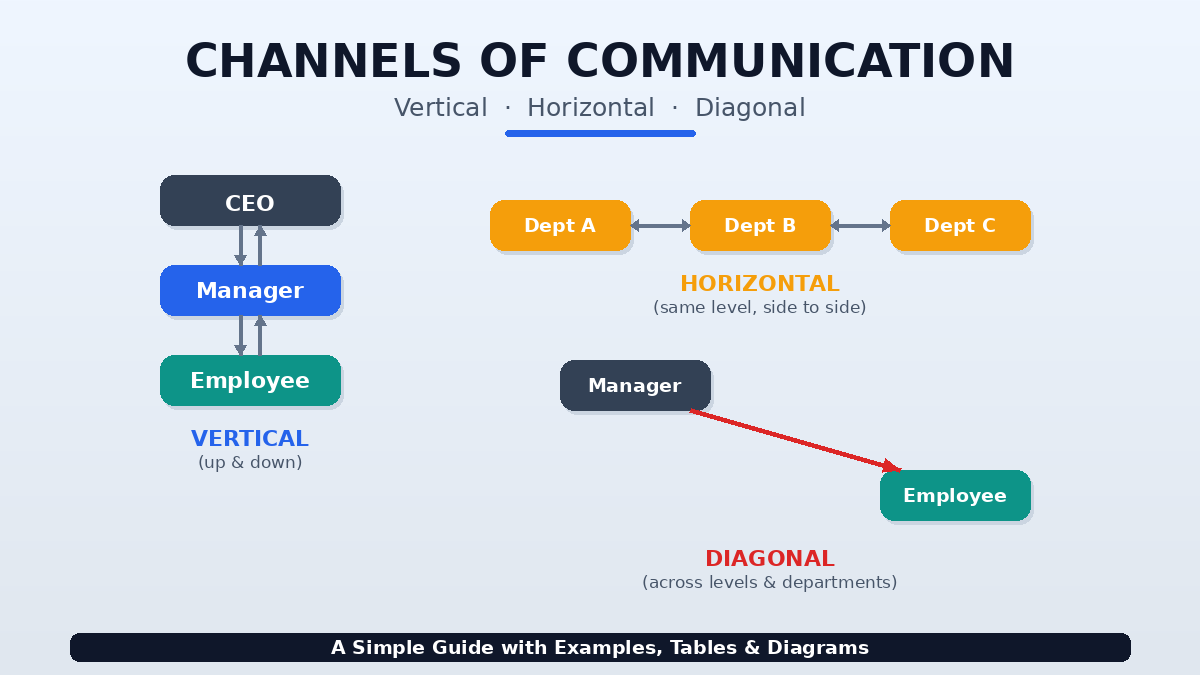
- Vertical Communication – up and down (between different levels)
- Horizontal Communication – side to side (between equals)
- Diagonal Communication – across levels and departments (mixed)
Let’s picture it with a simple diagram.
              VERTICAL (up & down)
                     ↑ ↓
   HORIZONTAL  ← Manager ─ Manager →   HORIZONTAL
                     ↑ ↓  ⤡
                          ⤡  DIAGONAL (across)
              ↑ ↓
            Employee ── Employee
Now let’s understand each type one by one, in the easiest way possible.
1. Vertical Communication
Definition
Vertical communication is the flow of messages up and down between different levels of an organization — for example, between a boss and an employee.
Meaning
The word vertical means “up and down.” So vertical communication moves between higher and lower levels. A manager talks to a worker (downward), and the worker replies to the manager (upward).
It follows the chain of command — the official ladder of who reports to whom.
Flow Diagram
        CEO
         ↓ ↑
       Manager
         ↓ ↑
      Supervisor
         ↓ ↑
       Employee
The arrows go both ways. Down for orders and instructions. Up for feedback and reports.
Characteristics of Vertical Communication
- It follows the official chain of command.
- It moves in two directions — upward and downward.
- It is usually formal (official).
- It connects different levels (boss ↔︎ subordinate).
- It carries orders, reports, feedback and policies.
Importance
- Keeps everyone aligned with company goals.
- Passes clear instructions from top to bottom.
- Lets employees share problems and ideas upward.
- Builds a clear reporting structure.
Advantages
- Clear authority — everyone knows who to report to.
- Discipline — orders flow in an organised way.
- Accountability — tasks are tracked easily.
- Feedback loop — bosses learn what’s happening on the ground.
Disadvantages
- Slow — messages pass through many levels.
- Distortion — the message can change as it moves (like Chinese Whispers).
- Fear factor — juniors may hesitate to speak up honestly.
- Overload — top managers may get too many messages.
Examples of Vertical Communication
- Workplace Example: A manager emails the team their monthly targets (down). The team sends back a progress report (up).
- College Example: The Principal announces new exam rules to students (down). Students submit feedback through the class representative (up).
- Daily Life Example: Your parents ask you to be home by 8 p.m. (down). You call to say you’ll be 10 minutes late (up).
Vertical communication has two sub-types. Let’s look at both.
Upward Communication
Meaning
Upward communication is when a message flows from a lower level to a higher level — from employee to boss.
Simply put: the junior speaks, the senior listens.
Examples
- An employee submits a weekly report to the manager.
- A student gives feedback about a teacher through a suggestion box.
- A worker reports a machine fault to the supervisor.
- A team member shares a new idea with the boss.
Importance
- Helps managers understand real problems.
- Makes employees feel valued and heard.
- Brings fresh ideas from the ground level.
- Improves decisions with honest feedback.
Advantages
- Builds trust and openness.
- Gives leaders true information.
- Encourages new ideas and innovation.
- Increases employee motivation.
Limitations
- Employees may fear telling the truth to bosses.
- Some may hide bad news.
- It can be slow to reach the top.
- Managers may ignore the feedback.
Interview Question “What is the difference between upward and downward communication?” Quick answer: Downward flows from boss to employee (orders); upward flows from employee to boss (feedback). ✅
Downward Communication
Meaning
Downward communication is when a message flows from a higher level to a lower level — from boss to employee.
The senior speaks, the junior listens and acts.
Examples
- A manager gives instructions to the team.
- The Principal sends a notice to teachers.
- A coach explains the game plan to players.
- HR shares the new leave policy with staff.
Importance
- Passes clear orders and instructions.
- Explains company goals and rules.
- Guides employees on what to do.
- Keeps everyone informed of changes.
Advantages
- Clear instructions for everyone.
- Fast decision sharing from the top.
- Better control and discipline.
- Uniform information across the team.
Limitations
- Can feel one-sided (no reply expected).
- Message may get distorted on the way down.
- Employees may feel like they’re only taking orders.
- No feedback unless upward channel is open.
Common Mistake Many students think vertical communication is only “downward.” Wrong! Vertical = both upward and downward. ⚠️
2. Horizontal Communication
Definition
Horizontal communication (also called lateral communication) is the flow of messages between people at the same level — like two managers, or two classmates.
Lateral simply means “side to side.”
Meaning
Here, nobody is the boss of the other. They are equals. They talk to coordinate work, share ideas and solve problems together.
Flow Diagram
  Manager A  ⇄  Manager B  ⇄  Manager C
   (Sales)     (Marketing)   (Finance)
The arrows go sideways — same level, no ladder.
Characteristics
- Happens between equals (same level).
- Usually friendly and informal.
- Focused on coordination and teamwork.
- Faster than vertical communication.
Advantages
- Fast — no need to go up the ladder.
- Better teamwork between departments.
- Fewer misunderstandings between colleagues.
- Quick problem-solving among equals.
- Builds friendship and support at work.
Disadvantages
- Can lead to too much chatting and time-waste.
- Departments may form rival groups.
- Bosses may be left out of the loop.
- Can create conflict if goals clash.
Examples of Horizontal Communication
- Office Example: The Sales head and Marketing head meet to plan a new offer together.
- College Example: Two classmates discuss how to divide a group project.
- Daily Life Example: Two friends decide which movie to watch on the weekend.
Quick Tip Use horizontal communication for coordination. Use vertical for orders and reports. Matching the channel to the purpose saves hours! ⏱️
3. Diagonal Communication
Definition
Diagonal communication (also called crosswise communication) is the flow of messages between people at different levels and different departments — skipping the normal chain of command.
Meaning
This one is a mix. It’s neither purely up-down nor purely side-to-side. It goes across — like a slanting line on a chart.
For example, a junior developer talks directly to the marketing manager, even though the marketing manager is not the developer’s boss.
Flow Diagram
   Finance Manager
          ⤡
           ⤡  (diagonal — across level & department)
             Sales Executive
The arrow goes slanting across the organisation.
Importance
- Saves time by skipping unnecessary levels.
- Connects different departments directly.
- Speeds up problem-solving.
- Encourages teamwork across the company.
Advantages
- Fast — no long chain to climb.
- Flexible — right person is reached directly.
- Boosts innovation by mixing ideas.
- Reduces workload on middle managers.
Disadvantages
- Can confuse the chain of command.
- Bosses may feel bypassed or ignored.
- Can create conflict about authority.
- Hard to track who said what.
Examples of Diagonal Communication
- Corporate Example: An IT support staff member emails a senior manager in Finance directly to fix a software issue quickly.
- School Example: A class teacher speaks directly to the accounts clerk about a student’s fee, instead of routing it through the Principal.
- Hospital Example: A junior nurse informs a senior doctor from another department about an urgent patient need.
Exam Point Diagonal communication = different level + different department. If it’s the same level, it’s horizontal. If it’s the same department going up/down, it’s vertical. 🎯
Comparison Table: Vertical vs Horizontal vs Diagonal
| Feature | Vertical | Horizontal | Diagonal |
|---|---|---|---|
| Definition | Between different levels (boss ↔︎ employee) | Between the same level (equal ↔︎ equal) | Across levels and departments |
| Direction | Up and down | Side to side | Slanting / across |
| Purpose | Orders, reports, feedback | Coordination, teamwork | Speed, direct problem-solving |
| Formality | Mostly formal | Often informal | Mixed |
| Speed | Slow | Fast | Very fast |
| Advantages | Clear authority, discipline | Quick coordination, friendship | Saves time, boosts innovation |
| Disadvantages | Slow, message distortion | Time-waste, group rivalry | Confuses hierarchy, bypasses bosses |
| Example | Manager → Employee report | Two managers plan an offer | IT staff emails Finance head |
Remember Vertical = up/down. Horizontal = side/side. Diagonal = across. Three simple directions — that’s the whole topic in one line! ✨
Communication Flow Diagrams (Copy-Ready)
Here are clean, printable diagrams you can copy straight into your notes.
Vertical Communication (Chain of Command)
        CEO
         ↓ ↑
       Manager
         ↓ ↑
      Supervisor
         ↓ ↑
       Employee
Horizontal Communication (Same Level)
Employee A ⇄ Employee B ⇄ Employee CDiagonal Communication (Across Levels & Departments)
   Manager (Dept 1)
          ⤡
            Employee (Dept 2)
All Three Together
                 CEO
                ↓ ↑
        ┌────── Manager A ⇄ Manager B ──────┐
        ↓ ↑        ⤡ (diagonal)      ↓ ↑
     Employee A ⇄ Employee B ⇄ Employee C
        (horizontal, same level)
Decision Tree: Which Channel Should I Use?
Is the message an ORDER or REPORT?
        │
        ├── Yes → Different level? → Use VERTICAL
        │
        └── No → Is it with an EQUAL (same level)?
                        │
                        ├── Yes → Use HORIZONTAL
                        │
                        └── No (different level + department) → Use DIAGONAL
Keep this little map in mind, and you’ll always pick the right channel. 👍
Real-Life Case Studies
Let’s see all three channels working in the real world.
- Office: A manager assigns tasks (vertical-down). Team members coordinate among themselves (horizontal). One member emails another department’s head for data (diagonal).
- Hospital: The Chief Doctor sets duty rosters (vertical-down). Two nurses swap shifts by agreeing together (horizontal). A junior nurse alerts a senior doctor from another ward (diagonal).
- School: The Principal issues a holiday notice (vertical-down). Two teachers plan a joint activity (horizontal). A teacher speaks to the transport in-charge directly (diagonal).
- College: A HOD shares the exam schedule (vertical-down). Classmates split project work (horizontal). A student contacts the library head about a different department’s book (diagonal).
- Government Office: An officer forwards a policy to clerks (vertical-down). Clerks coordinate file movement (horizontal). A clerk emails another department for a record (diagonal).
- Bank: The Branch Manager sets daily targets (vertical-down). Two tellers help each other at the counter (horizontal). A teller asks the loan department for a quick check (diagonal).
- Railway: The Station Master gives train orders (vertical-down). Two ticket clerks manage the rush together (horizontal). A clerk contacts the maintenance team directly (diagonal).
- Military: A commander gives orders down the ranks (vertical-down). Soldiers of equal rank coordinate a drill (horizontal). A unit member liaises with a different unit’s officer (diagonal).
- IT Company: A team lead assigns coding tasks (vertical-down). Developers review each other’s code (horizontal). A developer pings the HR manager about leave (diagonal).
- Retail Store: The Store Manager sets the sale plan (vertical-down). Two cashiers manage billing together (horizontal). A salesperson asks the warehouse team for stock (diagonal).
- Factory: The Production Head sets output goals (vertical-down). Two line workers coordinate a task (horizontal). A worker reports a safety issue to the quality department (diagonal).
Did You Know? Most workplace problems are not caused by bad people — they’re caused by messages taking the wrong channel. Fix the channel, and half the problems disappear! 🔧
Everyday Examples (You Use These Daily!)
Communication channels aren’t just for offices. You use them every single day.
- Family: Parents guide children (vertical); siblings plan together (horizontal); you ask an uncle for advice (diagonal).
- Friends: Best friends chat as equals (horizontal).
- WhatsApp Group: The admin posts a rule (vertical-down); members chat freely (horizontal).
- School: Teacher instructs students (vertical); students discuss homework (horizontal).
- College: Senior guides a junior (vertical); classmates coordinate (horizontal).
- Market: You bargain with a shopkeeper (horizontal, equal footing).
- Restaurant: The manager instructs waiters (vertical); waiters coordinate orders (horizontal).
- Hospital: Doctor instructs nurse (vertical); two nurses coordinate (horizontal).
- Cricket Team: Captain sets the field (vertical-down); batsmen plan runs together (horizontal).
- Police Station: The Inspector gives orders (vertical); two constables coordinate patrol (horizontal).
- Shopping Mall: The floor manager guides staff (vertical); two sales staff help each other (horizontal).
See? You’re already an expert — you just didn’t know the names! 😄
Common Mistakes Students Make
Watch out for these traps. Fixing them can boost your exam marks and your real-life skills.
- Thinking vertical means only downward. (It’s both up and down.)
- Confusing horizontal with diagonal. (Horizontal = same level; diagonal = across.)
- Believing diagonal communication is wrong or banned. (It’s allowed and often useful.)
- Forgetting that upward communication needs courage and trust.
- Assuming informal chat is not real communication. (It absolutely is.)
- Mixing up channel (direction) with medium (email, phone, letter).
- Ignoring feedback — communication is incomplete without it.
- Writing that horizontal communication has no disadvantages. (It can waste time.)
- Saying diagonal communication has no rules. (It should still respect people.)
- Believing only managers communicate. (Everyone does, all the time.)
Exam Point Examiners love the line: “Vertical communication is two-way — both upward and downward.” Write it and score! ✍️
20 Tips for Effective Communication Through the Right Channels
- Pick the right channel for the message (order vs coordination).
- Keep your message short and clear.
- Use simple words everyone understands.
- Always ask for and give feedback.
- Respect the chain of command when needed.
- Don’t skip levels unnecessarily.
- Listen as much as you speak.
- Choose the right medium (call for urgent, email for records).
- Be polite in every direction — up, down or across.
- Confirm that your message was understood.
- Avoid gossip in horizontal channels.
- Keep bosses informed when using diagonal channels.
- Encourage juniors to speak up (open upward channels).
- Give instructions with reasons, not just orders.
- Use written proof for important decisions.
- Don’t let emotions distort your message.
- Reduce the number of levels a message must cross.
- Be quick to reply — silence causes confusion.
- Use positive tone, even in criticism.
- Practise active listening — repeat back what you heard.
- Match your body language to your words.
- Keep a calm voice, especially under pressure.
Quick Tip Before sending any message, ask: “Is this the shortest, clearest path to the right person?” If yes, send it. If not, fix the channel first. 🚀
Advantages of Using Proper Communication Channels
When channels are chosen well, magic happens:
- Faster work: Messages reach the right person quickly.
- Fewer errors: Clear paths mean fewer misunderstandings.
- Better teamwork: Departments cooperate smoothly.
- Stronger trust: People feel heard and respected.
- Smarter decisions: Leaders get honest, timely information.
- Higher motivation: Employees who are heard work harder.
- Smooth control: Managers can track and guide easily.
- Happy workplace: Less confusion means less stress. 😊
Disadvantages of Using the Wrong Communication Channels
When channels go wrong, the damage is real:
- Delays: A message stuck in the wrong path slows everything.
- Confusion: People act on wrong or half information.
- Conflict: Bypassed bosses feel disrespected.
- Mistakes: Wrong instructions lead to wrong results.
- Low morale: Ignored feedback frustrates employees.
- Wasted money: Repeated work costs time and cash.
Example A hospital nurse once passed an urgent report through the slow vertical chain instead of directly to the doctor. The delay caused a serious problem. Choosing the right channel isn’t just about speed — sometimes it’s about safety. 🏥
Quick Summary (Key Takeaways)
- Channels of communication = the paths a message travels between people.
- Vertical = up and down (boss ↔︎ employee). Includes upward (employee → boss) and downward (boss → employee).
- Horizontal (lateral) = side to side, between equals.
- Diagonal (crosswise) = across different levels and departments.
- Choose the right channel for the right purpose: orders (vertical), coordination (horizontal), speed (diagonal).
- Good channels bring speed, trust and teamwork. Wrong channels bring delays, confusion and conflict.
Frequently Asked Questions (FAQ)
1. What are the channels of communication? They are the paths through which a message flows between people — mainly vertical (up/down), horizontal (side to side), and diagonal (across levels and departments).
2. What is vertical communication? Vertical communication is the flow of messages up and down between different levels, such as between a manager and an employee.
3. What is horizontal communication? Horizontal (or lateral) communication is the flow of messages between people at the same level, like two managers or two classmates.
4. What is diagonal communication? Diagonal (or crosswise) communication is the flow of messages between people at different levels and different departments, skipping the normal chain of command.
5. What is upward communication? Upward communication flows from a lower level to a higher level — from employee to boss, such as reports and feedback.
6. What is downward communication? Downward communication flows from a higher level to a lower level — from boss to employee, such as orders and instructions.
7. What is the difference between vertical and horizontal communication? Vertical moves between different levels (up/down); horizontal moves between the same level (side to side).
8. What is the difference between upward and downward communication? Downward flows from boss to employee (orders); upward flows from employee to boss (feedback and reports).
9. Is diagonal communication formal or informal? It can be both. It is often quick and semi-formal because it skips the usual chain of command.
10. Why are communication channels important? They make communication fast, clear and organised, reduce errors, and build trust and teamwork.
11. Which channel is the fastest? Diagonal is usually the fastest because it goes directly across levels; horizontal is also fast among equals. Vertical is the slowest.
12. Is horizontal communication the same as lateral communication? Yes. “Horizontal” and “lateral” mean the same thing — communication between equals.
13. Can diagonal communication cause problems? Yes. It can confuse the chain of command and make bosses feel bypassed if overused.
14. Give one example of vertical communication. A manager emailing monthly targets to the team (downward), and the team sending a progress report back (upward).
15. Give one example of horizontal communication. Two department heads meeting to plan a joint offer.
16. Give one example of diagonal communication. An IT staff member emailing a Finance manager directly to fix a software issue.
17. What is the main purpose of downward communication? To pass clear orders, instructions, goals and policies from the top to the lower levels.
18. What is the main purpose of upward communication? To send feedback, reports, problems and new ideas from employees to managers.
19. What is the difference between a channel and a medium of communication? A channel is the direction (up, down, across); a medium is the tool (email, phone, letter, meeting).
20. Which channel is best for teamwork? Horizontal communication is best for teamwork because it connects equals for smooth coordination.
21. Which channel is best for giving orders? Vertical (downward) communication is best for giving clear orders and instructions.
22. What are the disadvantages of vertical communication? It can be slow, the message can get distorted across levels, and juniors may fear speaking honestly.
23. Why do students confuse horizontal and diagonal communication? Because both move “sideways.” The key difference: horizontal is the same level; diagonal crosses different levels and departments.
24. Is diagonal communication allowed in organizations? Yes. Many modern companies encourage it to save time and boost innovation, as long as bosses stay informed.
25. How can I remember all three channels easily? Vertical = up/down. Horizontal = side/side. Diagonal = across. Three directions, three simple words. 🎯
Conclusion: Small Skill, Big Difference
Let’s return to your first day at work. 😊
By now, you can name every direction your messages travelled — vertical, horizontal and diagonal. What felt confusing this morning now makes perfect sense.
Here’s the beautiful truth: communication is a skill, and every skill can be learned. You don’t need a fancy degree. You just need to choose the right path for your message and speak with clarity and kindness.
Do that, and people will trust you. Teams will respect you. Work will feel lighter. And your career — in an office, a hospital, a school, or a startup — will move faster than you imagined.
So the next time you send a message, pause for one second and ask: “Am I using the right channel?” That single question can change everything.
You’ve got this. 💪 Now go communicate like a pro!
📣 Found this helpful?
- 💬 Comment below with your own example of diagonal communication.
- 🔁 Share this with a classmate before the exam.
- 🔖 Bookmark it for quick revision.
- 🔔 Subscribe for more simple communication guides.