Table of Contents
Toggle10 Characteristics of Communication Every Student Should Know (With Simple Examples)
Have you ever sent a text message that was completely misunderstood?
Or watched a speaker win over an audience without saying a single fancy word? That’s communication at work — and it behaves in some very specific ways every single time.
If you’re studying Business Communication, preparing for an interview, or just want to understand why some conversations click while others fall flat, this article breaks down the characteristics of communication in the simplest way possible. No heavy jargon. Just clear points, real examples, and a quick table you can revise from before an exam.
Communication feels natural because we do it every day — talking, texting, presenting, even just nodding at someone in a lift. But underneath all that everyday ease, there’s a consistent pattern. The same handful of features show up again and again, whether you’re a first-year B.Com student writing your first business letter, or a working professional replying to a client. Once you can spot these features, you stop seeing communication as something vague and start seeing it as something you can actually manage and improve.
What Do We Mean by “Characteristics of Communication”?
Every subject has its own basic nature — things that are always true about it, no matter the situation. Communication is no different. Whether you’re chatting with a friend, sending an office email, or giving a class presentation, certain features are always present in the background.
These features are called the characteristics of communication. Understanding them helps you:
- Communicate more clearly in college, interviews, and the workplace
- Avoid common misunderstandings before they happen
- Answer exam questions with confidence and real understanding, not just memorised lines
Let’s look at each one, one at a time.
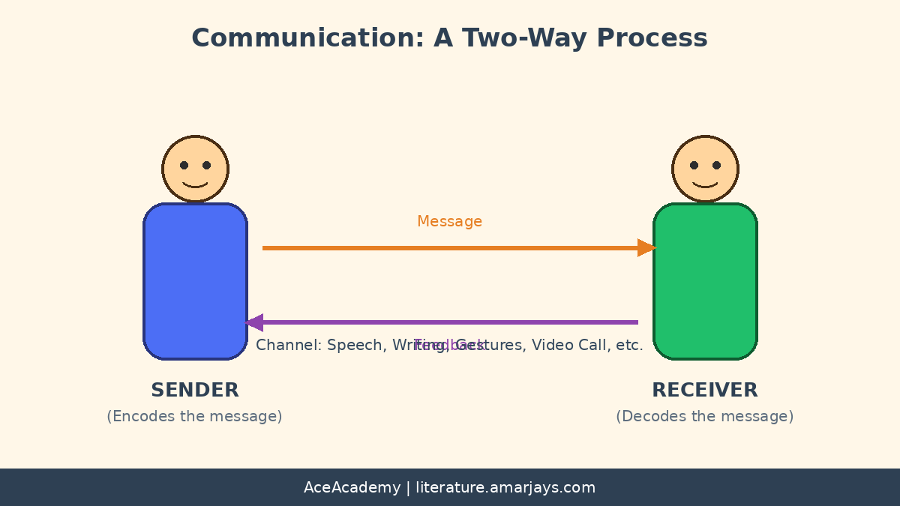
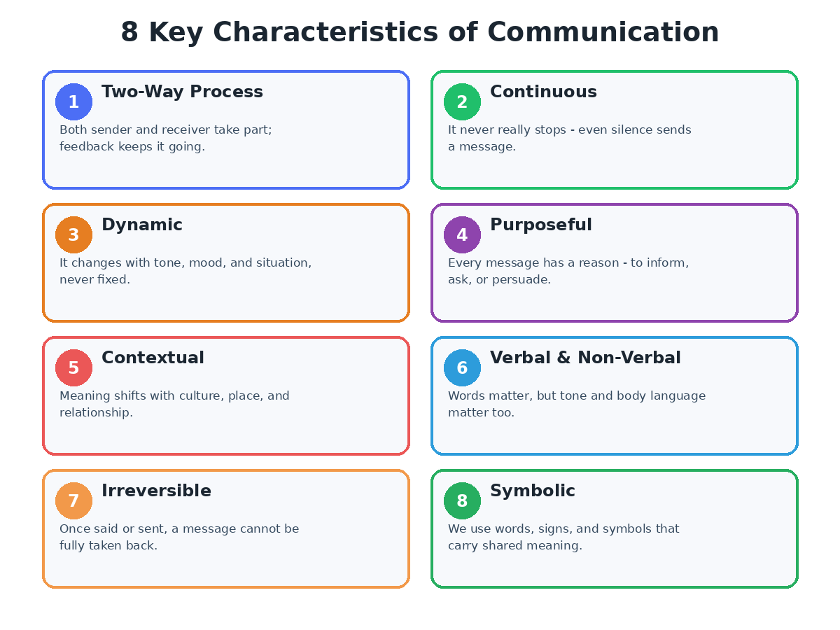
1. Communication Is a Two-Way Process
Many students think communication simply means “sending a message.” It doesn’t. Real communication only happens when the message is received, understood, and responded to in some way.
Example: A teacher explains a topic in class. If students nod, ask questions, or look confused, that’s feedback flowing back to the teacher. Without that back-and-forth, it’s just a monologue — not communication.
2. Communication Is Continuous
Communication doesn’t switch off just because nobody is talking. Silence, a blank expression, or even avoiding eye contact all send a message.
Example: If your manager doesn’t reply to your email for three days, that delay itself communicates something — maybe low priority, maybe they’re busy, maybe there’s a problem. You’re still “reading” a message, even without words.
3. Communication Is Dynamic, Not Fixed
The same words can mean different things depending on tone, timing, and mood. Communication constantly shifts and adapts — it’s never rigid or identical every time.
Example: Saying “Great job” in a warm tone is a compliment. Saying it sarcastically after someone makes a mistake means the exact opposite. The words stayed the same; the meaning changed completely.
4. Communication Is Purposeful
Every message — even a short one — is sent for a reason. It might be to inform, to persuade, to request, to entertain, or to build a relationship.
Example: A company sends a product email not just to “say hello,” but to persuade you to buy something. A birthday text isn’t random — it’s meant to strengthen a personal bond.
5. Communication Is Contextual
The same message can be understood differently depending on the situation, culture, and relationship between the people involved.
Example: Calling your friend “buddy” is casual and friendly. Calling your college principal “buddy” would seem disrespectful. The words are simple — the context changes everything.
6. Communication Is Both Verbal and Non-Verbal
Words are only part of the story. Tone of voice, facial expressions, posture, and gestures often communicate more than the words themselves.
Example: In an interview, saying “I’m confident” while looking down and fidgeting sends a mixed, less convincing message than saying the same words while sitting upright and making eye contact.
7. Communication Is Irreversible
Once a message is sent, it cannot be fully taken back — even if you apologise or try to explain later. This is exactly why thinking before speaking (or typing) matters so much.
Example: A harsh comment made in anger, or a hastily sent email, can damage a relationship even after a sincere apology. The impact of the original message often lingers.
8. Communication Is Symbolic
We don’t transfer thoughts directly from one mind to another — we use symbols: words, signs, gestures, and images that both people have agreed to understand in a shared way.
Example: A red traffic light isn’t inherently “stop” — it’s a symbol we’ve all agreed means stop. Similarly, words only work because both sender and receiver share the same understanding of them.
Bonus: Two More Characteristics Worth Knowing
Most syllabi stop at the eight covered above, but two more characteristics are worth understanding, especially if you want to go beyond textbook answers and actually think like a communicator.
9. Communication Is Unavoidable
You cannot choose not to communicate. Even trying to “say nothing” sends a message — think of someone who stays quiet in a meeting when asked a direct question. That silence is read as hesitation, disagreement, or lack of preparation, whether or not that was the intention.
Example: A candidate who avoids answering a tricky interview question directly is still communicating something to the interviewer — often that they’re uncomfortable or unprepared, even if they never say so in words.
10. Communication Is a Learnable Skill
Some people seem naturally good at communicating, but the truth is that clarity, confidence, and persuasion can all be built with practice. This is genuinely good news: it means weak communication skills today don’t have to stay that way.
Example: A student who struggles with public speaking in the first year can become a confident presenter by the final year, simply through repeated practice, feedback, and small corrections along the way.
How These Characteristics Show Up in Everyday Situations
It helps to see these characteristics working together, not just as a list. Here’s a quick walkthrough of one simple scenario — a student emailing a professor to ask for a deadline extension.
- Purposeful: The email has a clear goal — requesting more time.
- Contextual: The tone used with a professor is more formal than the tone used with a classmate.
- Two-way: The professor’s reply (approval, refusal, or a question back) completes the exchange.
- Irreversible: Once sent, a poorly worded or rude email can’t be unsent — first impressions matter.
- Non-verbal (even in writing): Tone, punctuation, and word choice act as the “non-verbal” layer of a written message — an email in all capital letters feels very different from a calm, polite one.
Notice how almost every characteristic quietly shows up in even one short, everyday email. That’s exactly why understanding them matters — they’re not abstract theory, they’re active in every message you send.
Characteristics vs. Elements of Communication: Don’t Confuse the Two
Students often mix up “characteristics” with “elements” of communication in exams — and examiners notice this mistake quickly. Here’s the simple difference:
- Elements of communication are the building blocks — sender, message, channel, receiver, and feedback. These answer the question “What is communication made of?”
- Characteristics of communication describe the nature or behaviour of communication itself — things like being continuous, dynamic, or irreversible. These answer the question “How does communication behave?”
Keeping this distinction clear is a small detail that can meaningfully improve your exam score, since many students lose marks by blending the two together.
Quick Revision Table: Characteristics of Communication
Characteristic | What It Means | Real-Life Example |
Two-Way Process | Needs a sender, a receiver, and feedback | Class discussion, not a lecture |
Continuous | Never really stops, even in silence | An unanswered email says something too |
Dynamic | Changes with tone, mood, and situation | “Great job” — sincere vs. sarcastic |
Purposeful | Always has a reason behind it | A sales email meant to persuade |
Contextual | Meaning depends on the situation | “Buddy” to a friend vs. a principal |
Verbal & Non-Verbal | Words plus tone, face, and body language | Confident words with nervous posture |
Irreversible | Cannot be fully taken back once sent | A harsh comment sent in anger |
Symbolic | Uses shared signs and words to convey meaning | A red traffic light meaning “stop” |
Unavoidable | You cannot choose not to communicate | Staying silent in a meeting still sends a message |
Learnable Skill | Can be improved with practice over time | A shy student becoming a confident speaker |
Why These Characteristics Matter for Students and Professionals
Understanding these characteristics isn’t just an exam formality — it changes how you communicate every single day.
- For students: You’ll answer “explain the characteristics of communication” questions with real understanding instead of memorised lines, which examiners can always tell apart.
- For job seekers: Knowing that communication is non-verbal as much as verbal helps you prepare better for interviews — your posture and tone matter as much as your answers.
- For professionals: Knowing communication is irreversible reminds you to pause before sending that reactive email or message at work.
Simple Tips to Apply These Characteristics in Real Life
Knowing the theory is only half the job — here’s how to actually use it, whether you’re in a classroom, an interview, or a workplace.
- Pause before sending: Since communication is irreversible, read your message once more before hitting send, especially emails written in frustration.
- Watch your tone, not just your words: Because communication is verbal and non-verbal together, practice saying the same sentence in different tones and notice how the meaning shifts.
- Read the room: Since communication is contextual, adjust your language depending on whether you’re speaking to a friend, a professor, or an interview panel.
- Invite feedback actively: Because communication is two-way, don’t just talk — ask “Does that make sense?” or “What do you think?” to keep the loop open.
- Practice regularly: Since communication is a learnable skill, treat every presentation, interview, or group discussion as practice, not just a test.
Common Mistake Students Make
A very common exam mistake is listing these characteristics without examples. Examiners specifically look for whether you can apply the concept, not just recall it. Always attach one small, relatable example to each point — exactly like this article has done — and you’ll stand out immediately.
Frequently Asked Questions
Q1. What are the main characteristics of communication?
The main characteristics are: two-way process, continuous, dynamic, purposeful, contextual, verbal and non-verbal, irreversible, symbolic, unavoidable, and learnable.
Q2. Why is communication called a two-way process?
Because it only becomes complete when the receiver understands the message and responds in some way — through words, action, or even silence.
Q3. Why is communication called irreversible?
Because once a message is spoken, written, or sent, its effect cannot be completely undone — even with a later apology or correction.
Q4. Is silence a form of communication?
Yes. Silence can express disagreement, discomfort, thoughtfulness, or even respect, depending on the context — which is why communication is described as continuous.
Q5. What is the difference between characteristics and elements of communication?
Elements are the components communication is built from — sender, message, channel, receiver, feedback. Characteristics describe how communication behaves — for example, being dynamic, contextual, or irreversible.
Q6. Can communication skills really be improved?
Yes. Communication is considered a learnable skill, which means clarity, confidence, and persuasion can all be developed through consistent practice, feedback, and self-correction over time.
Q7. Why do the same words sometimes mean different things?
Because communication is contextual and dynamic — meaning is shaped by tone, culture, relationship, and situation, not just by the literal words used.
Final Thoughts
Communication looks simple on the surface, but it’s built on some very consistent underlying features — features that stay true whether you’re texting a friend, writing a business email, or sitting in an interview. Once you understand these ten characteristics, you’ll not only answer exam questions better, you’ll actually communicate better in real life.
Found this useful? Explore more simple, exam-ready notes on Business Communication Skills right here on the site — new notes are added every week.
To revise quickly, remember that the characteristics of communication describe how every message works — it is a two-way, continuous and purposeful process. These characteristics of communication apply equally to oral, written and non-verbal messages. If an exam question asks you to explain the characteristics of communication, list the ten points above and support each with a short example.
Related notes: Objectives and Functions of Communication | Methods of Communication | Feedback in Communication. For a broader academic view, read this detailed overview of communication.