Introduction
Imagine the first day of college. Your professor walks in and says, “Good morning, everyone!” You smile and reply. Later, she writes the timetable on the board, and you copy it down. In five minutes, you have already used two different methods of communication.
Communication is simply sharing ideas, feelings, or information with another person. You do it all day — talking to friends, sending WhatsApp messages, writing emails, or nodding in class.
Good communication skills decide how well you perform in interviews, group discussions, and business meetings. That is why every Business Communication course starts with this topic.
In this lesson, we will study the three main methods of communication:
- Oral Communication — sharing messages by speaking
- Written Communication — sharing messages through writing
- Face-to-Face Communication — speaking directly in person
📌 Quick Note: The communication process always has a sender, a message, a medium, a receiver, and feedback. The “method” is the route your message takes.
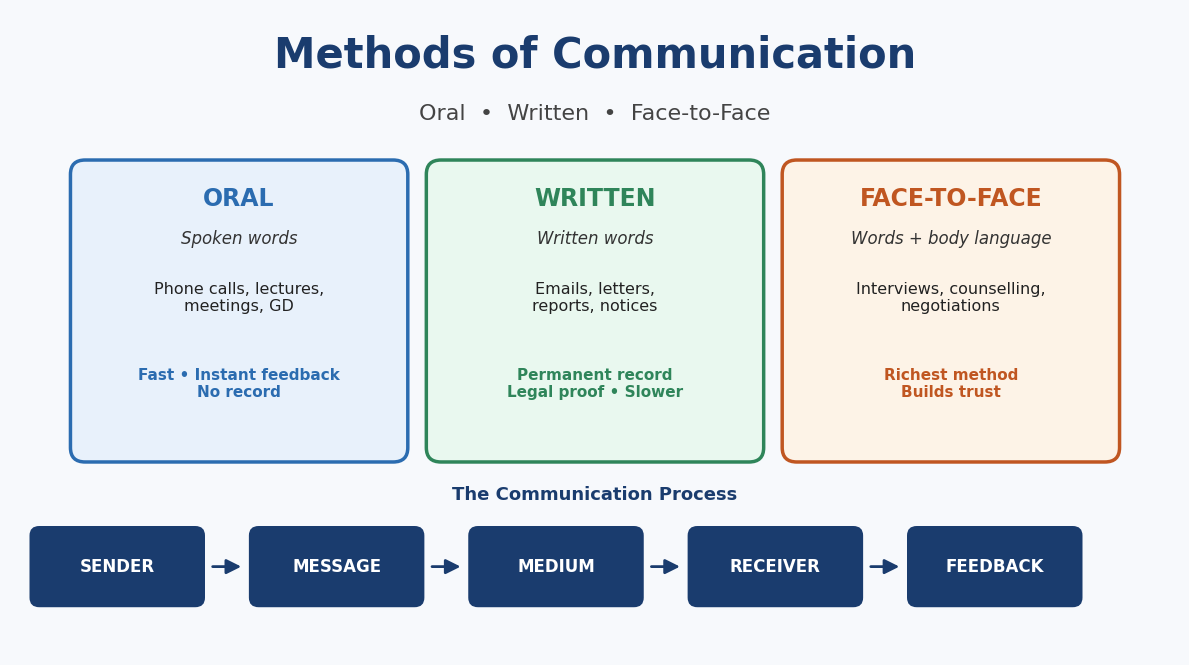
The Communication Process
Sender → Message → Medium → Receiver
↑ |
└─────────── Feedback ←──────────┘
What are Methods of Communication?
A method of communication is the way you deliver your message. Think of it like travelling. You can reach college by bus, bike, or on foot. The destination is the same, but the route differs. Similarly, the same message can be spoken, written, or delivered in person. Many textbooks also discuss these under types of communication.
In business communication, we choose among these methods of communication depending on the situation. Choosing the right method reflects the true importance of communication in business. A wrong choice can cause confusion, delay, or even loss of money.
| Method | How the Message Travels | Simple Example |
| Oral Communication | Through spoken words | Phone call to a customer |
| Written Communication | Through written or typed words | Leave application, email |
| Face-to-Face Communication | Spoken words + body language, in person | Job interview |
💡 Did You Know? Studies on the communication process suggest that a large part of meaning comes from tone and body language, not just words. That is why face-to-face talks feel more powerful than text messages.
Oral Communication
Meaning
Oral communication is the first of the three main methods of communication. It means sending a message through spoken words. It can happen in person, on the phone, or through a video call.
Definition
Oral communication is the exchange of information, ideas, and feelings between people through spoken words, either directly or through devices like phones.
Features
- Uses spoken words, tone, and voice
- Gives instant feedback
- Is usually informal and fast
- Leaves no permanent record (unless recorded)
Importance
Most daily business happens through speech. Managers instruct, teachers explain, and shopkeepers deal with customers orally. Strong speaking skills directly improve your career.
Advantages of Oral Communication
- Speed: The message reaches instantly.
- Instant feedback: Doubts get cleared on the spot.
- Low cost: Talking costs almost nothing.
- Flexibility: You can change your words after seeing the listener’s reaction.
- Personal touch: Voice and tone build relationships.
Disadvantages of Oral Communication
- No record: Words disappear once spoken.
- Misunderstanding: Listeners may forget or twist the message.
- Not suitable for long messages: Nobody remembers a 30-minute instruction fully.
- No legal proof: You cannot show a spoken promise in court.
- Distance and noise can distort the message.
Examples of Oral Communication
- A teacher explaining a chapter in class
- A phone call to book a gas cylinder
- A group discussion during campus placement
- A doctor asking a patient about symptoms
- Announcements at a railway station
Real-life example: Ramesh, a sales executive in Pune, calls a customer about a new policy. The customer asks three questions, gets instant answers, and the deal closes in ten minutes.
Tips to Improve Oral Communication
- Think before you speak; plan your main point.
- Speak slowly and clearly. Avoid fillers like “umm” and “you know”.
- Listen first. Good speakers are good listeners.
- Practise speaking in front of a mirror or with friends.
- Read aloud for ten minutes daily to improve fluency.
🎓 Teacher Tip: In exams, always write that oral communication is fast but has no record. Examiners love this contrast.
🎯 Mini Classroom Activity: In pairs, one student explains “how to make tea” in 60 seconds. The partner repeats the steps. See how much gets lost!
Written Communication
Meaning
Written communication is the second of the three methods of communication. It means sending a message through written or typed words. It includes letters, emails, reports, notices, and even WhatsApp messages.
Definition
Written communication is the transmission of messages through written symbols, such as letters, emails, reports, memos, and notices, which create a permanent record.
Features
- Uses written or typed words
- Creates a permanent record
- Allows careful drafting before sending
- Feedback is slow or delayed
Importance
Business runs on documents — appointment letters, invoices, contracts, and bank statements. Without writing, no organisation can maintain proof of its work. This is why the difference between oral and written communication is a favourite exam question.
Advantages of Written Communication
- Permanent record: You can read the message again anytime.
- Legal proof: Written contracts hold up in court.
- Accuracy: You can check and correct before sending.
- Wide reach: One notice can inform thousands of people.
- Best for complex matters: Figures, rules, and data need writing.
Disadvantages of Written Communication
- Slow: Drafting, sending, and replying take time.
- No instant feedback: You wait for the reply.
- Costly: Paper, printing, and storage cost money.
- Useless for the illiterate: Readers must know the language.
- Rigid: Once sent, words cannot be taken back easily.
Examples of Written Communication
- A leave application to the principal
- An email to a bank about a failed transaction
- A college notice about exam dates
- A business report sent to the head office
- A WhatsApp message confirming a meeting time
Real-life example: Priya takes an education loan. Months later, a dispute arises about the interest rate. She shows the bank’s sanction letter, and the matter is settled instantly. The written record saved her.
Tips for Effective Written Communication
- Keep sentences short and simple.
- Use the KISS rule — Keep It Short and Simple.
- Check spelling and grammar before sending.
- Write the main point in the first line.
- Read your message once as the receiver before hitting send.
⭐ Exam Tip: Remember the 7 Cs of communication — Clear, Concise, Concrete, Correct, Coherent, Complete, Courteous. They apply best to written messages.
🎯 Mini Activity: Ask for one day’s leave twice — first as a WhatsApp message, then as a formal application. Compare the tone, format, and words.
Face-to-Face Communication
Meaning
Face-to-face communication, the richest of all methods of communication, happens when the sender and receiver are physically present and talk directly. It is the oldest and richest form of oral communication.
Definition
Face-to-face communication is the direct, in-person exchange of messages where spoken words, facial expressions, gestures, and eye contact all work together.
Importance
Interviews, negotiations, counselling, and family decisions all happen face-to-face. Trust builds faster when people can see each other, and body language adds meaning no email can carry.
Characteristics
- Sender and receiver are present at the same place
- Words, tone, and body language combine
- Feedback is immediate and visible
- Emotions are easily understood
Advantages of Face-to-Face Communication
- Complete message: Words plus expressions give full meaning.
- Instant doubt clearing: Questions get answered on the spot.
- Builds trust and relationships
- Persuasion is easier: You can adjust based on reactions.
- Best for sensitive matters like apologies or negotiations.
Disadvantages
- Both people must be present at the same place and time.
- Costly for distant parties — travel takes time and money.
- No record of what was said.
- Emotions or anger can spoil the discussion.
- Difficult for large audiences spread across cities.
Examples and Real-Life Situations
- A campus job interview at your college
- A parent-teacher meeting about a student’s progress
- A doctor breaking difficult news to a family
- A shopkeeper bargaining with a customer in the local market
- A team meeting in an office cabin
How Body Language Affects Face-to-Face Communication
Your body speaks before your mouth does. A firm handshake shows confidence, crossed arms signal disinterest, and eye contact shows honesty.
Face-to-Face Communication = Words + Tone + Body Language
Words → What you say
Tone → How you say it
Expressions → What your face shows
Gestures → What your hands say
Posture → What your body position says
📌 Remember: In an interview, your answer may be perfect, but poor eye contact and a dull posture can still create a weak impression.
🎯 Mini Activity: Say “That’s great” three times — happily, sarcastically, and angrily. The same words change meaning with tone and expression!
Comparison Table: Oral vs Written vs Face-to-Face
The table below compares all three methods of communication side by side.
| Method | Speed | Cost | Feedback | Record Keeping | Personal Touch | Suitable For |
| Oral | Very fast | Very low | Instant | No record | Good | Quick instructions, phone queries |
| Written | Slow | Moderate | Delayed | Permanent record | Low | Contracts, reports, notices |
| Face-to-Face | Fast | High (if travel needed) | Instant + visible | No record | Excellent | Interviews, negotiations, counselling |
Advantages and Disadvantages: Summary Table
Here is a one-look summary of all three methods of communication.
| Method | Main Advantage | Main Disadvantage |
| Oral Communication | Speed and instant feedback | No permanent record |
| Written Communication | Permanent record and legal proof | Slow feedback |
| Face-to-Face Communication | Body language adds full meaning | Both must be present; costly over distance |
Practical Examples From Daily Life
The table below shows how the methods of communication appear in different workplaces.
| Place | Oral | Written | Face-to-Face |
| Office | Phone call to a vendor | Office memo, email | Team meeting |
| College | Lecture, viva voce | Notice board, assignment | Group discussion |
| School | Morning announcements | Report card, circular | Parent-teacher meeting |
| Business | Telephonic order | Invoice, contract | Client negotiation |
| Hospital | Calling a patient’s name | Prescription, reports | Doctor-patient consultation |
| Bank | Phone banking | Passbook, sanction letter | Talking to the branch manager |
| Customer Service | Helpline call | Complaint email | Service desk visit |
| Online Classes | Audio explanation | Chat box, PDF notes | Video with camera on (nearest substitute) |
Common Mistakes Students Make
Students often make these mistakes while using different methods of communication:
- Speaking too fast during presentations and interviews.
- Using slang like “yaar” or “matlab” in formal speech.
- Sending emails without a subject line.
- Writing long, confusing sentences in applications.
- Not proofreading messages before sending.
- Avoiding eye contact during face-to-face talks.
- Interrupting the other person instead of listening.
- Using WhatsApp language (“plz”, “u”, “thx”) in official emails.
- Choosing the wrong method — for example, resigning over a text message.
- Ignoring body language while focusing only on words.
⚡ Shortcut: Before communicating, ask yourself — Right message? Right method? Right time? Right person?
How to Choose the Right Method of Communication
- All methods of communication have strengths. Use these simple rules. Need speed? → Choose oral (call or meet).
- Need proof or record? → Choose written.
- Message is sensitive or emotional? → Choose face-to-face.
- Audience is large and spread out? → Choose written (notice, email).
- Message is complex with figures? → Written, followed by an oral explanation.
- Building a new business relationship? → Face-to-face first, written follow-up later.
🔑 Key Point: Smart professionals combine methods. A meeting (face-to-face) followed by minutes of the meeting (written) gives both trust and proof.
Case Study: The Cancelled Order
Sunita runs a small garment unit in Solapur. A Mumbai retailer phoned and ordered 500 shirts, promising payment in 20 days. Excited, she started production without asking for a written purchase order.
After delivery, the retailer claimed he had ordered only 300 shirts at a lower rate. With no written proof, Sunita lost ₹40,000. Now she confirms every phone order with an email and takes an advance.
Think and Answer:
- Which method of communication failed Sunita, and why?
- How should oral and written communication be combined in business deals?
Quick Revision: Important Points
- Three main methods of communication: oral, written, face-to-face.
- Oral = fast + instant feedback, but no record.
- Written = permanent record + legal proof, but slow.
- Face-to-face = words + tone + body language; richest method.
- Communication process: sender → message → medium → receiver → feedback.
- The right choice among the methods of communication depends on speed, proof, cost, distance, and sensitivity.
Common Exam Questions
Short Notes (4–5 marks): Oral communication; Written communication; Face-to-face communication; Body language; Feedback.
Long Questions (10 marks):
- Explain the methods of communication with suitable examples.
- Discuss the difference between oral and written communication with a comparison table.
- “Face-to-face communication is the richest method.” Justify with advantages and limitations.
MCQs:
- Which method provides a permanent record? (a) Oral (b) Written (c) Face-to-face (d) None — Answer: (b)
- Instant feedback is the biggest advantage of ______ communication. (a) Written (b) Oral (c) Postal (d) None — Answer: (b)
Fill in the Blanks:
- A job interview is an example of ______ communication. (face-to-face)
- An invoice is an example of ______ communication. (written)
True or False:
- Written communication gives instant feedback. (False)
- Body language plays a role in face-to-face communication. (True)
Very Short Answers:
- Name the five elements of the communication process. (Sender, message, medium, receiver, feedback)
- Give one example of oral communication in a bank. (Phone banking call)
Frequently Asked Questions (FAQs)
Q1. What are the three main methods of communication? The three main methods of communication are oral communication, written communication, and face-to-face communication.
Q2. What is oral communication with an example? Oral communication is sharing a message through spoken words, such as a teacher explaining a lesson or a phone call to a customer.
Q3. What is written communication with an example? Written communication is sharing a message through written words, such as an email, a leave application, or a business report.
Q4. What is the main difference between these two methods of communication — oral and written? Oral communication is fast and gives instant feedback but has no record. Written communication is slower but creates a permanent, legal record.
Q5. Why is face-to-face communication considered the most effective? Because it combines words, tone, facial expressions, and gestures, giving the most complete meaning and instant feedback.
Q6. What are the advantages of oral communication? Speed, instant feedback, low cost, flexibility, and a personal touch.
Q7. What are the disadvantages of written communication? It is slow, gives delayed feedback, costs more, and cannot be changed easily once sent.
Q8. Is a WhatsApp message oral or written communication? A typed WhatsApp message is written communication. A WhatsApp voice note or call is oral communication.
Q9. Which method of communication is best for legal matters? Written communication is the safest of the methods of communication for legal matters, because documents act as legal proof in disputes.
Q10. How can students improve their communication skills? By listening actively, reading daily, practising speaking, writing short clear messages, and observing good speakers.
Q11. Why is choosing the right method of communication important in business? The right method saves time and money, avoids misunderstanding, and protects the business with proper records.
Conclusion
Communication is a skill, not a talent. Every confident person you admire — your favourite teacher, a news anchor, a successful manager — practised daily.
Start small. Speak up once in every class. Write one clear email this week. Maintain eye contact in your next conversation. These tiny steps will transform your communication skills faster than you expect.
Keep practising all three methods of communication every day. Your words can open doors that marks alone cannot. So practise, polish, and communicate with confidence!
Related reading: Communication: Meaning, Definition, Process and Elements · Objectives and Functions of Communication · Characteristics of Communication · Feedback in Communication · Encoding and Decoding in Communication